Preprint: Students’ access to generative AI did not ensure equally usable support across languages
Ming Li, Qin Xie, Ariunaa Enkhtur, Lilan Chen, Fei Cheng
arXiv preprint (work in progress)
500-शब्द सार
Ming Li and colleagues report interviews with 42 undergraduates at one university each in China, Japan, and Mongolia. The October 4 work-in-progress preprint examines how access conditions and languages shaped reported AI use. Interviews took place during 2024 and early 2025. Researchers combined qualitative interpretation with exploratory text-network and correspondence analyses of translated transcripts.
The sample included 15 students in China, 13 in Japan, and 14 in Mongolia. Participants described different tool choices and language practices. Some Mongolian participants reported switching to English when local-language responses seemed less satisfactory; Japanese participants mainly described interaction in Japanese. Across settings, students reported checking accuracy and considering privacy, dependence, and the place of AI in their academic work.
These are situated self-reports, not representative national results or tests of model quality. The authors identify small institutional samples, translated corpora, and differences in interview timing and mode as limitations. The preprint has not established learning effects. Its central question is nevertheless practical: what additional work must a student perform before a technically available service becomes useful for a particular academic task?
For AIEDHK, an editorial proposal is to test a teaching tool through a complete multilingual activity. Students could choose a familiar language, ask for an explanation of a course concept, check the response against an authoritative class resource, and record any translation or reformulation needed. The evaluation would inspect that whole sequence rather than ending when the tool returns fluent text. This is a suggested pilot, not a learning intervention validated by the interviews.
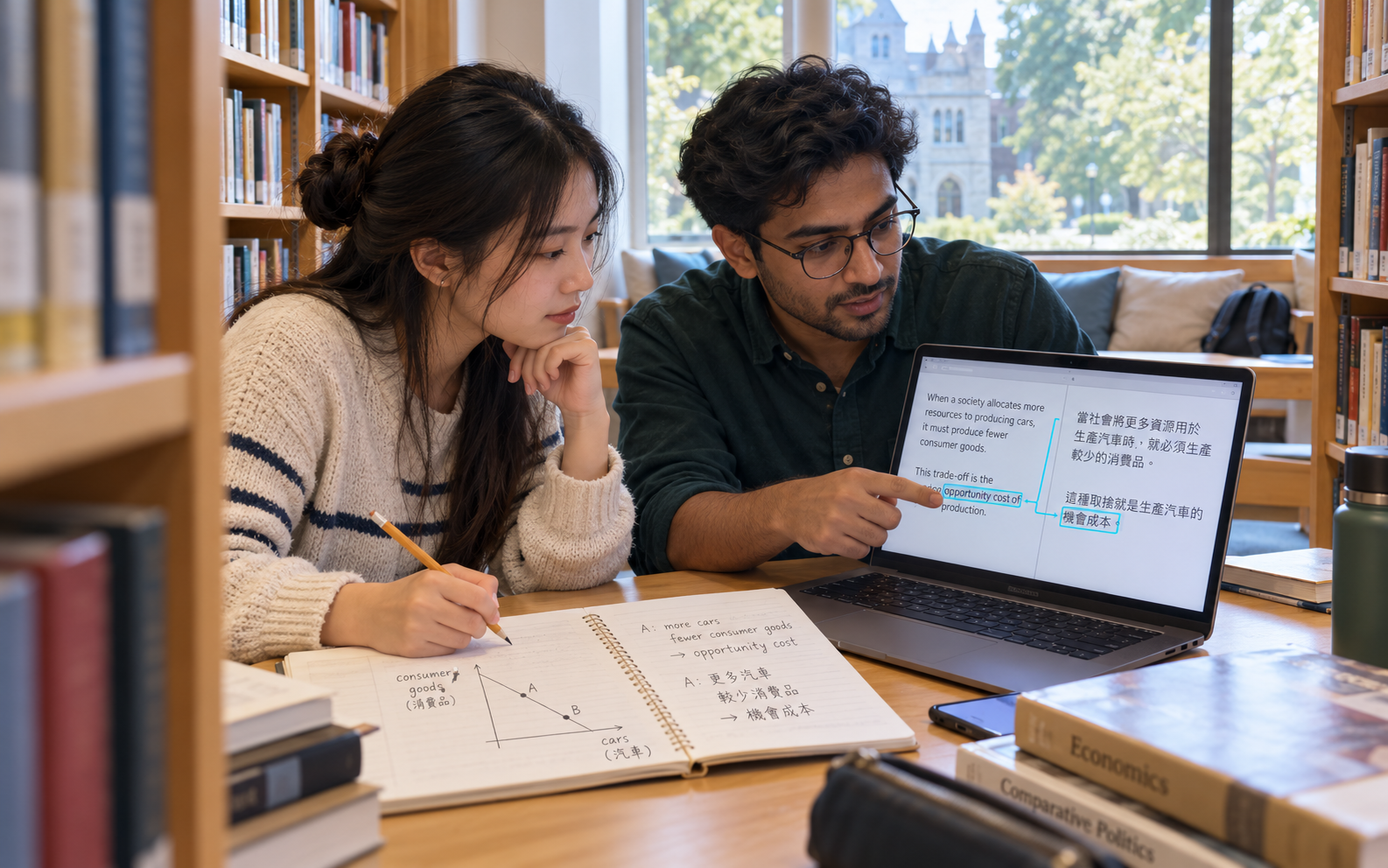
Consider an introductory economics explanation of opportunity cost. A student might understand an everyday example in Cantonese, need the formal term in English for the course, and submit an explanation in written Chinese. A useful test would examine whether meaning survives those transitions. A bilingual teacher could check whether the response quietly changes the choice being compared or introduces a culturally unfamiliar example. The student could identify which version helped and why, while retaining the original response so that corrections remain visible.
The resulting evidence could distinguish access, accuracy, language effort, and independent understanding. A platform might be easy to open yet require repeated translation before its content is usable. Another might be fluent in a preferred language but unreliable on a specialized concept. An unaided explanation after the activity could provide a separate check of what the student understood. Recording these dimensions separately would prevent a simple usage count from standing in for all of them, without presuming that more language switching is always harmful.
Institutions could also invite students to describe workarounds that routine analytics miss: consulting a classmate, comparing two language versions, or returning to a textbook. These reports would guide support and future evaluation, rather than rank language communities by ability or readiness. The preprint gives an initial vocabulary for asking such questions. A local programme would still need evidence from its own learners, subjects, and language combinations before claiming that a tool provides equitable educational support.