Product news: OpenAI adds Brazilian Portuguese to its educator course, keeping teacher judgment at the centre
OpenAI
AI Product and Learning Report
ملخص 500 كلمة

OpenAI announced on October 15, 2026 that its AI for Educators course was available in Brazilian Portuguese on the free OpenAI Academy platform. The announcement describes materials for primary, secondary, and higher education, including lesson preparation, activities, assessment, and communication. Its stated emphasis is preserving educators' pedagogical judgment. The language addition is the news event; the announcement does not present an evaluation showing that completing the course improves teaching or student attainment.
The same article encourages educators to examine questioning through ChatGPT's existing Study Mode. For a school considering the course, a useful starting point would be a lesson the teacher already understands well. The teacher could compare a generated question with the question they would ordinarily ask and explain which response each question is intended to elicit. This would make professional learning visible in a specific decision, rather than using confidence with the interface as the main sign of progress.
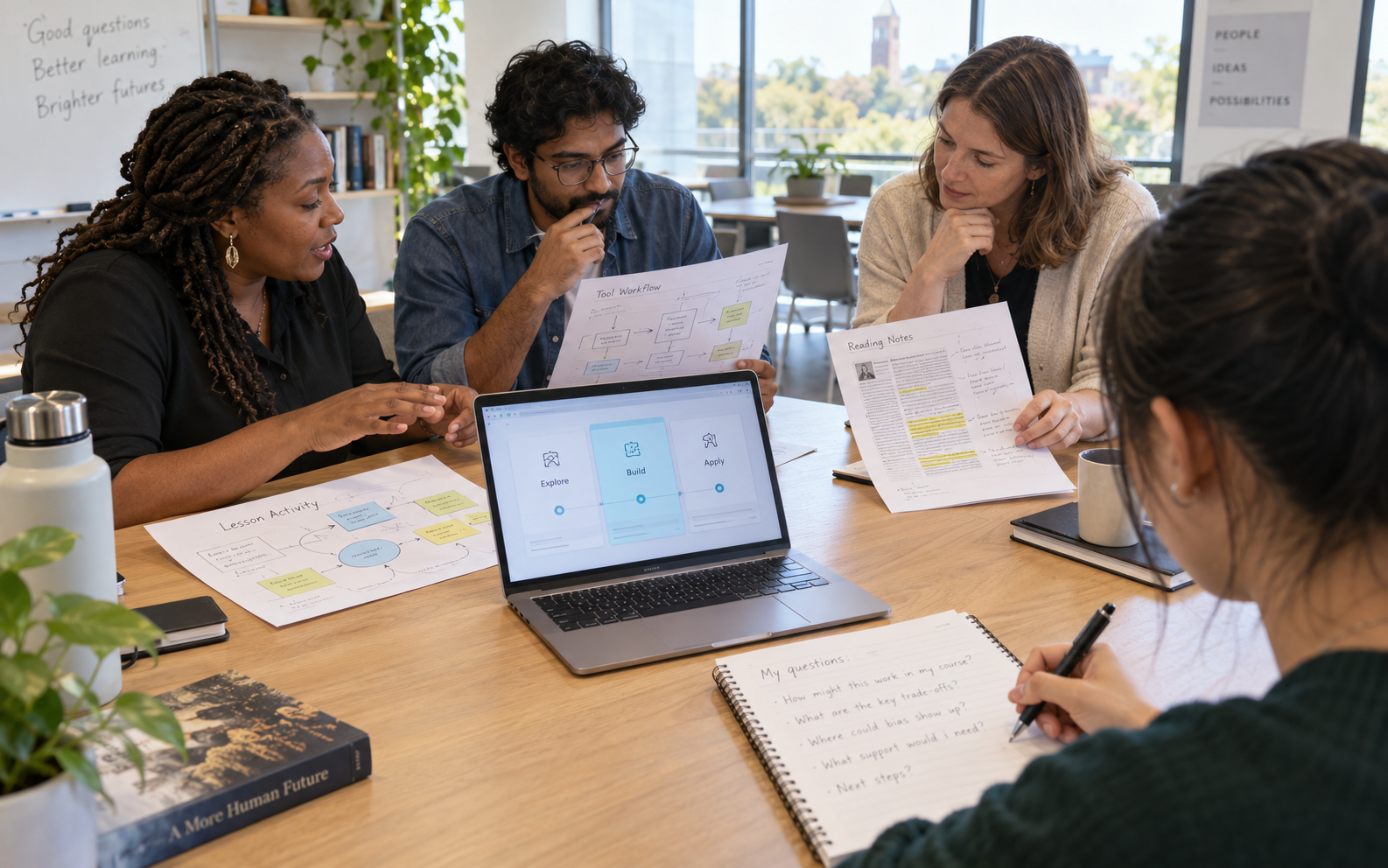
Consider a proposed staff workshop on interpreting a historical source. Each participant brings a short, permitted extract and writes one initial question without AI assistance. Participants then ask for alternative questions and sort them according to purpose: locating evidence, explaining perspective, or weighing a competing interpretation. They should retain examples they reject as well as those they adapt. Their explanation of why a question is unsuitable can be as informative as the final activity, particularly when an attractive prompt asks students to speculate beyond the evidence provided.
A shared language can make professional discussion easier to organize, but local adaptation still requires concrete choices. A teacher might examine whether vocabulary suits the class, whether an example assumes unfamiliar cultural knowledge, and whether learners can respond through more than one format. Colleagues could review the adapted task using those explicit criteria. These are proposed design checks, not measured effects of the translated course. They also avoid assuming that a single language label describes every educator's context, curriculum, or preferred way of learning.
The workshop could finish with a short rehearsal. One colleague plays the learner, offering an incomplete or mistaken answer; another explains the next question they would ask and why. The team records which part of the activity needed revision and what classroom evidence would justify keeping it. If the task is later used with students, teachers can examine actual responses and an independent follow-up task. Such evidence would be more relevant to instructional decisions than a polished AI-generated worksheet or a certificate alone.
For AIEDHK readers, the announcement is an opportunity to connect access to professional learning with deliberate classroom experimentation. Institutions could invite Portuguese-speaking educators to review the materials, choose one bounded practice, and document its fit to their setting. Participation should lead to a reviewable teaching decision and an honest account of what remains uncertain. The immediate benefit offered by the release is access to course content in another language; stronger claims about teaching practice, inclusion, or learning would need evidence gathered for those specific questions.