Designing Responsible AI Learning Systems
A lifecycle method for turning learning goals into bounded AI roles, representative evaluation, understandable controls, human responsibility, monitoring, incident response, and evidence of independent learner capability.
Источники
Полное резюме урока
A responsible AI learning system begins with an educational purpose, not a model demonstration. Designers first state what learners should understand or do, what productive effort should remain theirs, and why AI is needed. They compare non-AI and lower-risk alternatives before selecting a role such as generating practice, retrieving approved sources, offering graduated hints, supporting accessibility, or helping teachers inspect patterns. A narrow role is easier to evaluate and govern than a promise to personalize everything.
The system includes more than a model. Data, prompts, retrieval sources, interfaces, policies, educators, learners, vendors, and institutional routines shape its effects. Designers map this sociotechnical system and identify affected people, especially those who may be excluded or burdened. They examine privacy, security, bias, accuracy, accessibility, academic integrity, intellectual property, emotional effects, and the risk that assistance replaces learning. Requirements should turn each concern into a testable control.
Evaluation uses representative tasks and users. Technical measures may include correctness, calibration, latency, harmful-output rates, and source fidelity. Educational measures include quality of feedback, unaided retention, transfer, learner agency, teacher workload, accessibility, and distribution of outcomes. A polished average can hide severe failures, so teams inspect examples, uncertainty, subgroup patterns, and boundary cases. A pilot has predefined success, stop, escalation, and rollback conditions.
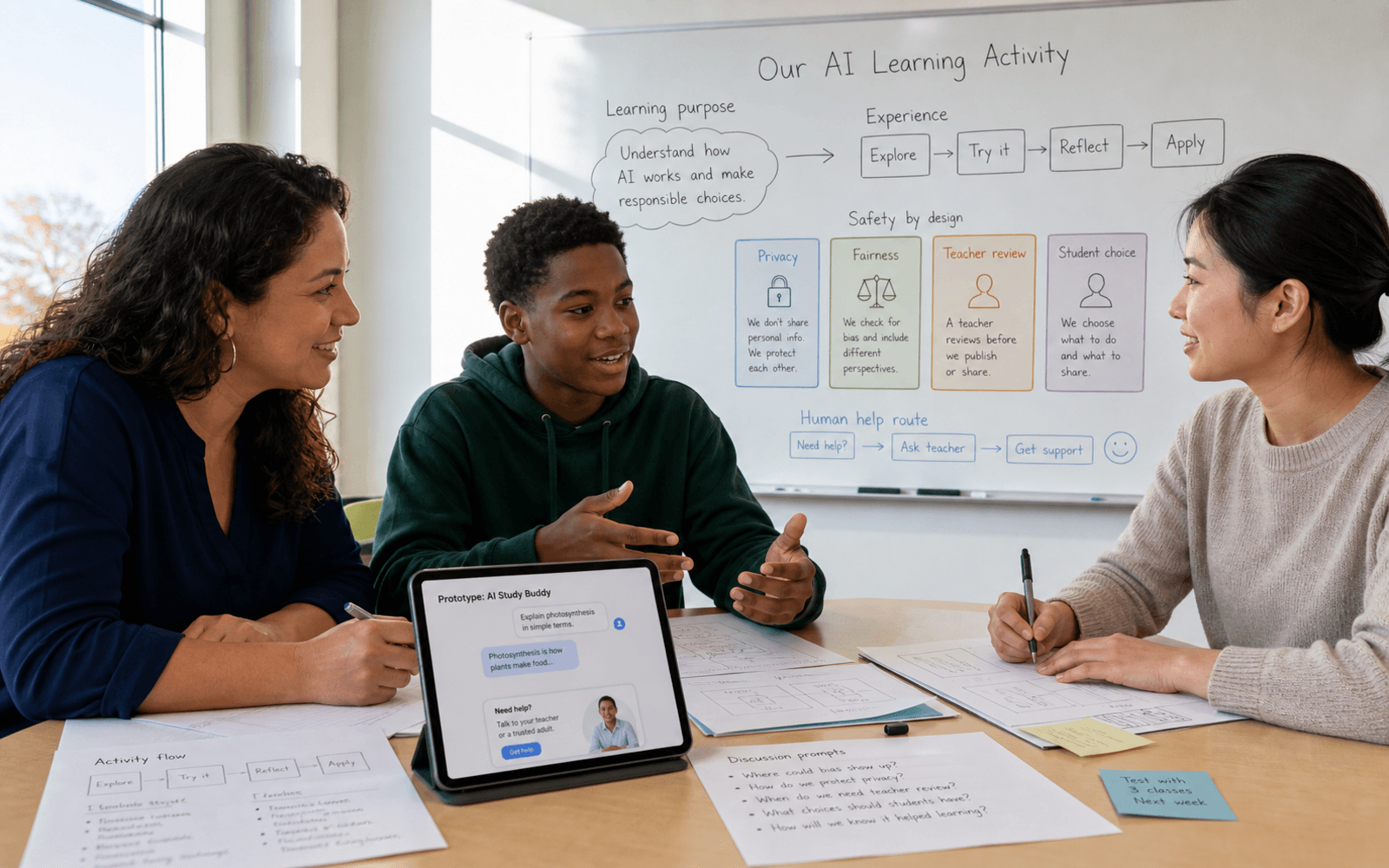
Human control must be operational. Learners need to know when AI is involved and how to question or avoid it. Teachers need evidence, time, training, and authority to override recommendations. High-impact decisions require accountable people and independent information. Interfaces should reveal sources, uncertainty, and the scope of an action without overwhelming users. Data collection and retention should be minimized, while consent and alternatives should match the actual educational setting and age group.
In education, learners can design a hint system for fraction problems. They define the target understanding, sequence hints from recall prompt to partial representation, and forbid immediate completed answers. They test the prototype with diverse fictional cases, including language and accessibility needs, then record failures and revise. An unaided transfer item checks whether support produced capability rather than task completion. A governance card identifies the owner, data used, review date, and shutdown route.
Responsibility continues after launch. Models, content, users, and policies change, so teams monitor incidents, drift, complaints, costs, and educational outcomes. They communicate updates and retire systems whose value no longer outweighs harm or burden. Frameworks can organize the work, but responsibility is demonstrated through evidence and action. A responsible learning system makes its purpose, limits, decisions, and consequences inspectable while protecting the human relationships and intellectual activity education exists to develop. Learners and educators should receive the results of monitoring in understandable form and have a visible route to request correction, alternative support, independent review, or immediate suspension.