Computer Vision for Learning
How computer vision turns pixels into predictions, how its tasks and evaluations differ, and why classroom uses require consent, fairness checks, and human judgment.
Источники
Полное резюме урока
Computer vision is the field of computing that enables systems to process images or video and produce useful predictions. A digital image is first represented as an array of pixel values, not as objects with human meaning. A model may classify the whole image, locate objects with bounding boxes, separate regions through segmentation, estimate body keypoints, read characters, or track movement across frames. These are different tasks with different outputs. A camera records light, while a computer vision pipeline converts that record into a task-specific estimate.
Earlier systems often relied on human-designed features such as edges, corners, color histograms, and geometric relationships. Modern systems usually learn representations from many examples using convolutional neural networks, vision transformers, or multimodal models. During training, labeled examples connect pixel patterns with target categories, locations, masks, or captions. Data augmentation can vary crops, lighting, and orientation to improve robustness. Yet a model does not automatically acquire a complete concept. It may depend on background cues, camera position, annotation conventions, or correlations that fail outside the training collection.
Evaluation must match the intended task. Classification can be examined with accuracy, precision, recall, confusion matrices, and calibration. Detection and segmentation also depend on how predicted regions overlap reference annotations, often measured with intersection over union. A held-out benchmark such as COCO can support comparison, but benchmark performance does not guarantee reliable classroom performance. Schools have different cameras, lighting, languages, accessibility needs, learner demographics, and activities. Testing should therefore include realistic local conditions, difficult counterexamples, subgroup analysis, and explicit thresholds for uncertain predictions.
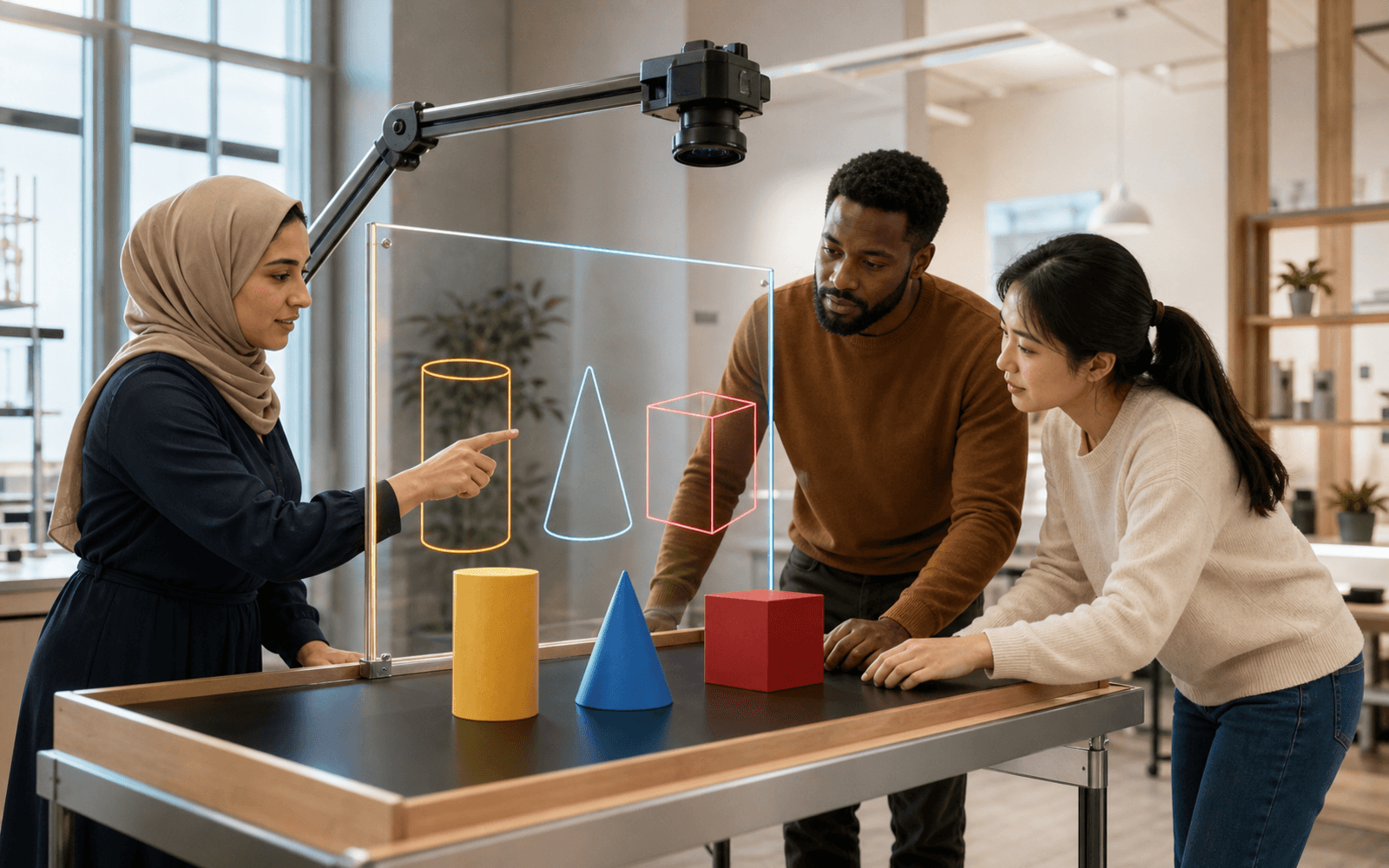
Educational uses can include digitizing handwritten work, recognizing mathematical diagrams, supporting laboratory observation, creating descriptions for visual materials, or helping learners examine motion and spatial relationships. Risks grow when a system identifies people or infers attention, emotion, behavior, or ability from appearance. Such inferences may be scientifically weak, uneven across groups, intrusive, and difficult to challenge. Images can reveal faces, locations, disability, relationships, and classroom routines. Consent, data minimization, secure retention, accessibility, and meaningful alternatives should be designed before collection begins.
In education, learners can build a small investigation with photographs of familiar objects under varied lighting and viewpoints. They define the categories, inspect errors, compare false positives and false negatives, and identify which visual cues the model may be using. They can then decide whether the evidence is adequate for a low-stakes learning aid and what a human reviewer must check. They should also document when the system declines to make a prediction. The central lesson is that computer vision does not simply see. It performs a specified measurement shaped by data, labels, objectives, and context. Responsible use keeps those choices visible and leaves consequential interpretations with people who can examine the learner, the setting, and evidence beyond the image.