← 研究ニュースに戻る
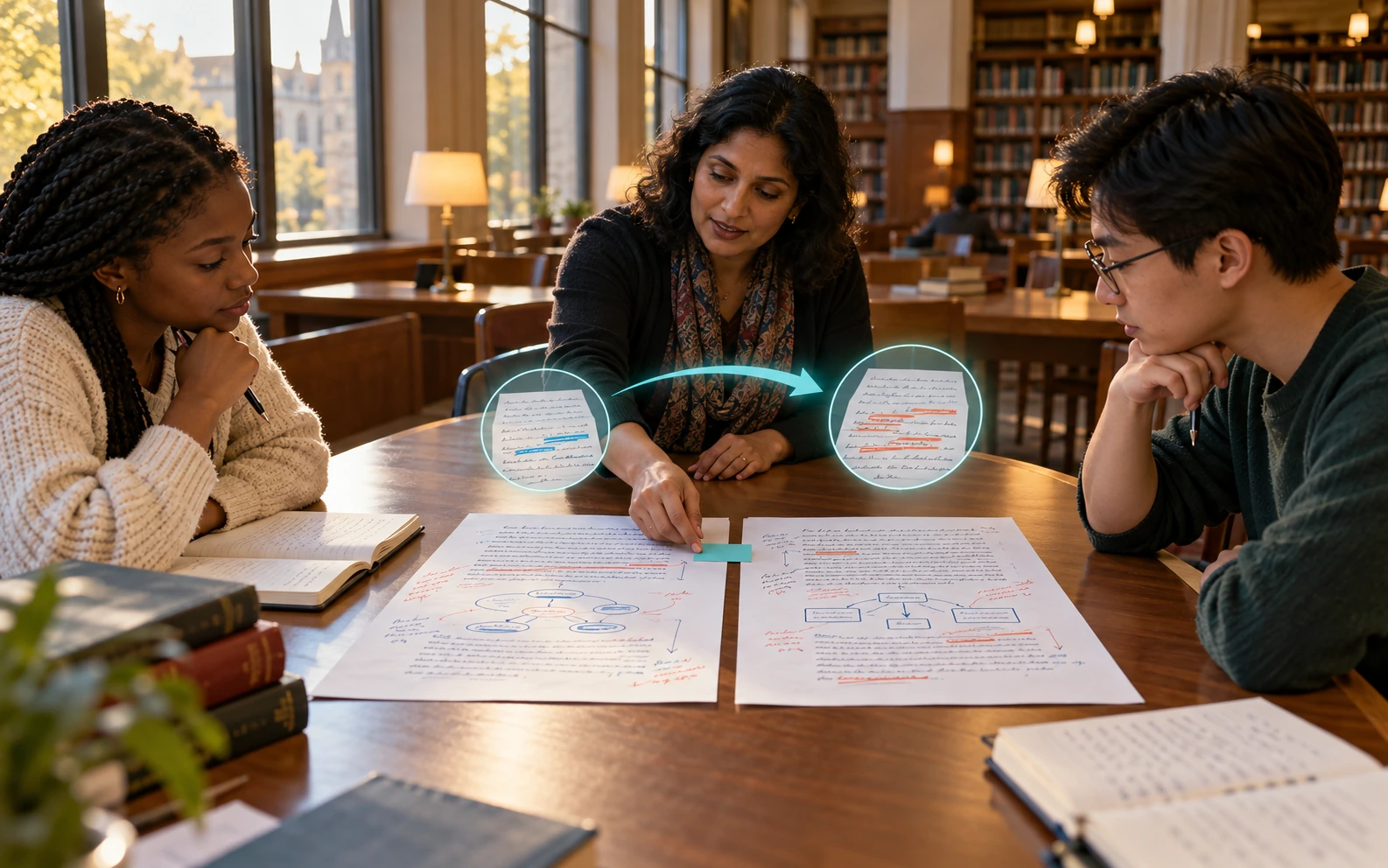
ライティング講師と 2 人の大学の学習者が、変更される改訂優先順位間の視覚的なリンクを抑制しながら、大きなセミナー テーブル上で注釈付きの連続する段落草稿を比較します。
会議論文Conference paper20262026年10月23日· 4 min

学会論文:FeedTypeが文章の推敲段階に応じたAIフィードバックの焦点の変化を検証

Norah Almousa, Shayan Peyghambari Oskoui, Raquel Coelho, Gayle Rogers, Xiang Lorraine Li, Diane Litman

Proceedings of the Artificial Intelligence in Measurement and Education Conference (AIME-Con): Full Papers

500語要約
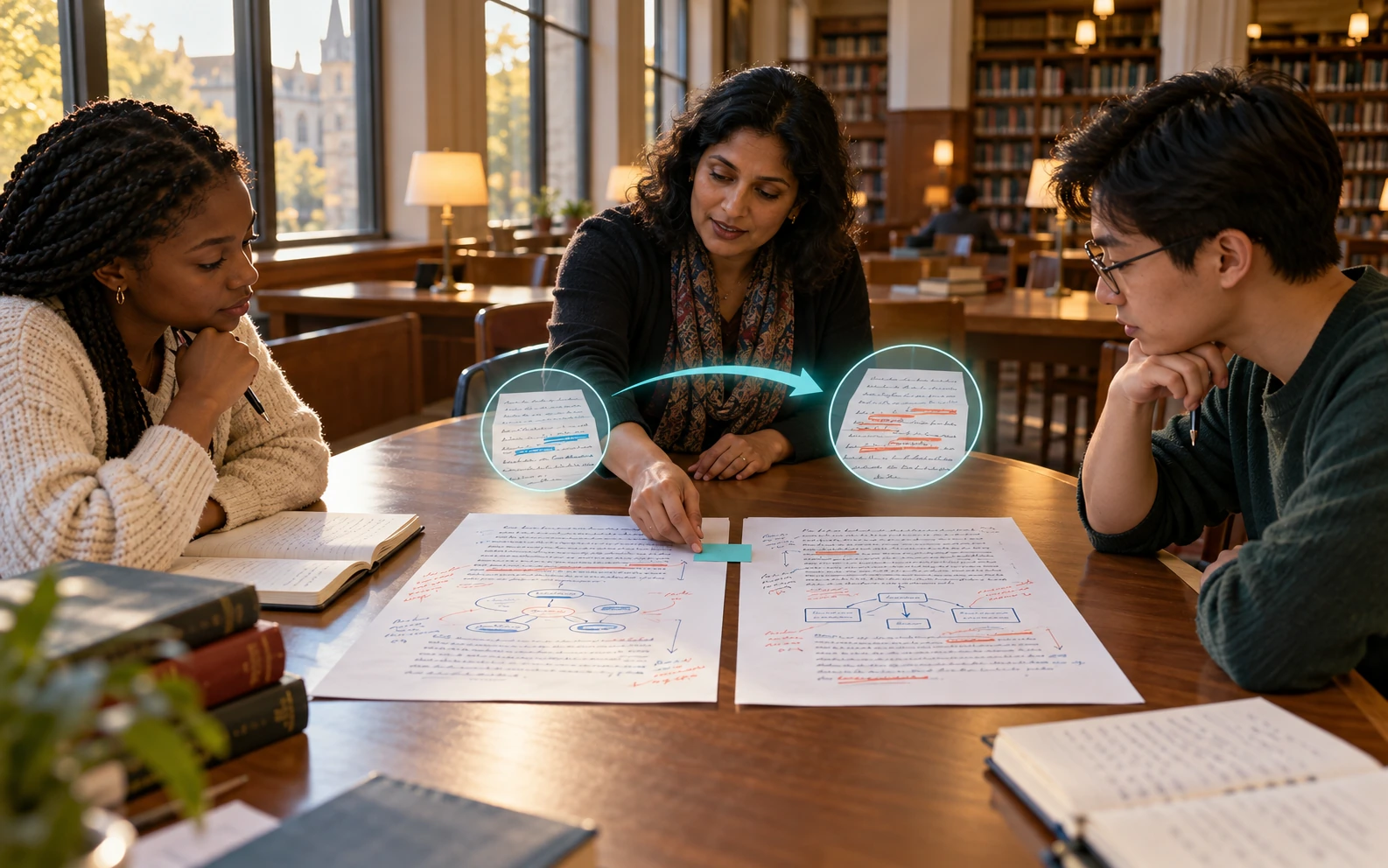
ライティング講師と 2 人の大学の学習者が、変更される改訂優先順位間の視覚的なリンクを抑制しながら、大きなセミナー テーブル上で注釈付きの連続する段落草稿を比較します。

Norah Almousa氏らは、2026年10月5~7日に開催されたAIME-Conの論文集でFeedTypeを発表した。このベンチマークは大学レベルの3つの文章作成コースから得た1,966段落を用い、3種類のプロンプト戦略の下で教師と6つの言語モデルのフィードバックを比較する。内容の焦点を7分類で捉え、自動アノテーションを人の判断と照合した。モデルは多くの分類を網羅したが、教師の調整パターンを完全に再現したものはなかった。草稿の推敲段階と学習者の成績水準に関する分析は、compositionという文章作成コースに限られる。学習への介入効果を検証した研究ではない。

その貢献度は、コメントが何に焦点を当てているか、そしてその焦点が適切に変更されるかどうかを尋ねる方法です。 別の応答の方が役立つ場合でも、システムは繰り返し詳細を要求する場合があります。 教師のカテゴリ分布と一致すること自体は、すべてのコメントが正確であるか役立つことを証明するものではありません。 ベンチマークのコース、注釈の選択、テストされたモデルのバージョンによっても、結果が報告された設定を超えてどこまで到達できるかが制限されます。

AIEDHK の場合は、同じ段落の 2 つの草案を中心に構築された執筆ワークショップの提案を検討してください。 生成されたフィードバックを読む前に、教師は課題のその段階で最も重要な次のステップを特定します。 次に、学生は提案を比較し、それぞれが取り上げている証拠のテキストを見つけて、どの問題が最初に注目に値するかを説明できます。 これは、ベンチマーク調査によって評価された活動ではなく、編集上の指導提案です。

たとえば、地域の環境問題に関する初期の草案には、適切な情報源によるより明確な主張が必要な場合があります。 今後の草案ではすでにその関連性が示されており、代わりに資格の正確な説明が必要になる可能性があります。 どちらの場合でも詳細を尋ねると、異なるリビジョンの優先順位が見逃されてしまいます。 学習者は、一見役に立ちそうなコメントが現在の課題から気をそらしてしまう理由を説明でき、教師に執筆に関する判断の証拠を与えることができます。

ローカルのパイロットは、草案、提案されたコメント、学習者が選択したアクション、およびその選択の短い理由を保持できます。 教師は、より多くの提案を受け入れることがより良い学習を示すと考えるのではなく、同意と意見の相違の小さなサンプルを検査することができます。 レビュー担当者は、適切なカテゴリを特定しながら、不適切な変更を提案しているコメントも検討する必要があります。 目的は、執筆プロセスの特定の瞬間におけるフィードバックがどのように意思決定をサポートするかを理解することです。

バイリンガルライティングクラスでは、コメントが言語を超えて筆者の意図した意味を保持しているかどうかを調べることができます。 生徒は課題の目的を利用して改訂を擁護することができますが、教師は言語の洗練が未解決の議論や裏付けのない主張から気をそらしていないかどうかを検討します。

この調査では、製品チームに対して、導入前に具体化できる評価の質問が提案されています。フィードバックは、課題、現在のドラフト、学習者が実証した困難に対応していますか? この質問は、教師のこれまでの行動を疑問の余地のない基準にすることなく、範囲を限定した復習セットを導くことができます。 その後、少ない支援で完了した執筆は、補完的な学習証拠を提供する可能性があります。 FeedType は、適応フィードバックを調べるための有用な研究リソースを提供します。 教室や教育機関での採用の決定には、学習者が実際に受け取るコメントの質と結果に関する証拠が依然として必要です。


関連論文

Illustrative research-review scene with two raters comparing repeated and progressive activity sequences beside a screen with one rising and one falling chart.
ツール / データセット2026
ツール / データセット 239

Preprint: Raising a tutor metric lowered human ratings in an optimization experiment

Daniel Domínguez Figaredo, Rafael Fernández De la Cruz

arXiv preprint

An optimization experiment produced higher automated scores but lower human ratings for instructional sequences. Its synthetic cases and constrained intervention make it a warning about evaluation design, not evidence of harm to actual students.

preprintAI tutoringevaluation validity
500語要約を読む →
A South Asian female lecturer and a White male university student examine two differently annotated statistics feedback sheets beside a hand-drawn confidence-interval diagram
ジャーナル論文2026
ジャーナル論文 216

Students’ feedback ratings reflected source credibility without consistently matching expert judgments

Tanya Nazaretsky, Hagit Gabbay, Tanja Käser

Computers and Education: Artificial Intelligence

Researchers compared human and AI feedback on 979 responses from six university STEM courses, then examined ratings from 472 students. Expert analysis found broadly similar pedagogical quality, while students’ judgments were associated with their views of the source’s credibility. The study did not measure feedback uptake or learning gains. For educators, it raises a practical question: how can students justify an evaluation of advice before deciding whether to use it?

feedback literacysource credibilityhigher education
500語要約を読む →
A mathematics lecturer and peer discuss a university student's induction proof beside a laptop showing feedback on the next step.
会議論文2026
会議論文 206

LeanTutor: Towards a Verified AI Mathematical Proof Tutor

Manooshree Patel, Rayna Bhattacharyya, Thomas Lu, Arnav Mehta, Niels Voss, Narges Norouzi, Gireeja Ranade

Proceedings of the AAAI Conference on Artificial Intelligence

LeanTutor connects a language model to the Lean theorem prover to support mathematical proof feedback. Its technical evaluation shows promising hints on a small selected benchmark, but also exposes a crucial boundary: a verifier can check the formal proof only after the learner's words have been translated correctly. The study did not test classroom learning, and feedback evaluation excluded failed translations. It is an early system design with explicit limitations, not a validated replacement for mathematics instruction.

Mathematics EducationIntelligent TutoringFormal Verification
500語要約を読む →