← Kembali ke Berita Riset

#AI evaluation

Evaluasi AI

6 makalah

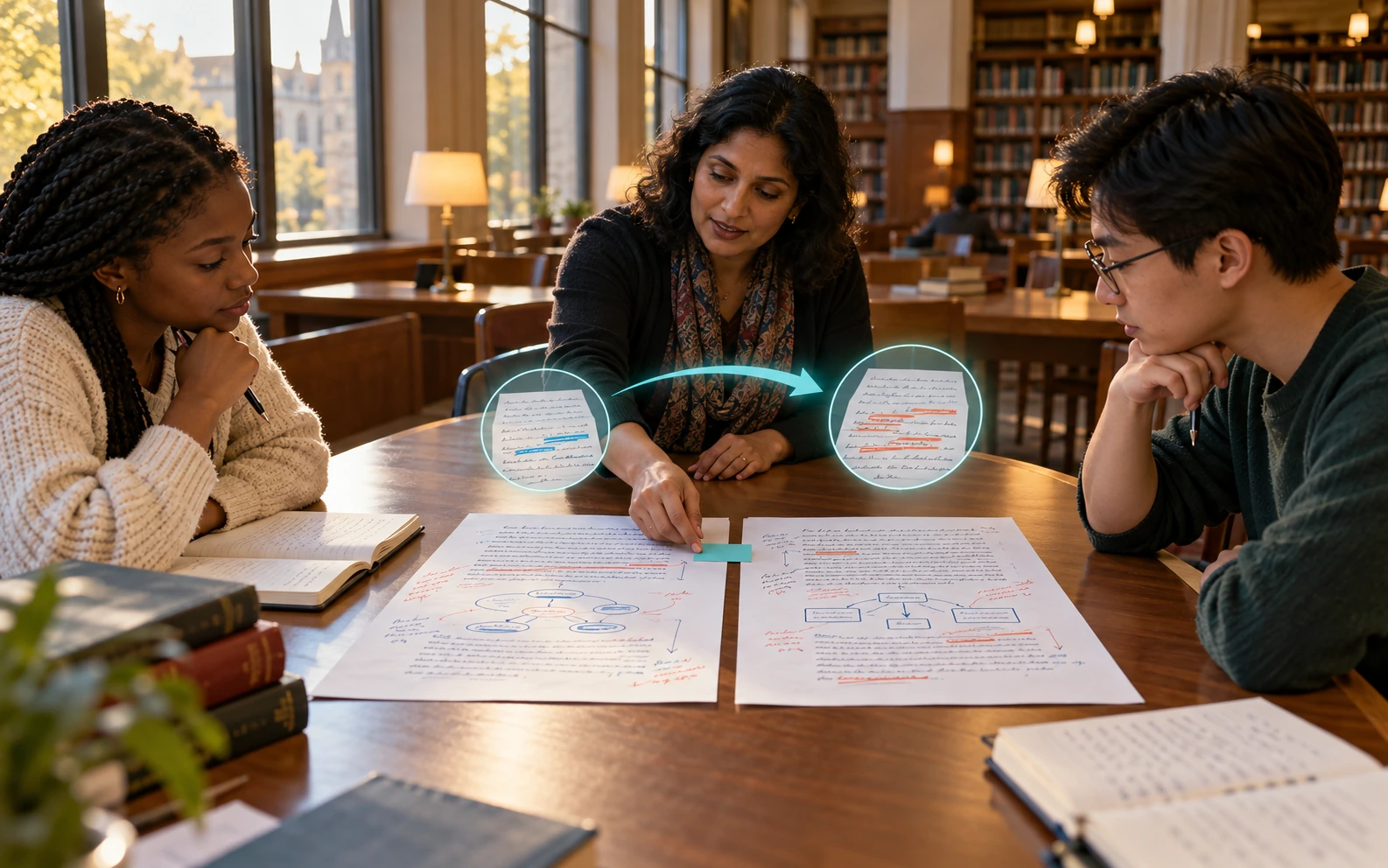
Seorang instruktur menulis dan dua mahasiswa membandingkan draf paragraf beranotasi berturut-turut di meja seminar besar, dengan hubungan visual yang terbatas antara perubahan prioritas revisi
Makalah konferensi2026
Makalah konferensi 232

Makalah konferensi: FeedType menguji perubahan fokus umpan balik AI selama revisi tulisan

Norah Almousa, Shayan Peyghambari Oskoui, Raquel Coelho, Gayle Rogers, Xiang Lorraine Li, Diane Litman

Proceedings of the Artificial Intelligence in Measurement and Education Conference (AIME-Con): Full Papers

FeedType membandingkan fokus umpan balik dalam mata kuliah penulisan tingkat universitas, enam model bahasa, dan tiga strategi penyusunan prompt. Model mencakup banyak kategori, tetapi distribusi dan penyesuaiannya tidak sepenuhnya sesuai dengan pengajar. Penelitian ini menyediakan tolok ukur untuk memeriksa umpan balik, bukan bukti peningkatan kemampuan menulis mahasiswa.

umpan balik penulisanadaptasi pedagogisFeedType
Baca ringkasan 500 kata →


A South Asian female lecturer and a White male university student examine two differently annotated statistics feedback sheets beside a hand-drawn confidence-interval diagram
Makalah jurnal2026
Makalah jurnal 216

Students’ feedback ratings reflected source credibility without consistently matching expert judgments

Tanya Nazaretsky, Hagit Gabbay, Tanja Käser

Computers and Education: Artificial Intelligence

Researchers compared human and AI feedback on 979 responses from six university STEM courses, then examined ratings from 472 students. Expert analysis found broadly similar pedagogical quality, while students’ judgments were associated with their views of the source’s credibility. The study did not measure feedback uptake or learning gains. For educators, it raises a practical question: how can students justify an evaluation of advice before deciding whether to use it?

feedback literacysource credibilityhigher education
Baca ringkasan 500 kata →
A student explains equivalent fraction bars to a listening teacher and classmate, with a tablet set aside.
Makalah konferensi2025
Makalah konferensi 208

Nonstandard English and the Automated Scoring of Open-Ended Math Problems

Abubakir Siedahmed, Jaclyn Ocumpaugh, Zelda Ferris, Dinesh Kodwani, Neil Heffernan, Eamon Worden

Proceedings of the 18th International Conference on Educational Data Mining

A study of 394 authentic mathematics responses examined how GPT-4o scores language associated with African American Vernacular English. Changing one targeted dialect feature did not significantly alter scores, while changing the grading prompt did. The latter contrast also changed rubric wording, so it cannot cleanly establish that a dialect instruction removed bias. The study makes a useful case for testing content scoring carefully, with language variation and mathematical reasoning evaluated separately.

Mathematics AssessmentEducational EquityAI Evaluation
Baca ringkasan 500 kata →
A mathematics lecturer and peer discuss a university student's induction proof beside a laptop showing feedback on the next step.
Makalah konferensi2026
Makalah konferensi 206

LeanTutor: Towards a Verified AI Mathematical Proof Tutor

Manooshree Patel, Rayna Bhattacharyya, Thomas Lu, Arnav Mehta, Niels Voss, Narges Norouzi, Gireeja Ranade

Proceedings of the AAAI Conference on Artificial Intelligence

LeanTutor connects a language model to the Lean theorem prover to support mathematical proof feedback. Its technical evaluation shows promising hints on a small selected benchmark, but also exposes a crucial boundary: a verifier can check the formal proof only after the learner's words have been translated correctly. The study did not test classroom learning, and feedback evaluation excluded failed translations. It is an early system design with explicit limitations, not a validated replacement for mathematics instruction.

Mathematics EducationIntelligent TutoringFormal Verification
Baca ringkasan 500 kata →
A lecturer, research assistant and postgraduate compare two concept explanations and a table of points to check while recording revision notes.
Kebijakan / etika28 Sep 2026
Kebijakan / etika 183

Product news: Claude Sonnet 5.5 targets faster everyday work, with task boundaries still central to educational use

Anthropic

AI Product and Learning Report

Anthropic released Claude Sonnet 5.5 on September 28, positioning it as a faster, lower-cost complement to Opus 5.5 for well-defined work. The company reports improvements in coding, documents, and communication, with efficiency gains dependent on the task. OpenAI's recently released GPT-6 Sol and Luna and Gemini's course-connected support provide context. Educational teams should evaluate the work they actually need, including the review required before a draft becomes usable.

product newsClaude Sonnet 5.5model selection
Baca ringkasan 500 kata →
An education researcher and a developer compare an annotated geometry lesson with code and a verification diagram on a laptop in a university studio
Kebijakan / etika22 Sep 2026
Kebijakan / etika 171

Product news: Claude Opus 5.5 brings lower-cost research workflows and clearer collaboration

Anthropic

AI Product and Learning Report

Anthropic released Claude Opus 5.5 on September 22, emphasizing stronger coding and knowledge work, clearer communication, and lower operating costs. The same day's GPT-6 Sol and Luna launch broadened the choice of affordable models, while Gemini's established Guided Learning tools offered a contrasting educational purpose. For universities, the opportunity is to compare research workflows carefully while keeping model performance, completed artifacts, and student learning as separate outcomes.

product newsClaude Opus 5.5GPT-6 Sol
Baca ringkasan 500 kata →