← शोध समाचार पर लौटें

#learning analytics

learning analytics

11 पेपर

Illustrative photograph of a language teacher and learner arranging sentence cards while a sparse sequence of revision steps appears on a nearby display.
टूल / डेटासेट2026
टूल / डेटासेट 247

Preprint: Grammar-game traces reveal context-sensitive reasoning patterns

Trystan Geoffre, Zheng Yuan, Thierry Geoffre

arXiv manuscript

A manuscript analyzes sequences of actions in a French grammar game to describe reasoning patterns and predict validation success. Its observational design leaves the learning effects of proposed scaffolding untested.

preprintlearning analyticsgrammatical reasoning
500-शब्द सार पढ़ें →

Illustrative photograph of two educators examining a simple prediction baseline and uneven error bars on a seminar-room display.
टूल / डेटासेट2026
टूल / डेटासेट 245

Preprint: Tutoring logs add little to simple score predictions in one course

Zeyu Dong, Mikael Kwame Kuada, Asa Holley Buchakjian-Tweedy, Ibrahem Aljabea

arXiv preprint

A retrospective analysis compares tutoring-interaction features with constant score predictions. Small overall gains and uneven errors show why a support model needs more than a favorable average accuracy figure.

preprintlearning analyticsprediction baselines
500-शब्द सार पढ़ें →
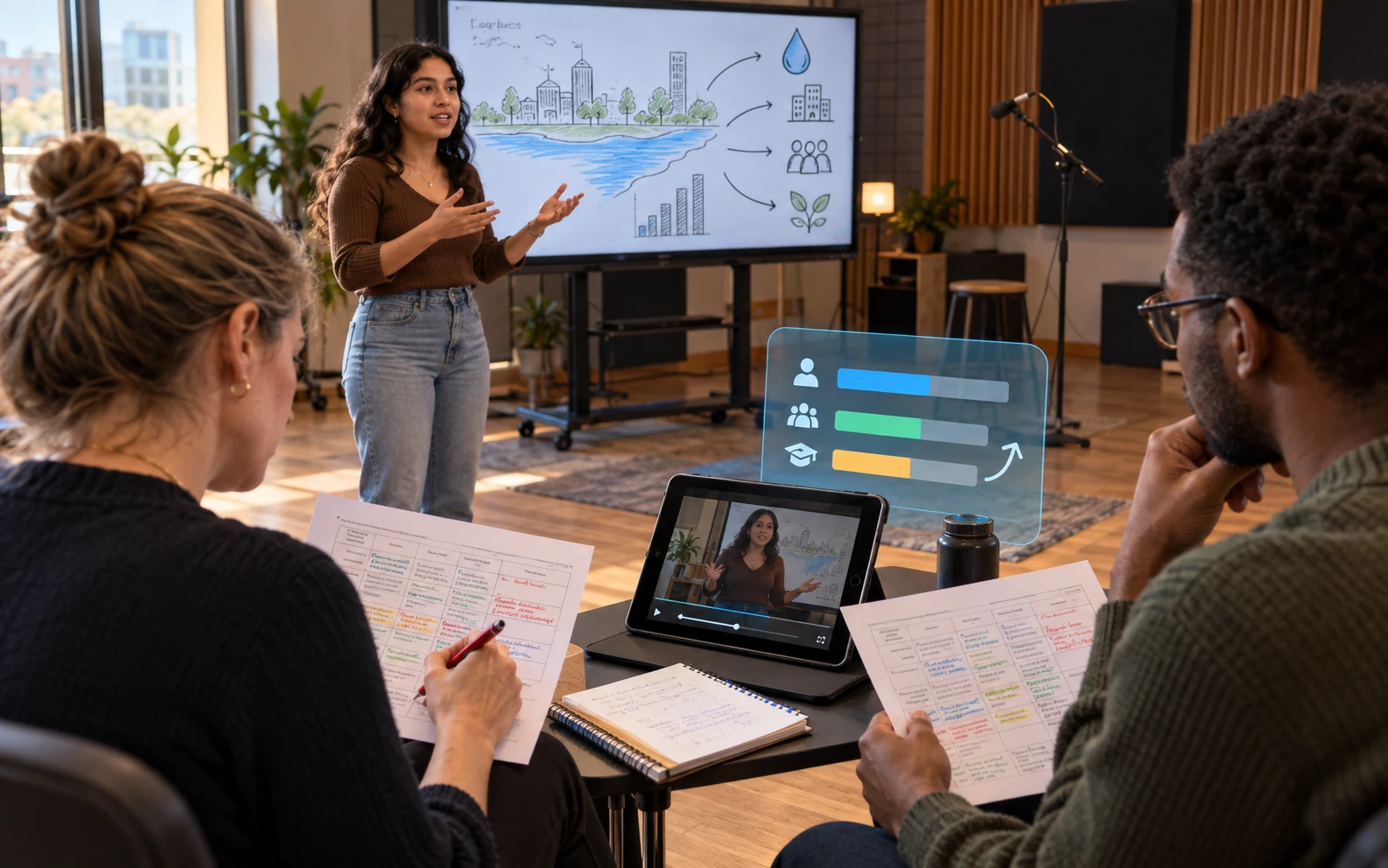
एक विश्वविद्यालय का शिक्षार्थी पानी के उपयोग के बारे में एक प्रस्तुति का पूर्वाभ्यास करता है जबकि एक प्रशिक्षक और एक सहकर्मी टैबलेट पर रिकॉर्डिंग के साथ रूब्रिक एनोटेशन की तुलना करते हैं
कॉन्फ्रेंस पेपर2026
कॉन्फ्रेंस पेपर 230

सम्मेलन प्रदर्शन-पत्र: AICoFe सहपाठी मूल्यांकन, स्व-मूल्यांकन और शिक्षक द्वारा जाँची गई AI प्रतिक्रिया को जोड़ता है

Alvaro Becerra, Alejandra Palma, Ruth Cobos, Julian Fierrez

European Conference on Technology Enhanced Learning (EC-TEL 2026), demonstration paper

AICoFe प्रदर्शन पेपर प्रेजेंटेशन रिकॉर्डिंग, रूब्रिक निर्णय और शिक्षक-क्यूरेटेड AI फीडबैक को जोड़ने वाले वर्कफ़्लो का वर्णन करता है। इसके विश्वविद्यालय परिनियोजन में सकारात्मक संतुष्टि रेटिंग वाले 65 छात्र शामिल थे। रिपोर्ट किए गए साक्ष्य कथित उपयोगिता और प्रयोज्यता से संबंधित हैं, जिससे सीखने के लाभ और दीर्घकालिक कार्यभार की जांच की जा सकती है।

सहकर्मी मूल्यांकनआत्म-मूल्यांकनशिक्षक द्वारा निगरानी
500-शब्द सार पढ़ें →
A university student revises a biology multiple-choice question while a classmate and lecturer consider feedback shown beside a simple animal-cell drawing.
जर्नल पेपर2025
जर्नल पेपर 212

AI-Assisted Co-Creation: Bridging Skill Gaps in Student-Generated Content

Stanislav Pozdniakov, Jonathan Brazil, Mehrnoush Mohammadi, Mollie Dollinger, Shazia Sadiq, Hassan Khosravi

Journal of Learning Analytics

Students often rated AI feedback positively when creating multiple-choice questions in RiPPLE, but visible revision followed in only about 35 percent of editing sessions. The study examined feedback, activity logs, and student comments across introductory university courses. Its findings separate liking a response from using it and from learning through it. They suggest that question-authoring activities need explicit support for evaluating feedback, alongside safeguards against inaccurate or irrelevant suggestions.

Learning AnalyticsStudent AgencyAI Feedback
500-शब्द सार पढ़ें →
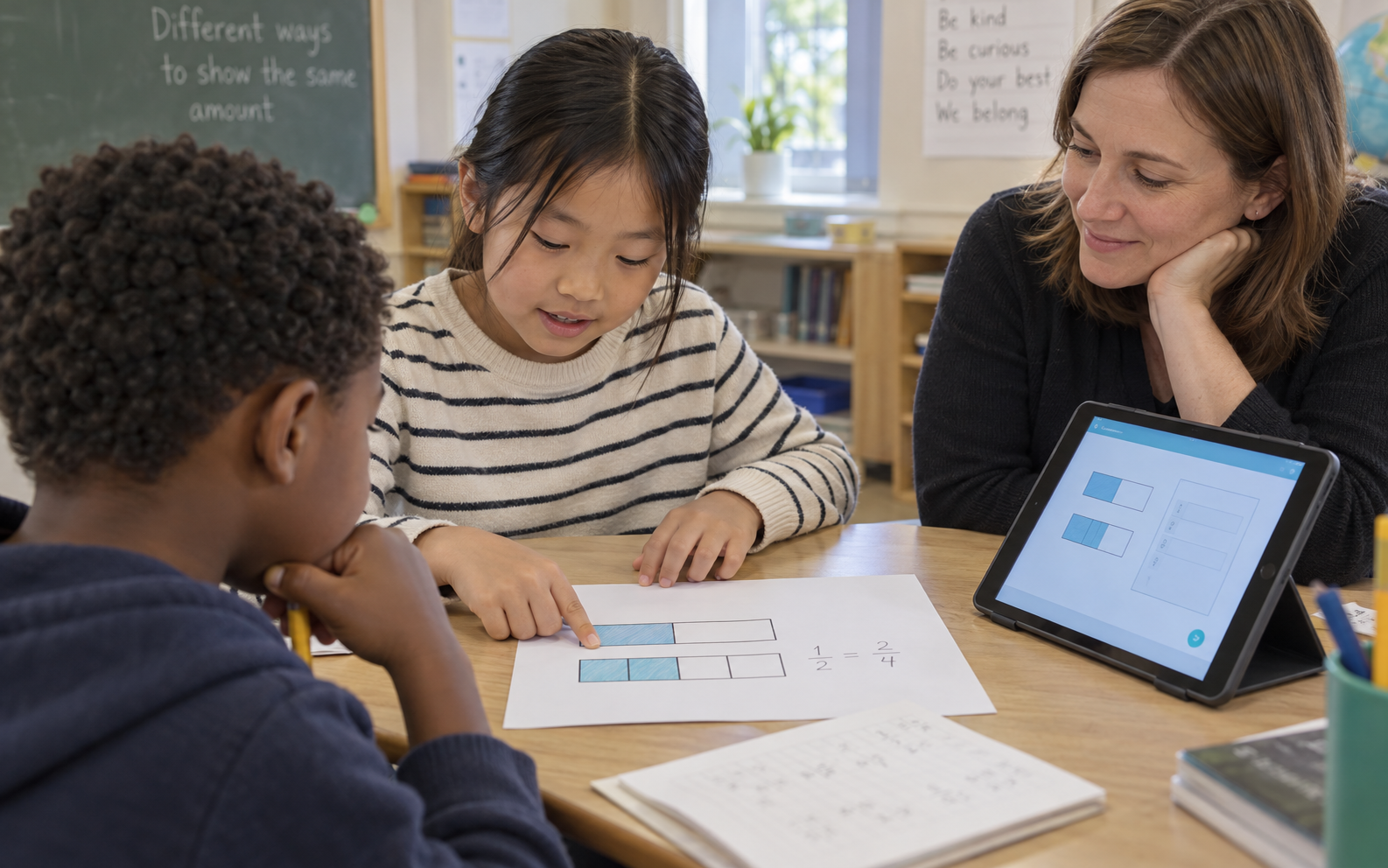
A teacher and two primary pupils compare equivalent fraction bars on a worksheet beside a tablet practice activity.
जर्नल पेपर2026
जर्नल पेपर 194

Computer-assisted learning in the real world: How Khan Academy influences student math learning

Taryn Eames, Emma Brunskill, Bogdan Yamkovenko, Kodi Weatherholtz, Philip Oreopoulos

Proceedings of the National Academy of Sciences

A large United States study links Khan Academy use with mathematics progress across roughly 214,000 students. Its observational design uses changes in classmates’ usage and extensive statistical controls, rather than random assignment. Average exposure was modest, and higher prior achievers appeared to benefit more. The findings highlight implementation and access to practice, while leaving uncertainty about causation. They concern established computer-assisted learning and should not be read as evidence for generative-AI chatbots.

Mathematics EducationAdaptive LearningLearning Analytics
500-शब्द सार पढ़ें →
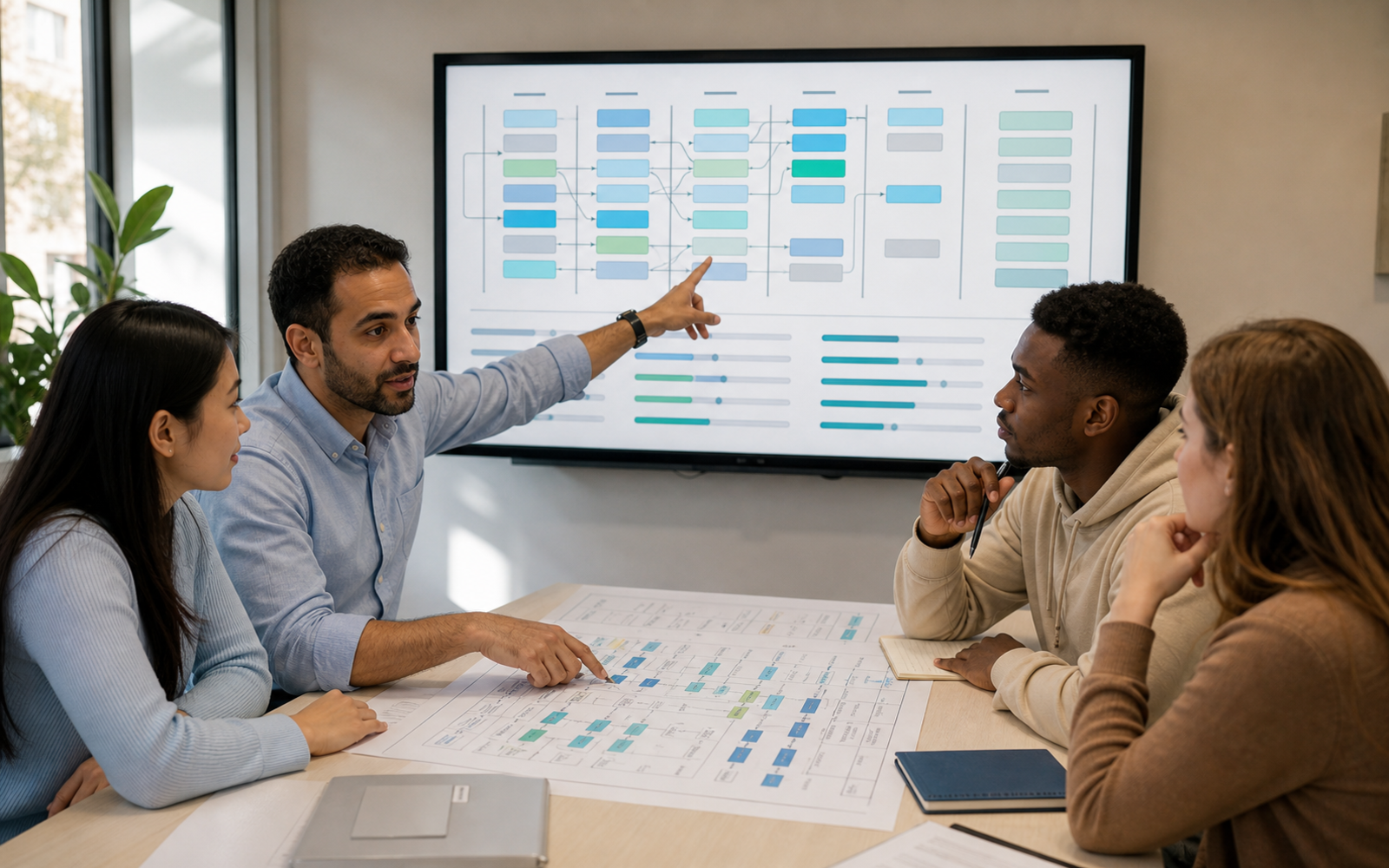
A student adviser and two adult learners review a feasible intervention timeline, a resource budget, and a learner-support dashboard in a university advising room
टूल / डेटासेट2026
टूल / डेटासेट 106

SC2R made student-risk recommendations machine-checkable without claiming causal improvement

Ngoc Luyen Le, Marie-Hélène Abel, Bertrand Laforge

arXiv preprint

Le, Abel and Laforge introduce SC2R, a counterfactual-recourse pipeline that combines calibrated risk prediction, integer programming, an RDF intervention vocabulary, and SHACL validation. Offline OULAD experiments show that semantic checks can reject plans that ignore timing, budget, immutability, or availability. The authors explicitly avoid causal outcome claims, so the contribution is operational feasibility rather than proof that an intervention helps students.

learning analyticscounterfactual recoursesemantic constraints
500-शब्द सार पढ़ें →
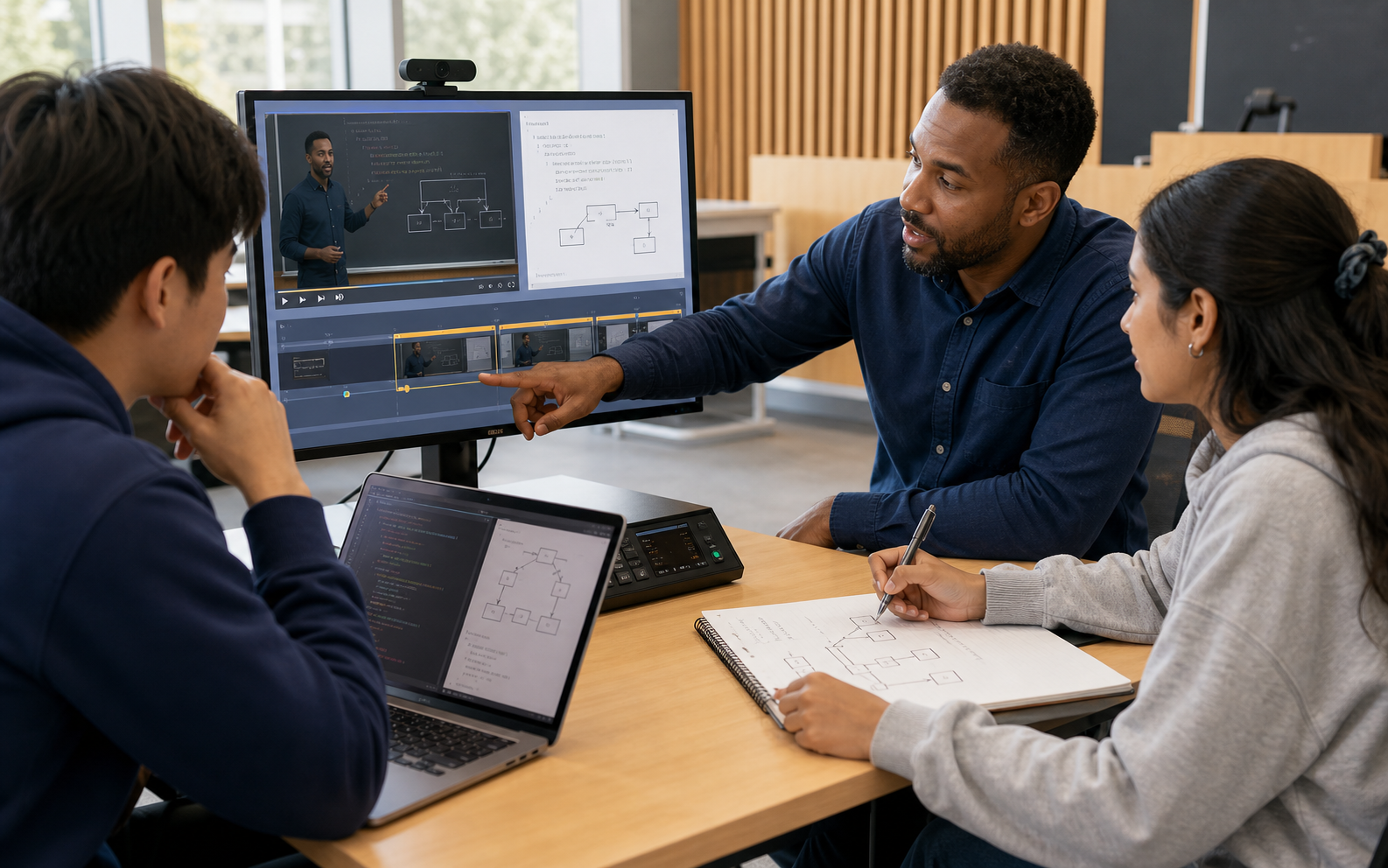
A programming lecturer and two university students review an educator-verified lecture clip timeline, code diagrams and study notes in a bright computing studio
टूल / डेटासेट2026
टूल / डेटासेट 96

Lecture-video curation grounded AI help in course material, but the pilot measured engagement rather than learning

Owen Tang, Alexandra Vassar, Jake Renzella

arXiv preprint

Tang, Vassar and Renzella tested an alternative to open-ended AI answers: use LLMs to retrieve short, educator-delivered lecture clips for novice programming questions. Proprietary models produced relevant and sufficient selections across five benchmark queries, and a 903-student pilot showed repeat use and positive voluntary ratings. However, low overlap with one lecturer, LLM-only quality judgments and no learning-outcome measure mean the study demonstrates retrieval feasibility and engagement, not safer or better learning.

lecture video curationCS1retrieval-augmented generation
500-शब्द सार पढ़ें →
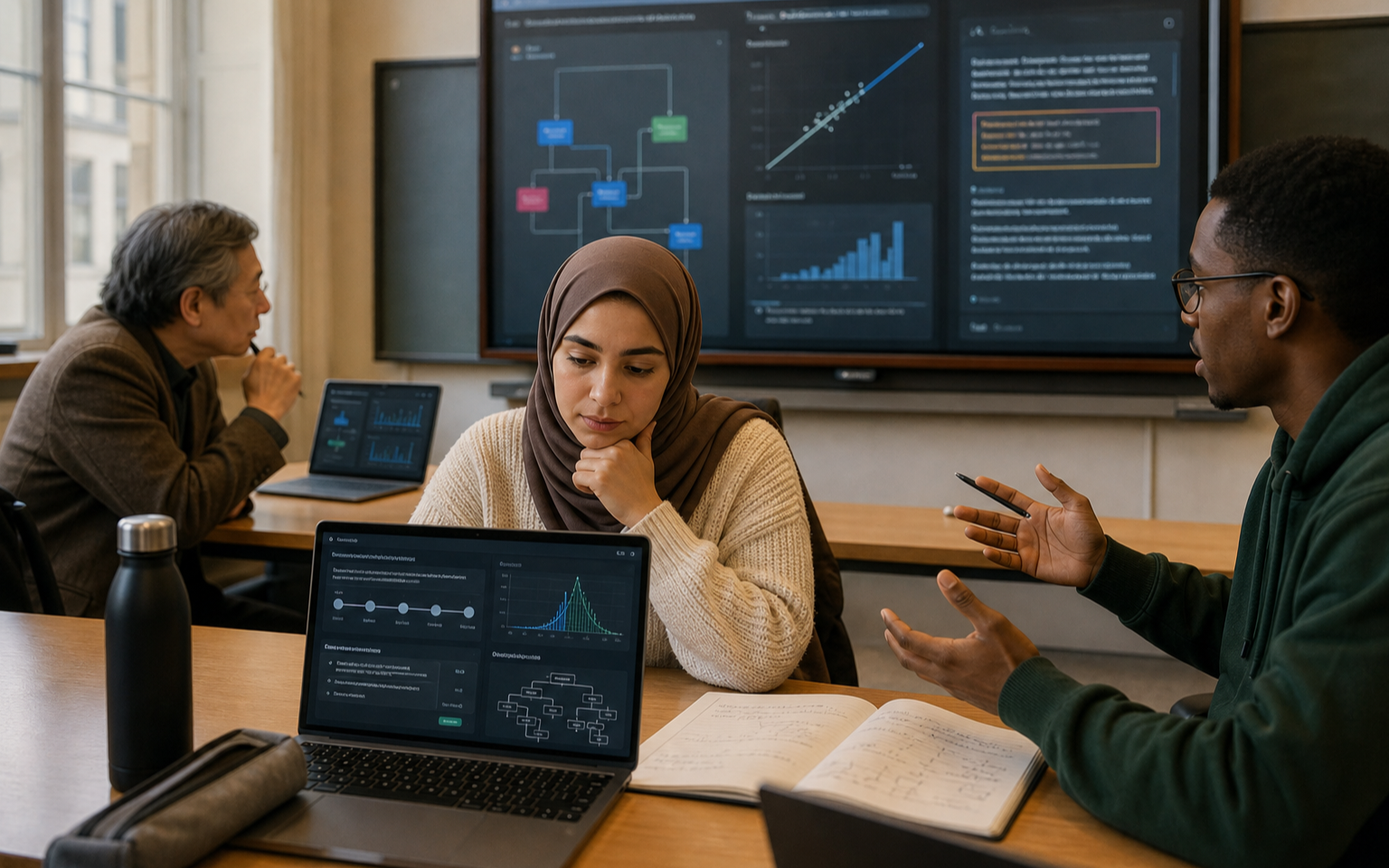
A diverse group of university students and a lecturer examine clustered dialogue cards, a ten-trait matrix and an exam-progress chart in a bright learning analytics studio
टूल / डेटासेट2026
टूल / डेटासेट 94

Principal Trait Analysis linked AI-tutor dialogue patterns to outcomes, but not yet to transferable skills

Hunter McNichols, Kai Du, Andrew Lan

arXiv preprint

McNichols, Du and Lan introduce Principal Trait Analysis, an LLM-assisted pipeline that turns human-AI conversation traces into interpretable behavioral traits. On 1,540 university AI-tutor sessions and 2,774 professional coding-agent sessions, selected traits added explanatory or predictive signal beyond prior performance. Conceptual questioning aligned positively with some exam outcomes, but cross-semester inconsistency, contradictory coefficients and mostly flat temporal patterns mean the traits cannot yet be treated as transferable AI collaboration skills.

Principal Trait AnalysisAI tutoring dialoguehuman-AI collaboration
500-शब्द सार पढ़ें →
An academic adviser and two university students compare concurrent course schedules, predicted grade ranges, and an advising decision map
टूल / डेटासेट2026
टूल / डेटासेट 100

TRACE predicted courses and grades jointly, cutting grade error without establishing intervention benefit

Paul Savala

arXiv preprint

Savala introduces TRACE, a transformer that represents courses by semester and jointly predicts a student's next course set and corresponding grades. On ten years of institutional data, joint training reduced mean absolute grade error by nearly 50 percent compared with the same architecture predicting grades alone and outperformed LSTM and graph baselines. External validity, fairness, calibration, and intervention effects remain open.

course predictiongrade predictiontransformer
500-शब्द सार पढ़ें →
A diverse computer science class uses a learning dashboard to record self-assessments and discuss algorithms with a teacher and an AI dialogue panel
जर्नल पेपर2026
जर्नल पेपर 76

An eliciting LLM dashboard prompted more reflective dialogue and showed a trend toward stronger learning-judgment calibration

Laura Graf, Patrick Bassner, Maximilian Anzinger, Felix Dietrich, Stephan Krusche, Oleksandra Poquet

Education and Information Technologies

A five-week exploratory study with 30 computer-science students compared no agent, a telling LLM agent and an eliciting agent inside a learning dashboard. The eliciting condition produced more reflective messages and showed descriptive trends toward clearer relationships between self-judgments and mastery estimates, but the study did not test achievement gains.

learning analyticsLLM pedagogical agentlearning dashboard
500-शब्द सार पढ़ें →