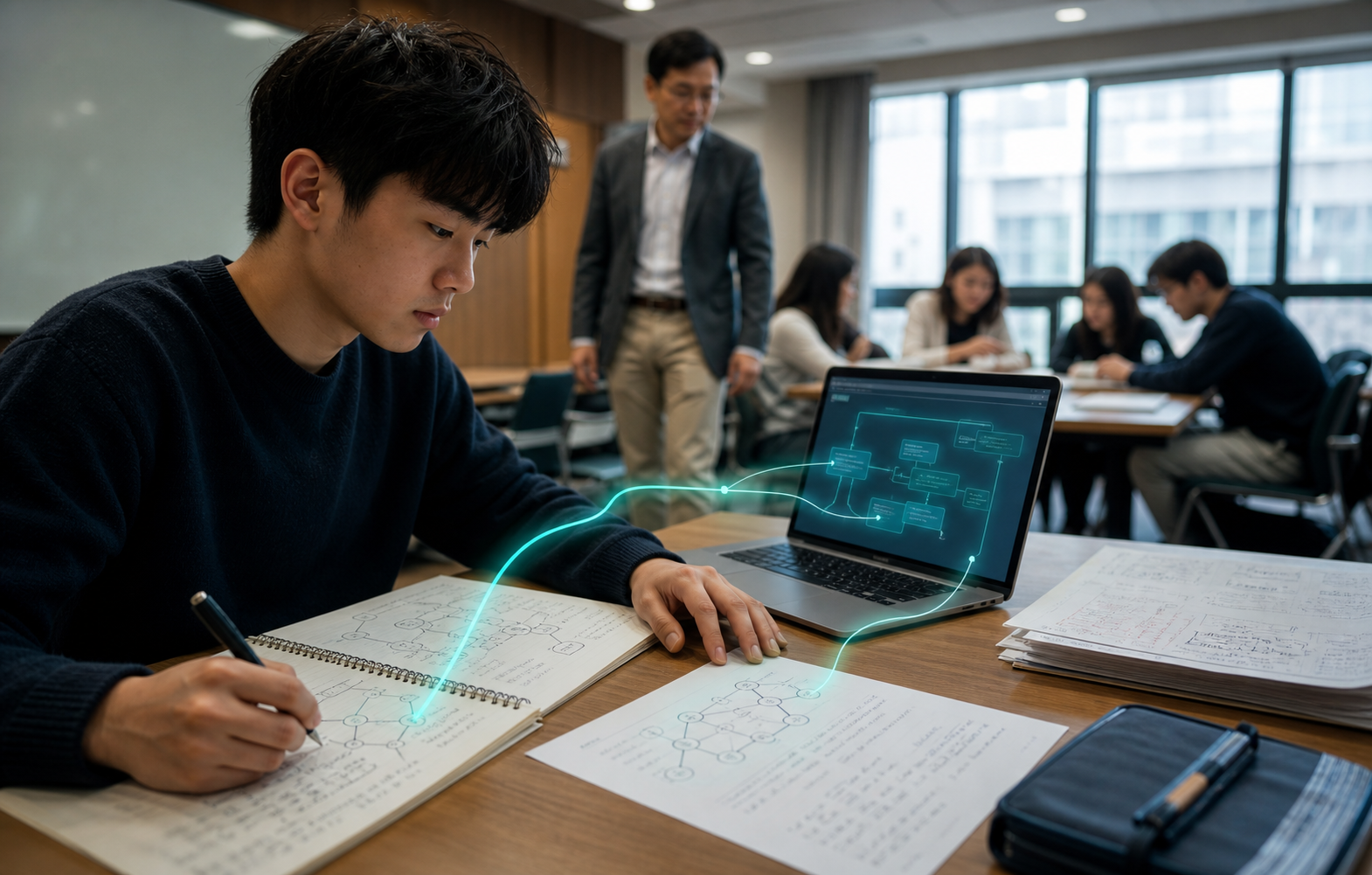
LearnAI piloted a two-layer route from campus AI awareness to supervised co-creation
Weihao Qu, Ling Zheng, Chris Buzaid, Daniel Crawford
arXiv preprint
Résumé de 500 mots

Weihao Qu, Ling Zheng, Chris Buzaid and Daniel Crawford present LearnAI, a two-layer framework for supporting AI work across disciplines at a comprehensive teaching university. The problem is a familiar institutional gap. General workshops can introduce concepts without helping participants complete a real project, while technical courses may be inaccessible to learners without programming experience. LearnAI links broad exposure to optional, just-in-time collaboration so participants can enter at different levels.
The Wide-Exposure Layer placed short presentations inside 18 existing courses across five disciplines. Its purpose was to create shared awareness without requiring a separate course. The Customized Co-Creation Layer then offered one-to-one sessions with trained undergraduate tutors. These sessions followed a five-stage script: problem framing, tool-task mapping, iterative co-prompting, deployment and verification, and ethical reflection. The sequence matters because it begins with a human purpose and ends with inspection and consequences rather than treating prompting as the whole practice.
Across two semesters, 35 clients co-created 36 portfolio websites and more than 20 deployed web applications. The paper also reports interviews with five clients and two tutors. Participants often described moving from seeing AI as a passive answer machine toward treating it as a tool directed through iterative human decisions. The authors include boundary cases, including people who felt overwhelmed and people who intentionally rejected AI. These accounts make the framework more credible than a success-only showcase because non-use and difficulty remain legitimate outcomes.
The evidence is still preliminary. The experience comes from one institution, interview samples are small, and the paired readiness data include only seven participants. Completed portfolios and applications show activity and production, not independent mastery, long-term transfer, accessibility, or educational quality. Tutors may also differ in how they interpret the five stages. The study cannot establish that LearnAI caused readiness gains or that the model will scale with the same support quality.
For a stronger evaluation, an institution could document tutor training and fidelity, sample the reasoning behind tool choices, assess artifacts with independent rubrics, and measure whether clients can later frame and verify a new task without assistance. It should compare participation and outcomes across prior experience, discipline, disability, language, and access to paid tools. Costs, maintenance, privacy, authorship, and responsibility for deployed applications also belong in the evaluation.
For AIEDHK, LearnAI offers a practical design pattern: distribute introductory access, then provide supervised help at the moment a learner has a meaningful problem. Its most valuable feature is not the number of artifacts but the pedagogical script that connects purpose, selection, iteration, verification, and ethics. Hong Kong universities could adapt the pattern through cross-faculty peer tutors and bilingual support, while keeping evidence claims proportionate. The report demonstrates an adoptable workflow and early participant experience; it does not yet demonstrate durable learning or equitable impact. Any replication should publish participation, non-completion, support intensity, accessibility, and follow-up evidence so apparent reach can be distinguished clearly from sustained capability.