← العودة إلى أخبار البحث

#higher education

higher education

22 أوراق

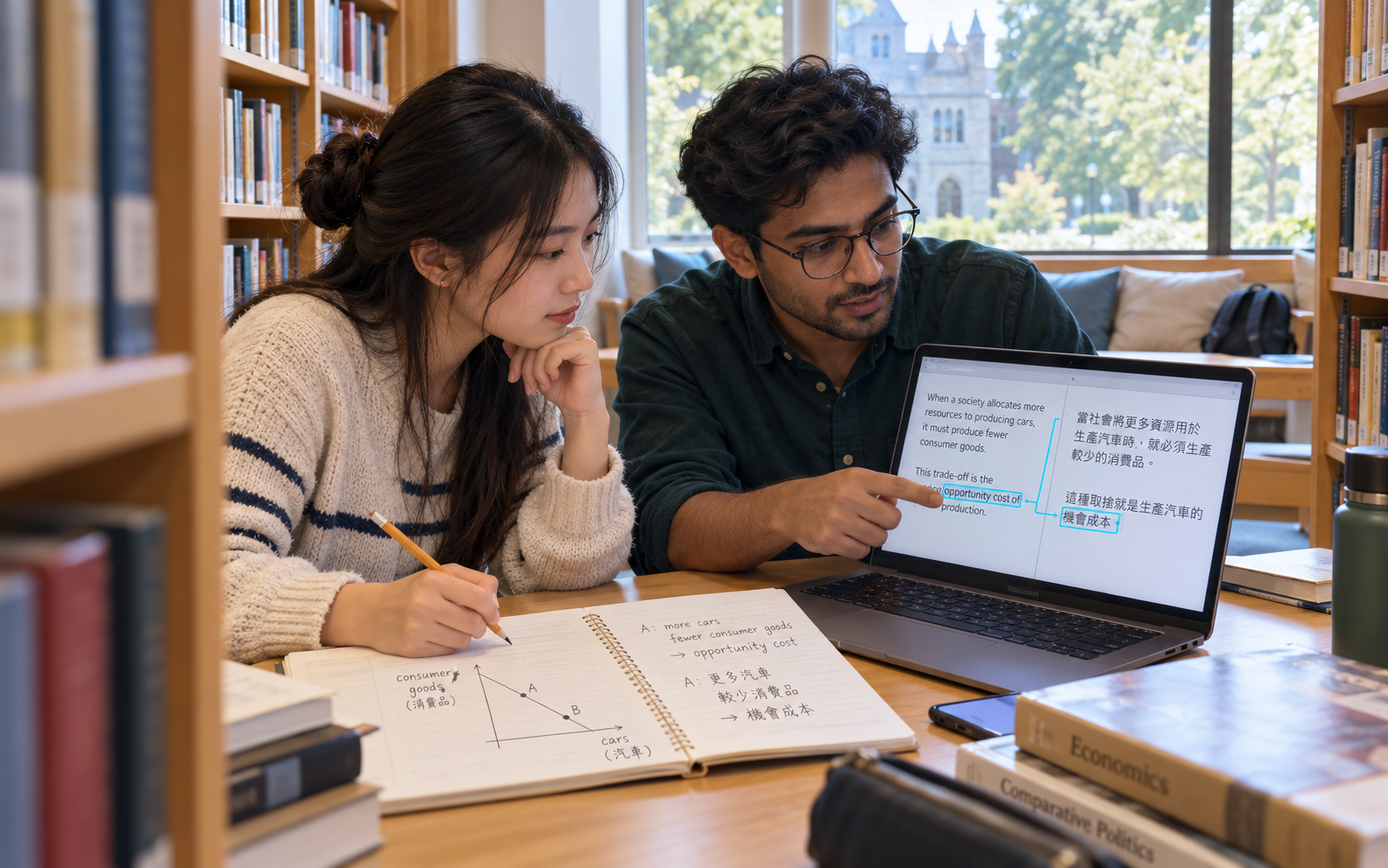
An East Asian female university student and a South Asian male language tutor compare bilingual economics notes and two AI explanations in a sunlit campus language centre
أداة / مجموعة بيانات2026
أداة / مجموعة بيانات 226

Preprint: Students’ access to generative AI did not ensure equally usable support across languages

Ming Li, Qin Xie, Ariunaa Enkhtur, Lilan Chen, Fei Cheng

arXiv preprint (work in progress)

Interviews with 42 undergraduates at universities in China, Japan, and Mongolia explored how students selected AI tools, chose interaction languages, and checked outputs. Participants described different routes from technical access to useful academic support, including switching languages when responses seemed inadequate. This work-in-progress preprint presents situated accounts rather than national comparisons or measured learning gains. It raises practical questions about evaluating an AI service in the languages students actually use.

preprintmultilingual educationAI access
اقرأ ملخص 500 كلمة →


A South Asian female lecturer and a White male university student examine two differently annotated statistics feedback sheets beside a hand-drawn confidence-interval diagram
ورقة مجلة2026
ورقة مجلة 216

Students’ feedback ratings reflected source credibility without consistently matching expert judgments

Tanya Nazaretsky, Hagit Gabbay, Tanja Käser

Computers and Education: Artificial Intelligence

Researchers compared human and AI feedback on 979 responses from six university STEM courses, then examined ratings from 472 students. Expert analysis found broadly similar pedagogical quality, while students’ judgments were associated with their views of the source’s credibility. The study did not measure feedback uptake or learning gains. For educators, it raises a practical question: how can students justify an evaluation of advice before deciding whether to use it?

feedback literacysource credibilityhigher education
اقرأ ملخص 500 كلمة →

A teaching assistant, instructor and university student discuss two proposed feedback comments beside a probability tree for two coin tosses.
ورقة مؤتمر2025
ورقة مؤتمر 210

Improving Generative AI Student Feedback: Direct Preference Optimization with Teachers in the Loop

Juliette Woodrow, Chris Piech, Sanmi Koyejo

Proceedings of the 18th International Conference on Educational Data Mining

Teaching assistants' choices can help adapt AI feedback to a particular course. In a university probability course, researchers trained a model using comments that staff selected, edited, or wrote themselves. Experts preferred its feedback to GPT-4o in a blind comparison, while classroom staff still frequently wrote their own responses. The study demonstrates a feasible feedback workflow and stronger teacher preference, but it did not test whether students learned more or used the feedback more effectively.

Teacher AgencyAI FeedbackHigher Education
اقرأ ملخص 500 كلمة →

A student drafts an essay at a window ledge while a peer points to an argument map and a lecturer observes.
ورقة مجلة2026
ورقة مجلة 202

Teacher feedback VS AI-assisted peer feedback in L2 writing: A quasi-experimental study in a Chinese University

Jinfeng Tang, Ping Li, Rong Luo

PLOS One

An eight-week study compared teacher comments with peer feedback supported by DeepSeek in two university English classes. Both approaches supported better revised essays, but their improvement patterns and feedback focus differed. An initial vocabulary-diversity advantage for the AI-peer class did not persist into the second task, and sentence-complexity results were limited. Because intact classes received different teaching packages, the findings cannot separate AI's contribution from peer discussion or other class differences.

Peer LearningWriting EducationAI Feedback
اقرأ ملخص 500 كلمة →
A university student revises an essay using an evidence-to-claim sketch while a lecturer and peer discuss the feedback.
ورقة مجلة2025
ورقة مجلة 190

Teacher, peer, or AI? Comparing effects of feedback sources in higher education

Joshua Weidlich, Flurin Gotsch, Kai Schudel, Claudia Marusic-Würscher, Jennifer Mazzarella, Hannah Bolten, Dario Bütler, Simon Luger, Bettina Wohlfender, Katharina Maag Merki

Computers and Education Open

Students can welcome feedback without producing stronger revisions. A randomized university study compared teacher, peer, and language-model feedback while concealing its source from recipients. AI and peer comments were perceived as fairer than teacher comments, but teacher feedback supported better scientific argumentation than AI feedback. The findings separate the experience of receiving comments from the quality of the work that follows, with implications for evaluating automated feedback tools.

Higher EducationAI FeedbackPeer Learning
اقرأ ملخص 500 كلمة →
A professor and teaching assistant compare a short-answer rubric, annotated responses and a laptop feedback draft while recording a justification.
ورقة مجلة2025
ورقة مجلة 174

AI-assisted short-answer grading broadly resembled instructor grading, without testing learning gains

Tobias Heinrich, Spencer Baily, Kuan-Wu Chen, Jack DeOliveira, Sanghoon Park, Navida Chun-Han Wang

PLOS ONE

Randomized grading comparisons across political-science courses analyzed 3,080 short-answer responses from 271 students. Instructor-guided GPT-4 prompts broadly resembled human grading on selected evaluation measures, with small and context-dependent differences. Human feedback was slightly more likely to be rated helpful overall. The study evaluates grading and feedback workflows, not student learning or critical-thinking gains, and low regrade-request rates cannot establish that all errors or biases were absent.

assessmentshort-answer questionsAI-assisted grading
اقرأ ملخص 500 كلمة →
An educator demonstrates a paper-reading tool on a large screen while university students watch, take notes, and hold an annotated expectations card.
ورقة مجلة2025
ورقة مجلة 128

Students rated AI tools differently after demonstrations, but expected support was not tested learning

Joana Heil, Dirk Ifenthaler, Martin Cooper, Maria Lidia Mascia, Rachele Conti, Maria Pietronilla Penna

Smart Learning Environments

A survey of 223 students at universities in Australia, Germany, and Italy compared expectations about six AI tools after short demonstrations. Perceived support varied by tool, and students reporting greater AI competence tended to give more positive ratings. Participants did not use the tools during the study. The results therefore inform questions about expectations and training needs, not claims about actual learning improvements or a current product ranking.

AI competencestudent expectationshigher education
اقرأ ملخص 500 كلمة →
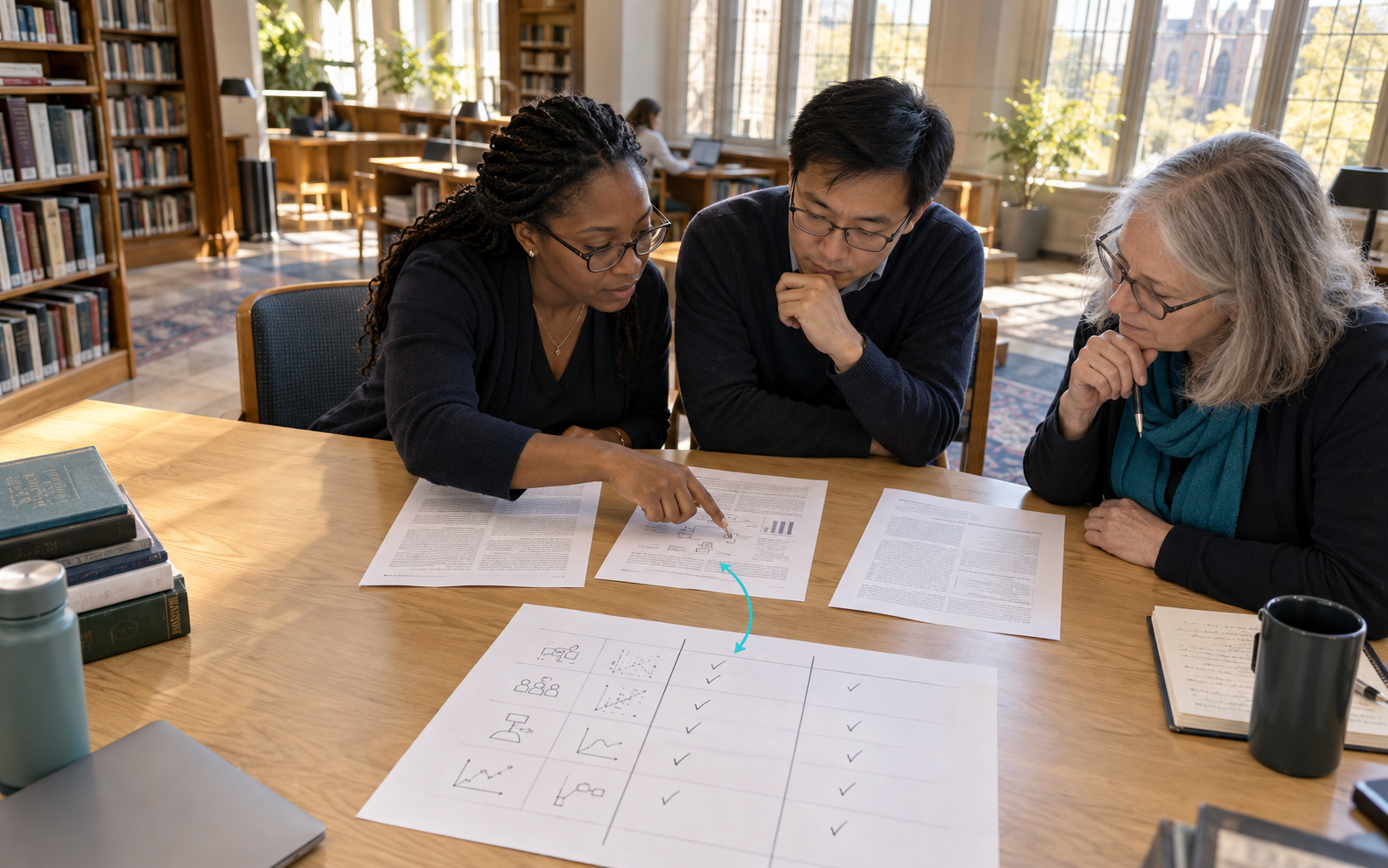
Three researchers compare printed studies and a hand-drawn evidence matrix at a sunlit library table, with a subtle cyan arrow linking the papers.
مراجعة2025
مراجعة 118

A review of early ChatGPT research separates model performance from evidence about student learning

Qian Liu, Anjin Hu, Tehmina Gladman, Steve Gallagher

Innovative Higher Education

A scoping review published in 2025 maps 39 studies from ChatGPT’s first eight months in higher education. It finds varied model performance, promising classroom uses, and repeated concerns about accuracy and assessment. Much of the evidence evaluated what the model could produce or what users believed. The review calls for stronger explanations of learning and should be read as an early baseline, not an evaluation of current models.

research reviewhigher educationassessment
اقرأ ملخص 500 كلمة →
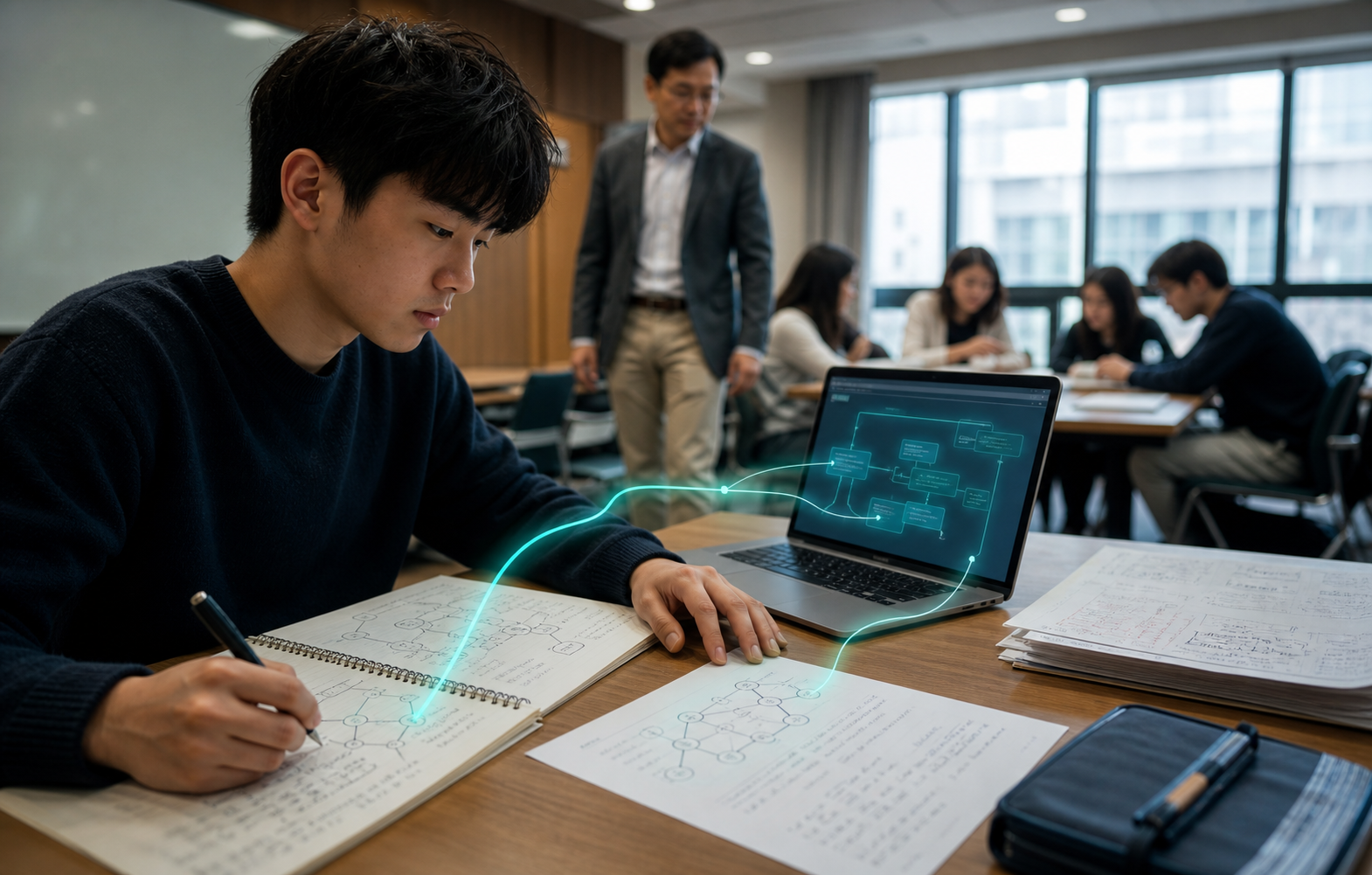
Illustrative scene of two learners rehearsing a workplace conversation beside a whiteboard flow diagram and bar chart while an educator reviews a tablet.
سياسة / أخلاقيات22 أغسطس 2026
سياسة / أخلاقيات 236

Industry news: Cengage expands course-based AI assistants, inviting evidence checks beyond product reach

Cengage

AI Product and Learning Report

Cengage announces wider integration of AI assistance, practice and instructor insights across its higher-education products. A local pilot could examine whether students can justify revisions and apply what they learn independently.

industry newscourse materialsAI literacy
اقرأ ملخص 500 كلمة →
A trained undergraduate tutor supports two learners from different disciplines as they frame an AI project and verify a working prototype in a university studio
ورقة مؤتمر2026
ورقة مؤتمر 108

LearnAI piloted a two-layer route from campus AI awareness to supervised co-creation

Weihao Qu, Ling Zheng, Chris Buzaid, Daniel Crawford

arXiv preprint

Qu and colleagues describe LearnAI, a university framework that paired short course-embedded introductions across 18 courses with optional one-to-one co-creation led by trained undergraduate tutors. Thirty-five clients produced 36 portfolios and more than 20 deployed applications. Interviews and a seven-person readiness comparison are preliminary, so the report supports feasibility and design learning rather than causal claims about skill growth.

AI co-creationpeer tutoringcross-disciplinary learning
اقرأ ملخص 500 كلمة →
A diverse group of university students explores a branching media-technology learning story while an instructor traces where quiz choices connect to the narrative
ورقة مؤتمر2026
ورقة مؤتمر 90

AI-generated learning stories were clear and well paced, but their quizzes did not belong in the plot

Finn Rogosch, Andreas Schrader

EDULEARN26 Proceedings

Rogosch and Schrader tested AI-generated interactive-fiction episodes with 22 STEM higher-education participants. The five-to-ten-minute stories were rated clear and appropriately long, but story-content coherence averaged below the neutral midpoint and engagement sat near it. Participants most often questioned why characters suddenly demanded technical answers, showing that a playable educational story can still fail to integrate its learning task.

interactive fictioneducational gamesgenerative AI
اقرأ ملخص 500 كلمة →
Four diverse university students practise prompting and source checking with an instructor at a library learning table
ورقة مجلة2026
ورقة مجلة 52

A 90-minute GenAI literacy course improved knowledge, prompting, source checking and self-efficacy across 65 university sections

Allison E. Connell Pensky, Lydia E. Eckstein, Michael C. Melville, Laura O. Pottmeyer, Zach Mineroff, Avi Chawla, Judy Brooks, Chad Hershock, Marsha C. Lovett

Computers & Education

In a large experiment involving 1,368 undergraduate and graduate students across 65 university course sections, a 90-minute asynchronous GenAI learning module improved knowledge of how the technology works, prompt-engineering performance, fact- and source-checking, and self-efficacy. It did not improve critical evaluation of bias, showing that short foundational training needs deeper practice for responsible judgment.

generative AI literacyrandomized experimenthigher education
اقرأ ملخص 500 كلمة →
A university student compares an AI explanation with handwritten concept notes while an instructor and peers work in a seminar room
ورقة مجلة2026
ورقة مجلة 50

Experimental evidence on the learning impact of generative AI: gains persisted when students used it for explanation rather than automation

Zara Contractor, Germán Reyes

arXiv working paper

A randomized, proctored experiment reported that undergraduate access to off-the-shelf generative AI raised immediate factual and conceptual test performance by 0.27 standard deviations and that the gains persisted one week later. The working paper also finds a consequential usage pattern: students who used AI to explain concepts showed stronger delayed gains than students who used it to automate drafting.

generative AIrandomized experimenthigher education
اقرأ ملخص 500 كلمة →
Editorial cover of undergraduate learners and a lecturer examining a course-grounded RAG chatbot alongside flat learning and motivation outcome traces
ورقة مجلة2026
ورقة مجلة 36

AI chatbots in higher education: Comparing expectations to evidence

Andrew Thoeni, Luke K. Fryer

Computers in Human Behavior Reports

A semester-long randomized field experiment with 454 undergraduates found that access to a course-grounded RAG chatbot did not significantly improve interest, self-efficacy, engagement, or test performance, despite students reporting that they liked the tool.

RAG chatbotrandomized field experimenthigher education
اقرأ ملخص 500 كلمة →
University students discuss transparent and responsible generative-AI use during a collaborative assignment while a teacher facilitates peer reflection
ورقة مجلة2026
ورقة مجلة 84

Perceived classmate GenAI use was associated with lower trust, while perceived AI literacy attenuated the direct link

Zhen Zhang, Jiaying Geng, Chunhui Qi

Behavioral Sciences

A cross-sectional survey of 406 students at two institutions found that perceiving a classmate as using more GenAI was associated with lower perceived warmth, competence and interpersonal trust. Perceived target AI literacy weakened only the direct association, while the design cannot establish that AI use caused distrust.

generative AIinterpersonal trustAI literacy
اقرأ ملخص 500 كلمة →
Editorial cover for a higher-education experiment with GPT-4 feedback
ورقة مجلة2026
ورقة مجلة 24

GPT-4 feedback increases student activation and learning outcomes in higher education

Stephan Geschwind, Johann Graf Lambsdorff, Deborah Voss, Veronika Hackl

International Journal of Artificial Intelligence in Education

A 2026 IJAIED field experiment finds that individualized GPT-4 feedback sustained voluntary participation and improved the content of students' open-ended macroeconomics answers more than lecturer-only or peer-feedback conditions.

AI feedbackstudent activationhigher education
اقرأ ملخص 500 كلمة →
Diverse university students plan an AI-assisted assignment while a lecturer helps them compare self-reported AI literacy, self-efficacy and independent study strategies
ورقة مجلة2026
ورقة مجلة 80

Self-reported AI literacy and self-efficacy showed different relationships with student dependency in a 478-person survey

Hilit Maizel, Maya Kalman Halevi, Miri Sarid, Rony Tutian

Education Sciences

A survey of 478 Israeli higher-education students found that technical dimensions of AI literacy were positively associated with self-reported AI dependency, while AI self-efficacy, academic self-efficacy and effort regulation were associated with less dependency. Its cross-sectional design identifies relationships, not causal effects.

AI dependencyAI literacyacademic self-efficacy
اقرأ ملخص 500 كلمة →
Editorial cover for ethical and behavioral factors in students' ChatGPT adoption
ورقة مجلة2026
ورقة مجلة 20

Generative AI in higher education: ethical and behavioral factors influencing students' intentions to use ChatGPT

Nina Rizun, Ovidiu Niculae Bordean, Anastasija Nikiforova, Ioana Natalia Beleiu, Aleksandra Revina

Computers and Education Open

A 2026 open-access study of 344 European students connects ChatGPT adoption in higher education with explainability, privacy, trust, social influence, and perceived control.

ChatGPTAI ethicshigher education
اقرأ ملخص 500 كلمة →
A racially diverse university language class evaluates AI-supported writing, speaking, translation and feedback activities with an instructor
مراجعة2026
مراجعة 78

A review of 101 higher-education English-language studies maps five roles for AI and recurring evidence gaps

Yanping Wang, Zuwati Hasim, Ling Wu, Yujia Fang

Cogent Education

A systematic review retained 101 empirical studies of AI in higher-education ESL and EFL from 1,536 records. It identified five broad roles for AI and generally positive reports, while finding regional and skill imbalances, uneven methods, overreliance risks and limited evidence about culture, equity and durable outcomes.

AI in educationEnglish language teachingsystematic review
اقرأ ملخص 500 كلمة →
University students and a lecturer from diverse backgrounds review responsible AI use, academic pressure and evidence checking in a seminar room
ورقة مجلة2026
ورقة مجلة 70

Survey of 493 Chinese university students links academic pressure and peer influence to AI misuse

Hui Zhang, Yutong Chen

Education Sciences

A cross-sectional survey of 493 students across nine Jiangsu institutions found AI misuse associated positively with academic pressure, peer influence and ease of use, and negatively with policy deterrence and academic self-efficacy. Misuse was also associated with lower self-reported innovation ability, not proven to cause it.

AI misuseacademic integrityhigher education
اقرأ ملخص 500 كلمة →
Academic cover for a systematic review of AI applications in higher education
مراجعة2019
مراجعة 01

Systematic review of research on artificial intelligence applications in higher education: where are the educators?

Olaf Zawacki-Richter, Victoria I. Marin, Melissa Bond, Franziska Gouverneur

International Journal of Educational Technology in Higher Education

A highly cited systematic review mapping AI applications in higher education and asking why educators, pedagogy, and ethical reflection remain underrepresented in the field.

higher educationAI applicationseducator role
اقرأ ملخص 500 كلمة →