Product news: GPT-Live-1 API gives language-learning designers more control over pauses and turn-taking
OpenAI
AI Product and Learning Report
ملخص 500 كلمة

OpenAI launched GPT-Live-1 in the API on September 10, 2026, bringing a voice model that can listen and speak simultaneously to developers. The announcement describes interruption handling and the ability to delegate deeper work to other models and tools. This September 14 report focuses on the implications for language practice. An early account from Speak describes fewer interruptions during learners' thinking pauses; it is a product evaluation report, not evidence of a gain in language proficiency.
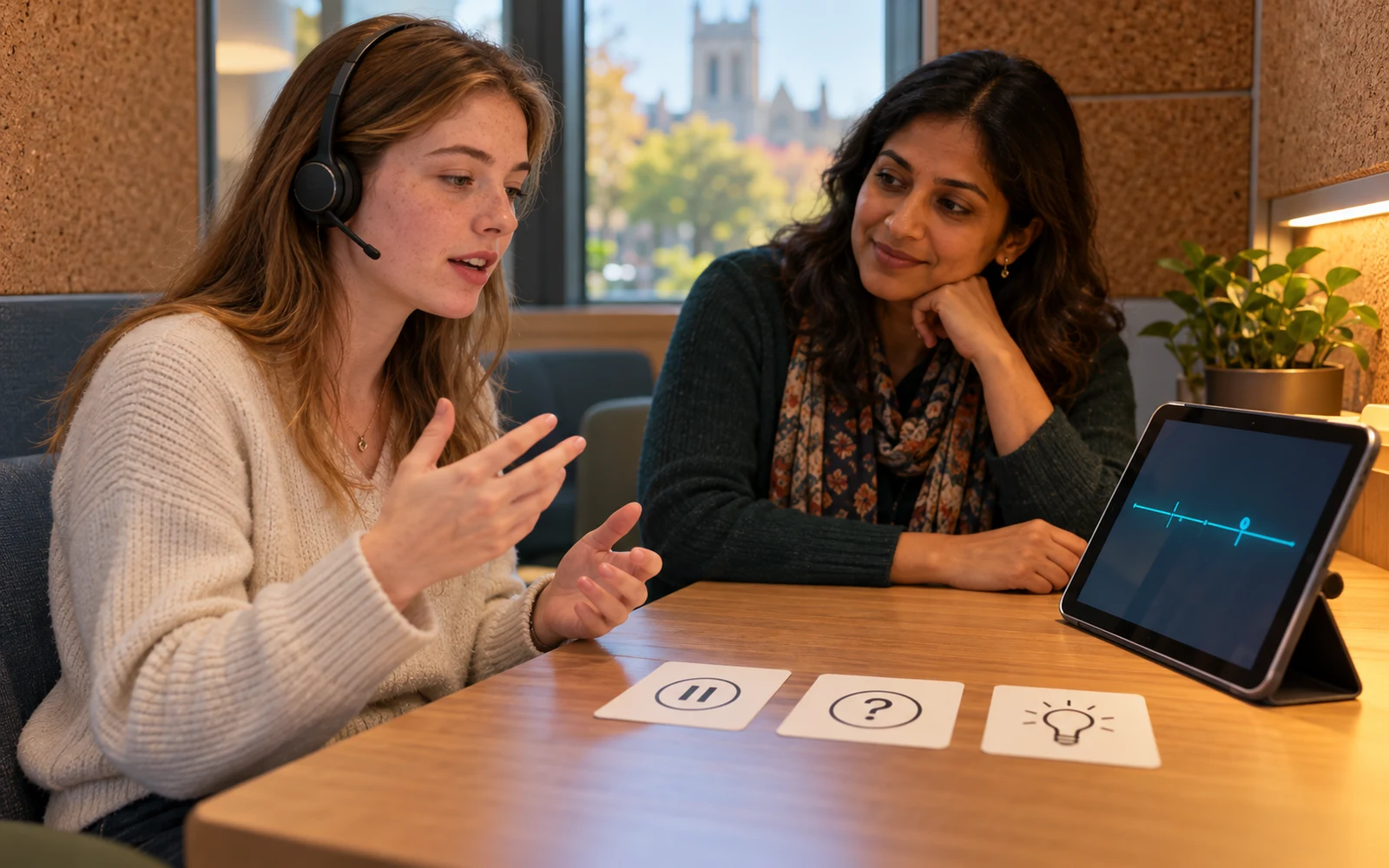
A pause in a language lesson can mean several things. The learner may be searching for a word, planning the next clause, checking grammar, or deciding whether to ask for help. An assistant that responds too quickly can remove the opportunity to complete the thought. One that waits indefinitely can leave the learner unsupported. The design problem is to make assistance responsive without making the learner a spectator in the conversation.
Teachers could evaluate a voice prototype with a small set of clearly defined interactions. One learner pauses mid-sentence, another corrects a word, and another explicitly asks for a hint. Reviewers would examine whether the assistant treats those situations differently and whether the learner can regain the floor. The task should include varied accents and speaking speeds, while avoiding the assumption that one conversational rhythm is the standard everyone should match.
The content of a reply matters as much as its timing. A smooth response can still misunderstand the learner's meaning or give an unhelpful correction. A useful transcript review would identify what the student was trying to say, how the assistant interpreted it, and whether the next exchange helped clarify the idea. This gives the teacher a way to inspect the interaction without reducing quality to speed or the number of turns.
Anthropic's shared chat and Cowork memory addresses continuity across tasks. Gemini's established Guided Learning addresses stepwise support for understanding. Compared with OpenAI's voice API, these features show that educational assistance has several dimensions: carrying context, shaping guidance, and managing conversation. A language activity may benefit from some of them, but should still be designed around what the learner needs to practise rather than around the assistant's most impressive feature.
A proposed lesson could ask learners to tell a short story, review one exchange with a teacher, and tell the story again to a classmate. The assessment would focus on whether the learner can communicate the intended meaning more effectively in the later interaction. Enjoyment, perceived confidence, and technical interruptions could be recorded separately. This would avoid assuming that a pleasant conversation automatically produces transferable speaking skill.
Developers also need to make the transition between speaking and acting clear. A request to explain a sentence is different from a request to save or send work. The application should preserve the learner's control over those actions. GPT-Live-1 makes more natural voice interaction available as a building block; its educational value depends on how designers protect thinking time, make misunderstandings recoverable, and connect assisted practice with meaningful human communication.