
← 返回研究新聞

#learner agency

learner agency

8 篇論文

Two university students and a teacher compare an annotated article with three question cards during a reading seminar.
期刊論文2026
期刊論文 178

Guided AI dialogue was followed by more developed reading questions, with task order limiting causal interpretation

Xiaoyu Zhao, Guili Kong, Hui Zhou, Liting Liao, Xiuhan Li

Smart Learning Environments

A within-student study of 112 undergraduates compared questions written after ordinary digital reading with questions written after a second reading supported by ERNIE Bot dialogue. The AI-supported phase produced more questions and higher rated question quality. Dialogue patterns also differed by performance. Because all students encountered the ordinary reading first and a different AI-supported text second, the evidence cannot separate assistance from order, practice and text effects or establish independent transfer.

digital readingquestion generationdialogue learning
閱讀 500 字摘要 →

大學生向教師解釋幾何作圖,同學在旁思考,桌上的電腦展示相關數碼圖解
政策 / 倫理2026年9月7日
政策 / 倫理 112

評論:Astra 的 AGI 主張,讓教育更需要看見人的真實學習

AIED.HK Editorial

AI Product News Commentary

OpenAI 於 2026 年 9 月 3 日發布 GPT-6 Astra,並引發關於 AGI 是否已經到來的討論。本文將這一說法視為需要歸屬的主張,而非已確立的共識。教育眼前的挑戰,是分清 AI 能產出甚麼,以及學習者能獨立解釋、質疑和遷移甚麼,再以更強的代理能力支援真正的學習。

產品新聞評論GPT-6 Astra
閱讀 500 字摘要 →
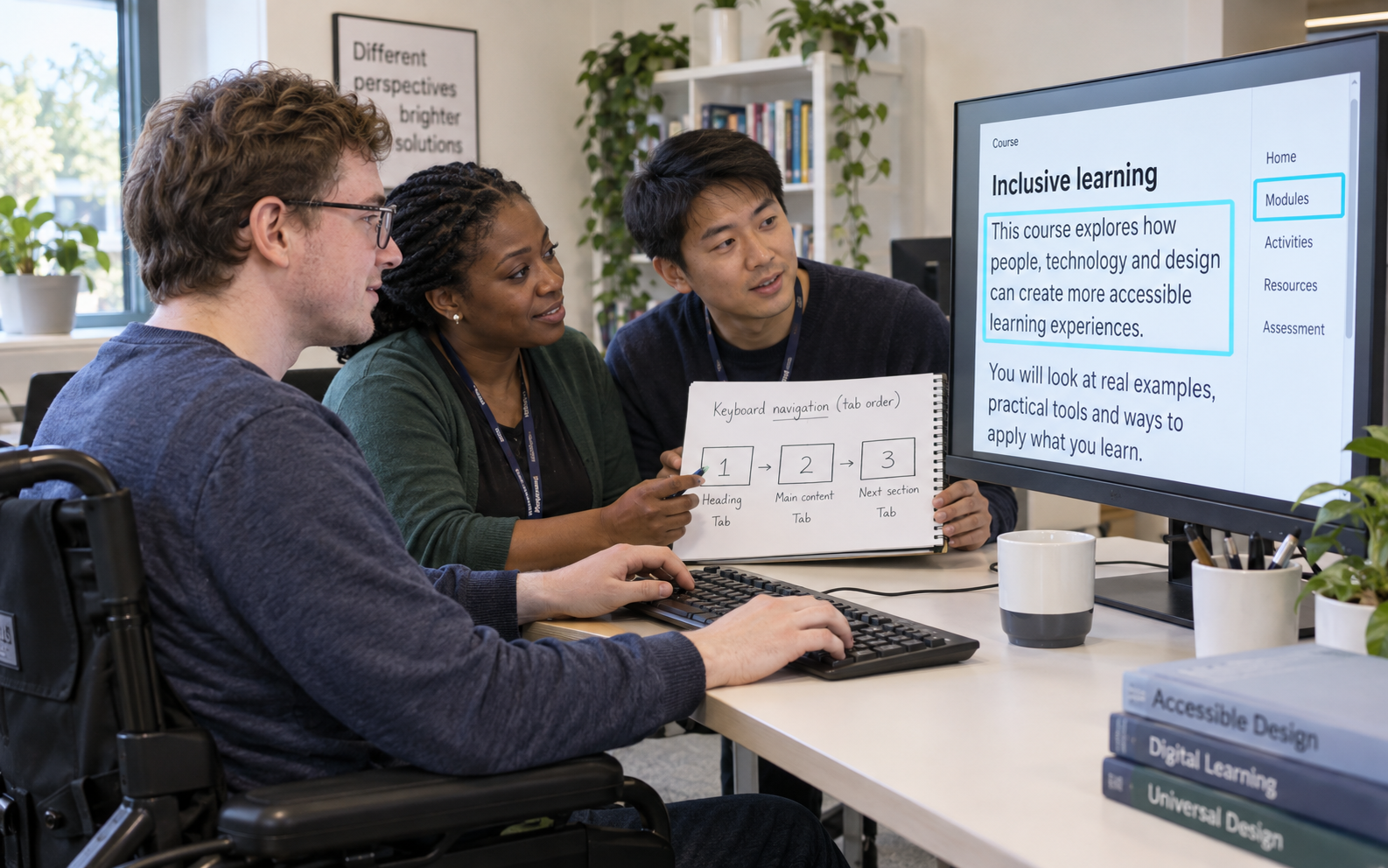
A student using a wheelchair works at a keyboard while two educators compare an enlarged course page with a hand-drawn keyboard-navigation sequence.
政策 / 倫理2026年9月5日
政策 / 倫理 139

Product news: An accessibility specialist uses ChatGPT to adapt reading tools, without shifting responsibility to users

OpenAI Academy

AI Product and Learning Report

An OpenAI Academy profile published September 4 describes accessibility specialist James Warnken using ChatGPT to create browser shortcuts and a keyboard-focus styling tool. Reported here on September 5, the case shows a person directing technology around a specific access need. Anthropic's teaching guidance and Gemini's educator training offer related learning opportunities, but personal adaptations do not replace a school's responsibility to provide usable digital materials.

product newsaccessibilityinclusive design
閱讀 500 字摘要 →
A language tutor and student compare a laptop suggestion with an underlined reference-book passage while another student presents an annotated page.
期刊論文2025
期刊論文 132

Language learners’ trust in AI was linked to reliance and resistance, with self-direction shaping reported use

Feifei Wang, Nuoen Li, Alan C. K. Cheung, Gary K. W. Wong

International Journal of Educational Technology in Higher Education

A mixed-methods study combined a survey of 682 Chinese university students with 40 follow-up interviews about AI use in language learning. Trust was associated with reliance, resistance, and intentions, while self-directed learning moderated the relationship between intention and reported use. Interviews distinguished thoughtful use from uncritical dependence. Because the design was cross-sectional and self-reported, the model explains patterns of association rather than causal pathways or measured language gains.

language learningtrust in AIself-directed learning
閱讀 500 字摘要 →
A doctoral student and supervisor compare an annotated earlier project brief with a revised research question, beside a laptop showing the two document versions.
政策 / 倫理2026年8月30日
政策 / 倫理 127

Product news: Claude unifies chat and Cowork memory, making remembered context open to correction

Anthropic

AI Product and Learning Report

Anthropic's August 25 memory update lets chat and Cowork draw on the same editable record of remembered topics. Reported here on August 30, it raises a useful educational question: who decides which account of a learner or project persists? OpenAI's workspace administration and Gemini's course-selected context offer contrasting controls. Continuity can reduce repetition, but educators should distinguish remembered preferences from current evidence about understanding.

product newsClaude memorylearner agency
閱讀 500 字摘要 →
Four university students discuss a hand-drawn project map around a round table, with a laptop showing a short task list highlighted in cyan.
期刊論文2025
期刊論文 126

Problem-based learning students saw AI as useful while negotiating effort, group trust, and rules

Sofie Otto, Stine Ejsing-Duun, Euan Lindsay

Education and Information Technologies

An exploratory study at Aalborg University surveyed 83 IT-focused students about generative AI in a problem-based learning environment. Students generally valued its support for explanations, ideas, and task completion, while describing tensions around missed learning opportunities, shared effort, and unclear rules. These are situated student accounts rather than measured learning effects, but they show why decisions about AI use need to include the project group and its educational goals.

problem-based learningcollaborationstudent perspectives
閱讀 500 字摘要 →
Two programming students trace and test their own code with an instructor in a university computer lab
期刊論文2025
期刊論文 114

Programming students shifted their AI habits with guidance, but better interaction was not a randomized learning effect

Hacer Güner, Erkan Er

Education and Information Technologies

A classroom study followed programming students through unguided ChatGPT use, a prompting demonstration, and embedded example prompts. Their interaction profiles changed substantially, while students who refined their own code often achieved stronger unaided quiz scores than students who requested complete solutions. The study offers practical evidence about classroom guidance, but its sequential tasks and existing knowledge differences do not establish that a particular prompting intervention caused better learning.

programming educationAI literacylearner agency
閱讀 500 字摘要 →
A teacher prompts a diverse group of secondary students to reason with question cards while an unused answer-generating tablet rests at the edge of the table
會議論文2026
會議論文 104

Students' essays supported a scaffold-don't-substitute principle, but not a causal harm estimate

Lucile Favero, Juan Antonio Pérez-Ortiz, Tanja Käser, Nuria Oliver

ACM AI Leadership Summit

Favero and colleagues organize educational AI risks across cognition, agency, emotional wellbeing, and ethics, then examine 49 International Baccalaureate essays. Eighty percent described reduced thinking through AI reliance, while students preferred tools that prompt recall and reflection rather than supply immediate solutions. The sample is exploratory and self-reported, so it motivates a design principle, not a prevalence or causal claim.

AI scaffoldingcognitive offloadinglearner agency
閱讀 500 字摘要 →