← 返回研究新闻

#Intelligent Tutoring

Intelligent Tutoring

4 篇论文

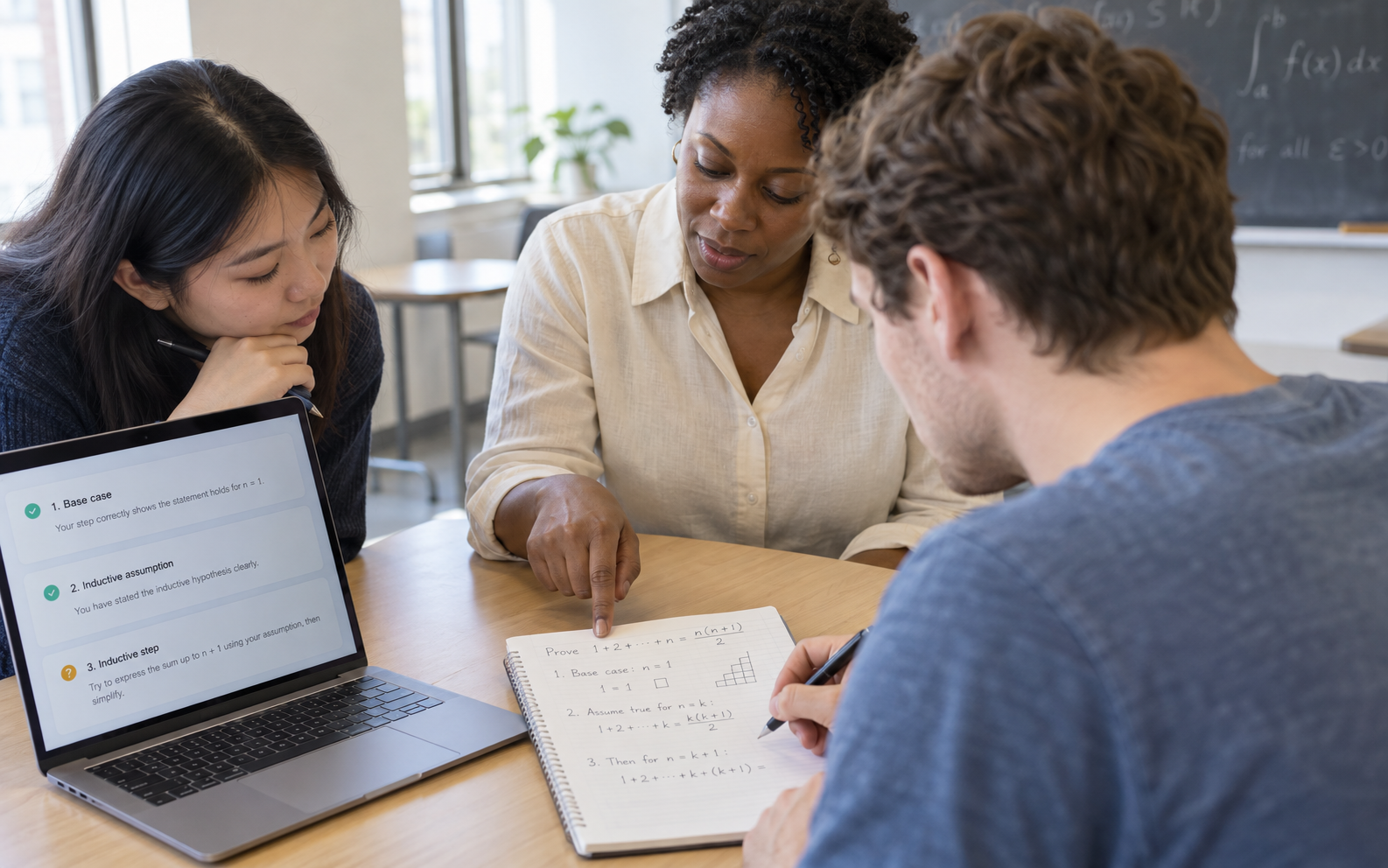
A mathematics lecturer and peer discuss a university student's induction proof beside a laptop showing feedback on the next step.
会议论文2026
会议论文 206

LeanTutor: Towards a Verified AI Mathematical Proof Tutor

Manooshree Patel, Rayna Bhattacharyya, Thomas Lu, Arnav Mehta, Niels Voss, Narges Norouzi, Gireeja Ranade

Proceedings of the AAAI Conference on Artificial Intelligence

LeanTutor connects a language model to the Lean theorem prover to support mathematical proof feedback. Its technical evaluation shows promising hints on a small selected benchmark, but also exposes a crucial boundary: a verifier can check the formal proof only after the learner's words have been translated correctly. The study did not test classroom learning, and feedback evaluation excluded failed translations. It is an early system design with explicit limitations, not a validated replacement for mathematics instruction.

Mathematics EducationIntelligent TutoringFormal Verification
阅读 500 字摘要 →
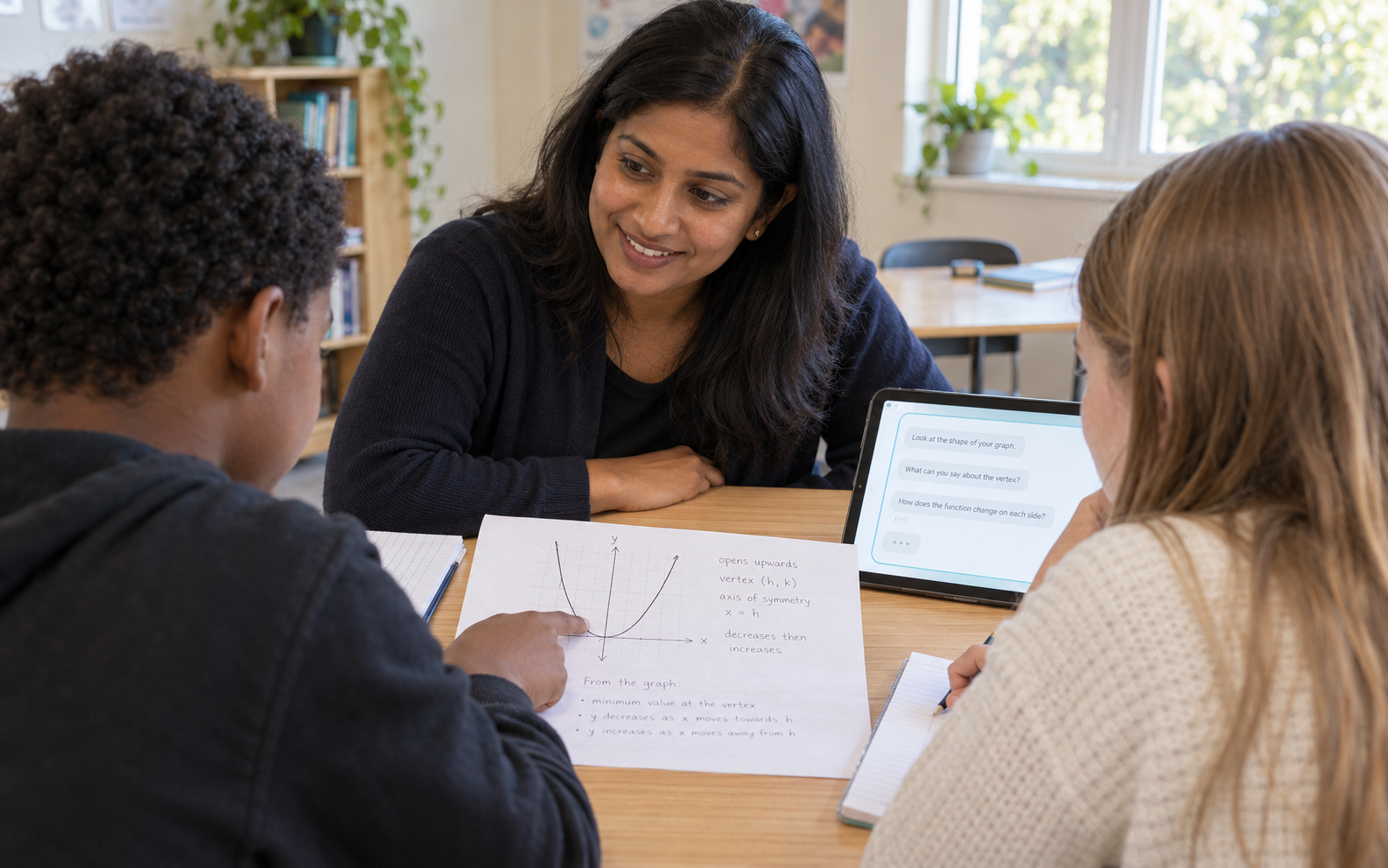

Two pupils discuss an upward quadratic graph with a teacher beside a tablet offering calm mathematical hints.
期刊论文2025
期刊论文 204

Designing Safe and Relevant Generative Chats for Math Learning in Intelligent Tutoring Systems

Zachary Levonian, Owen Henkel, Chenglu Li, Millie-Ellen Postle

Journal of Educational Data Mining

More than 8,000 learners used a structured growth-mindset conversation inside a mathematics tutor, giving researchers a practical view of moderation and response quality. Monitoring found no overtly objectionable model outputs, but identified subtler failures to respond appropriately to concerning student messages. A separate study found that educators preferred moderately guided textbook-supported answers. Neither safety monitoring nor response preference establishes improved learning, and both findings depend on the particular system and evaluation context.

Intelligent TutoringMathematics EducationAI Safety
阅读 500 字摘要 →