Thinking before consulting ChatGPT improved creativity on the next independent task
Sarah Shi Hui Wong, Sophia Xuefei Qiu
Educational Psychology Review
500 字摘要
An impressive AI-assisted idea is not necessarily evidence that its author has become more creative. Sarah Shi Hui Wong and Sophia Xuefei Qiu tested that distinction by measuring what participants could do after ChatGPT was removed. Their experiment compared unrestricted assistance with a guided sequence in which learners generated their own ideas before asking AI to improve them. The second, independent task is the crucial feature: it evaluates a consequence for the person beyond the quality of the assisted product.
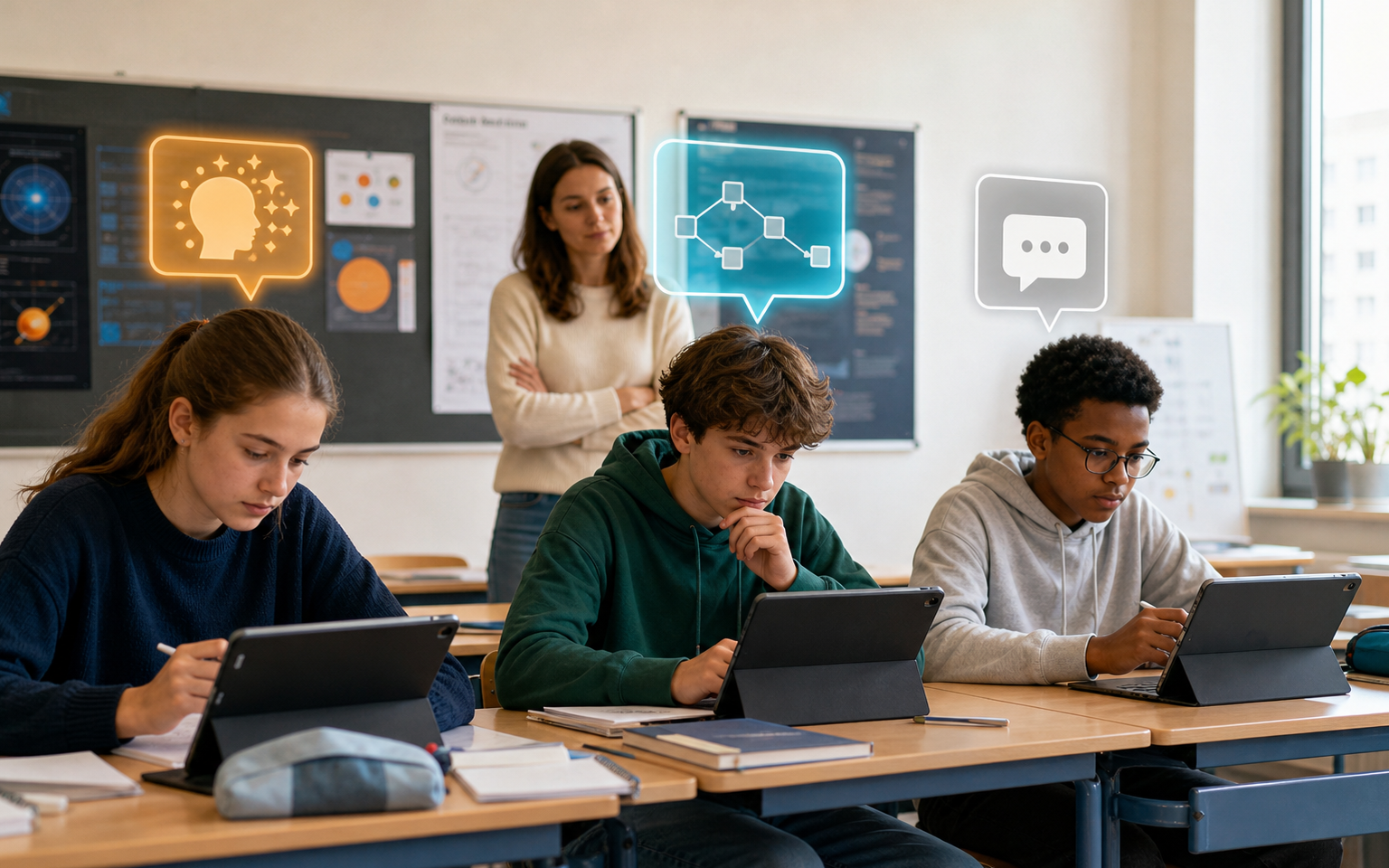
The analysis included 196 students from a university in Singapore, randomly assigned to human-only, general-AI or regulated-AI groups. Group sizes were 64, 67 and 65 respectively. Participants first completed a baseline creativity measure, then had twelve minutes to propose an improvement to an ordinary stuffed toy. The general-AI group could use ChatGPT freely. The regulated group first formed its own ideas and then received examples of prompts for developing, evaluating and improving them. The human-only group worked without AI assistance.
All groups subsequently completed a different twelve-minute invention task without ChatGPT or the sample prompts: propose a game to help adults learn foreign-language vocabulary. Two trained experts independently rated every response without knowing the participant's condition. Ratings distinguished originality, usefulness and elaboration. This separation is valuable because a longer or more detailed proposal can appear sophisticated without being especially novel or effective. The researchers also analyzed conversation transcripts to examine how participants actually engaged with the assistant.
During the assisted task, the general-AI group produced more original and useful solutions than the other groups. The pattern changed once assistance was removed. On the independent invention task, the regulated-AI group outperformed both comparison groups in originality and usefulness, while the general-AI group was comparable to the human-only group. For originality, the regulated group's advantage corresponded to reported standardized differences of about 0.52 against human-only and 0.48 against general-AI. The result therefore favors a particular collaboration sequence over unrestricted access in this setting.
The process analysis found more idea-development and evaluation prompts in the regulated group. Such prompts statistically mediated part of its later originality advantage, but that analysis does not independently prove the mechanism. The regulated intervention bundled initial self-generation, guidance and AI interaction. As the authors acknowledge, a group receiving the same guidance without AI would help isolate the assistant's contribution. The independent task also followed within the same experimental session. The evidence shows immediate carryover to a different creative task, not durable gains across weeks, subjects or professional design work.
For AIEDHK, the approach can inform a bounded classroom trial: preserve an initial human idea, use AI to question or extend it, and require the learner to justify the final choices. Assessment should then include a new task completed without assistance. A delayed follow-up and a similarly guided human-only comparison would make the evidence stronger. These are proposed extensions beyond the experiment. The practical lesson is to organize AI use around the development of a learner's thinking process, while testing independent performance rather than assuming that better assisted output automatically represents learning.