What Artificial Intelligence Is
A practical definition of AI that separates capabilities, methods, and human purposes without treating the technology as magic.
来源
完整课程摘要
Artificial intelligence is a broad name for computer systems that produce outputs associated with human cognitive abilities. Those outputs may be predictions, recommendations, classifications, generated language, images, plans, or decisions. A useful definition focuses on what a system does: it receives inputs, represents patterns in some computational form, and generates outputs that can influence a digital or physical environment. This avoids imagining AI as a single machine or a humanlike mind. A spelling checker, a recommendation engine, a face-recognition system, and a conversational model can all be AI, although their purposes and capabilities differ greatly.
Most contemporary AI is built from data and algorithms. An algorithm is a procedure for transforming information. In rule-based AI, people write many of the rules directly. In machine learning, developers specify a learning process and the system estimates useful patterns from examples. Neither approach understands the world exactly as a person does. Its performance depends on the task definition, training data, evaluation measures, computing resources, and conditions in which it is used. A system that performs very well on one benchmark may fail when language, users, or circumstances change.
It is helpful to separate narrow AI from the idea of general intelligence. Today’s deployed systems are designed or trained for bounded kinds of work, even when a general-purpose interface makes them appear flexible. They can combine several capabilities and operate across many topics, but fluency is not proof of consciousness, intention, or reliable reasoning. Outputs are statistical or programmed results, not guarantees of truth. Human users therefore need to judge whether a tool is suitable for the stakes, population, and context involved.
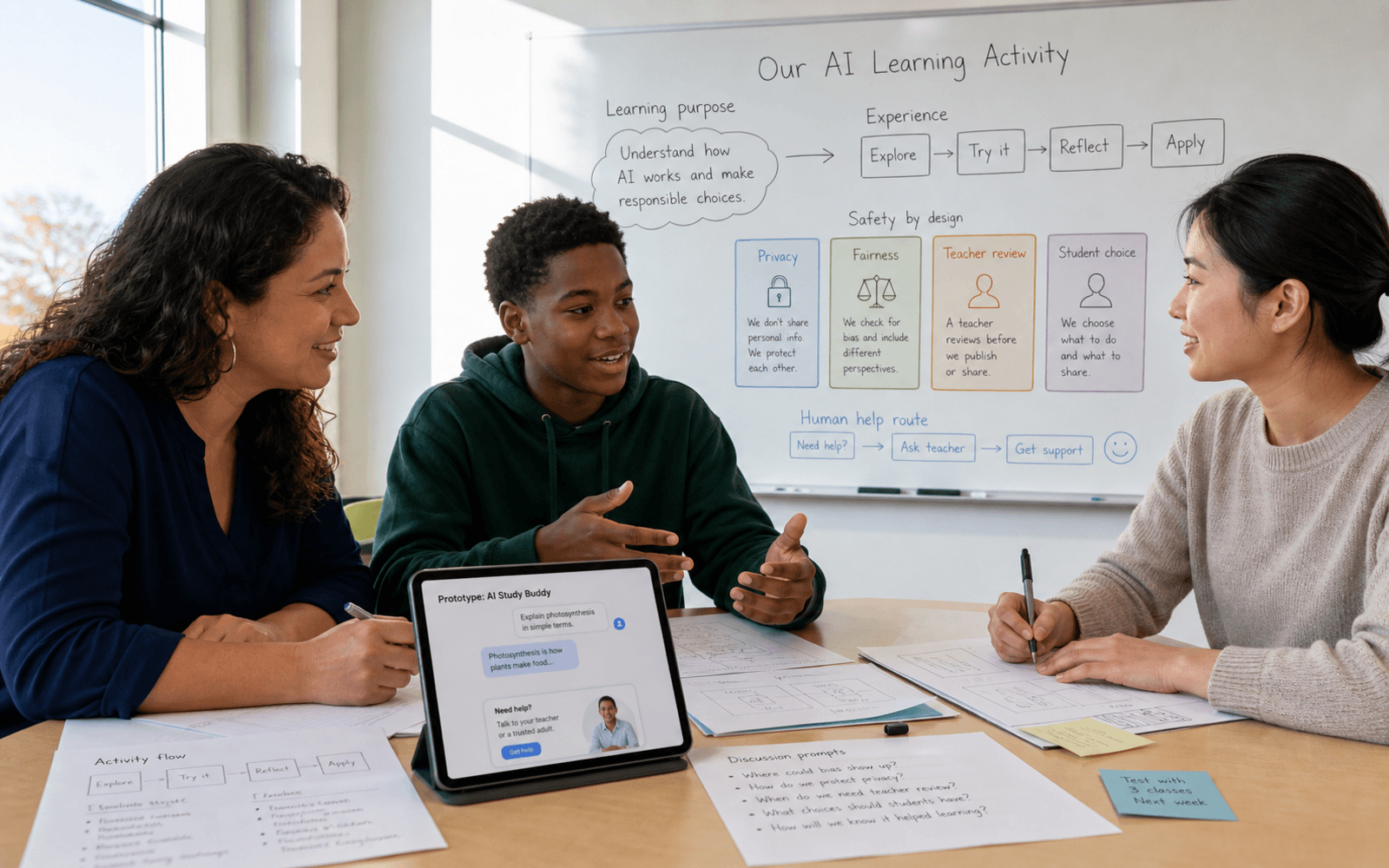
AI is also a sociotechnical system. The model is only one part. Data collectors, designers, teachers, institutions, policies, interfaces, and affected communities shape what the technology becomes in practice. Choices about labels, objectives, access, privacy, and acceptable error distribute benefits and harms. Responsible AI work asks who defines success, whose data are represented, how decisions can be challenged, and what human oversight remains. These questions are especially important in education, where a prediction or recommendation can affect opportunity and self-belief.
For learners, the strongest starting point is neither excitement nor fear but precise questioning. What task is the system designed to perform? What evidence shows that it works? Where did its information come from? What can it not do? Who remains accountable for the result? Those questions turn AI literacy into practical judgment. They also reveal why AI should usually support human purposes rather than define them. Understanding AI as designed, limited, and situated technology makes it easier to use its real strengths while noticing uncertainty, bias, and consequences. This definition also leaves room for future techniques: methods will change, but careful attention to purpose, evidence, context, and responsibility will remain essential.