Realistic Mathematics Education
Realistic Mathematics Education guides learners from meaningful situations and informal strategies toward increasingly general mathematical models, with deliberate teaching rather than unstructured discovery.
来源
完整课程摘要
A class can calculate a fraction correctly and still struggle to explain why the method works. Realistic Mathematics Education, usually called RME, approaches this problem by treating mathematics as an activity of organizing situations and relationships. Learners begin with contexts they can make sense of, develop informal methods, discuss those methods, and gradually construct more general mathematical tools. The teacher plans and guides this progression.
Realistic does not simply mean practical or taken from everyday life. A situation can be imaginable and meaningful without being a literal real-world task. A mathematical puzzle can therefore be a suitable starting point. What matters is whether learners can enter the situation and use it to develop the intended mathematics. An elaborate shopping story that obscures a relationship may be less helpful than a carefully chosen diagram.
RME distinguishes movement from a situation toward mathematical descriptions from further work within mathematics, such as comparing representations, organizing relationships, and generalizing. These are often called horizontal and vertical mathematization. Models are especially important. A drawing may initially represent a particular situation, then become a tool for reasoning about a wider family of problems. This change in the role of a model needs discussion; it does not happen automatically because a picture is present.
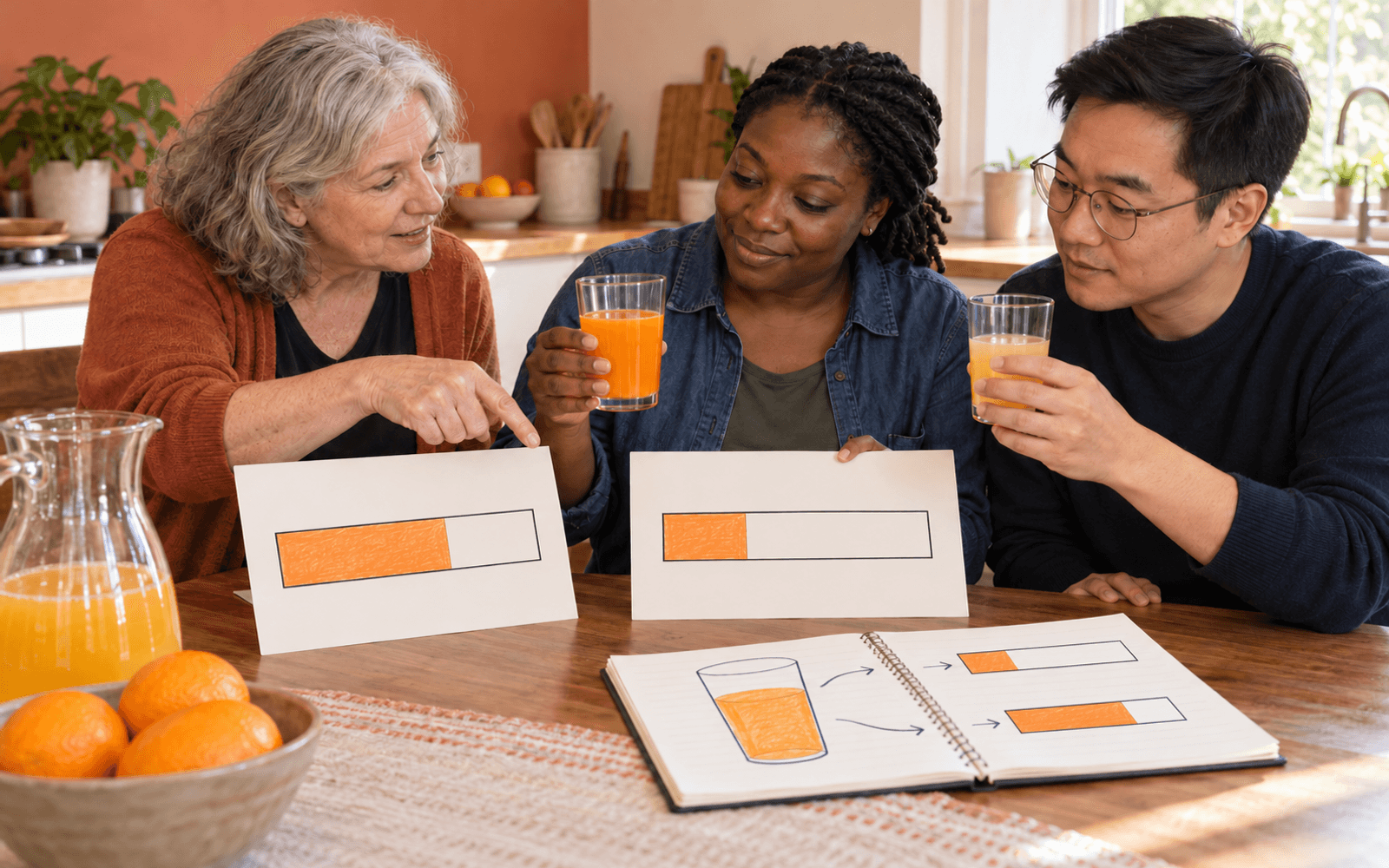
Imagine adult learners comparing two drink mixtures. One uses two cups of concentrate for three cups of water; another uses four cups of concentrate for six cups of water. Groups draw containers, make tables, and explain whether the taste should match. The teacher selects approaches that reveal the common multiplicative relationship. A ratio table initially describes these mixtures, then supports questions about unfamiliar quantities. Later, students express the relationship symbolically and identify which transformations preserve the mixture. The context provides an entry point while the mathematical structure becomes increasingly explicit.
Guided reinvention does not require each student to rediscover mathematics independently. Teachers anticipate likely strategies, choose productive contrasts, introduce notation, and connect contributions. Whole-class discussion should make the mathematical reasons visible rather than merely celebrate different answers. Some learners need additional examples, vocabulary support, or direct explanation before they can participate. Accessible materials and sufficient time matter because a supposedly familiar context may be unfamiliar to part of the class.
RME is a design tradition with a history and multiple implementations, not a guarantee that contextual problems always outperform other instruction. Its suitability depends on the mathematical goal, task sequence, prior knowledge, and teaching. Contexts can distract, and informal methods can remain disconnected from formal methods if the transition is weak. To evaluate a lesson, ask students to solve a new problem, explain the relationship, and use a representation outside the original story. Evidence of learning lies in increasingly flexible mathematical reasoning, not simply enthusiasm for the opening activity or the production of attractive drawings.