AI Governance in Education
How schools and universities translate values, law, evidence, roles, and risk into decisions across AI selection, piloting, use, monitoring, challenge, incident response, and retirement.
Источники
Полное резюме урока
AI governance is the set of structures, roles, rules, evidence, and practices used to direct and oversee artificial intelligence. In education, governance connects classroom purposes with privacy, safety, fairness, accessibility, academic integrity, procurement, security, and accountability. It is broader than a usage policy. A policy states expectations; governance determines who makes decisions, what evidence they require, how implementation is monitored, and what happens when a system fails.
The first step is an inventory. Institutions need to know which AI systems are approved, embedded in existing platforms, purchased by departments, or adopted informally. Each use should have a named educational purpose, owner, affected population, data classification, provider, model or service, and decision impact. A low-stakes brainstorming aid and an automated recommendation affecting student opportunity require different controls. Risk should be assessed in context rather than assigned only from a product category.
Governance spans a lifecycle. Before adoption, teams define success, consult affected learners and staff, compare alternatives, review contracts and data flows, and test accessibility and safety. A bounded pilot uses representative cases and clear stop conditions. During use, institutions monitor performance, subgroup effects, complaints, incidents, costs, and whether learning goals are met. Changes in models, policies, data, or users trigger reassessment. Retirement includes export, deletion, transition, and preservation of necessary records.
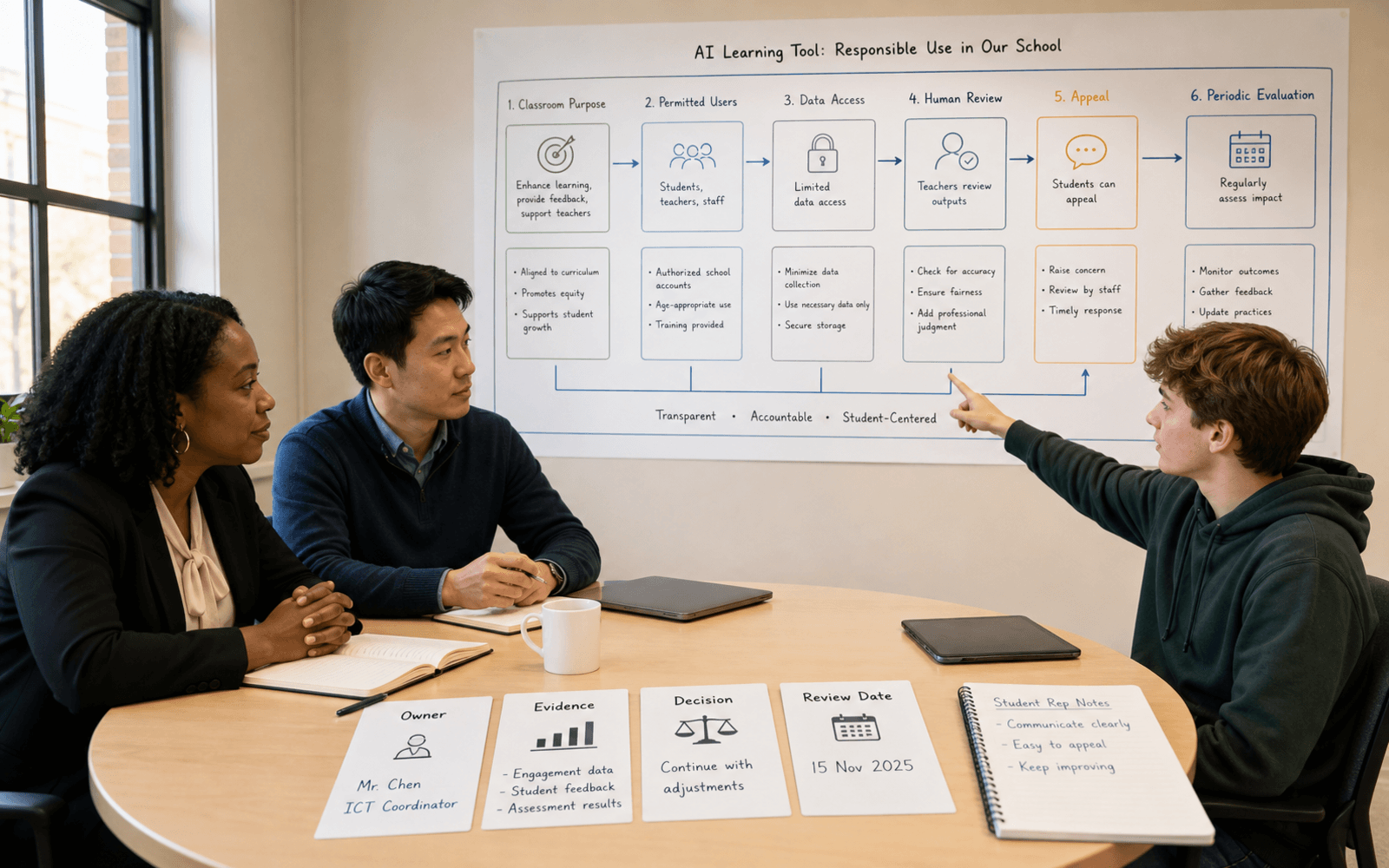
Roles must be explicit. Senior leaders set accountability and resources; educators define pedagogical fit; technical and security staff inspect infrastructure; data-protection and legal specialists review obligations; procurement staff enforce contract terms; learners and families contribute lived experience; and an identifiable person accepts or rejects high-impact decisions. Human oversight is meaningful only when the reviewer has time, competence, information, and authority to disagree.
In education, learners can form a governance council for a fictional AI tutor. They map stakeholders, classify intended uses, write success and harm indicators, examine a data-flow diagram, and design an appeal and incident path. They then decide whether to reject, pilot, approve with limits, or request evidence. Every decision names the accountable owner and review date. The exercise shows that governance is ongoing institutional learning rather than one permission form.
Good governance preserves educational agency. It makes approved and prohibited uses understandable, offers alternatives where possible, protects people who raise concerns, and publishes proportionate evidence. Frameworks such as the NIST AI Risk Management Framework, OECD AI Principles, and UNESCO guidance provide useful questions, but local institutions must translate them into operational decisions. Governance succeeds when values become observable controls and when people can challenge, improve, or stop a system before harm becomes routine. Annual review is insufficient for rapidly changing services; significant model, contract, feature, data-flow, population, or legal changes should trigger a documented reassessment before expanded use, with the outcome communicated to every affected school community.