← Voltar às notícias de pesquisa

#self-regulated learning

self-regulated learning

4 artigos

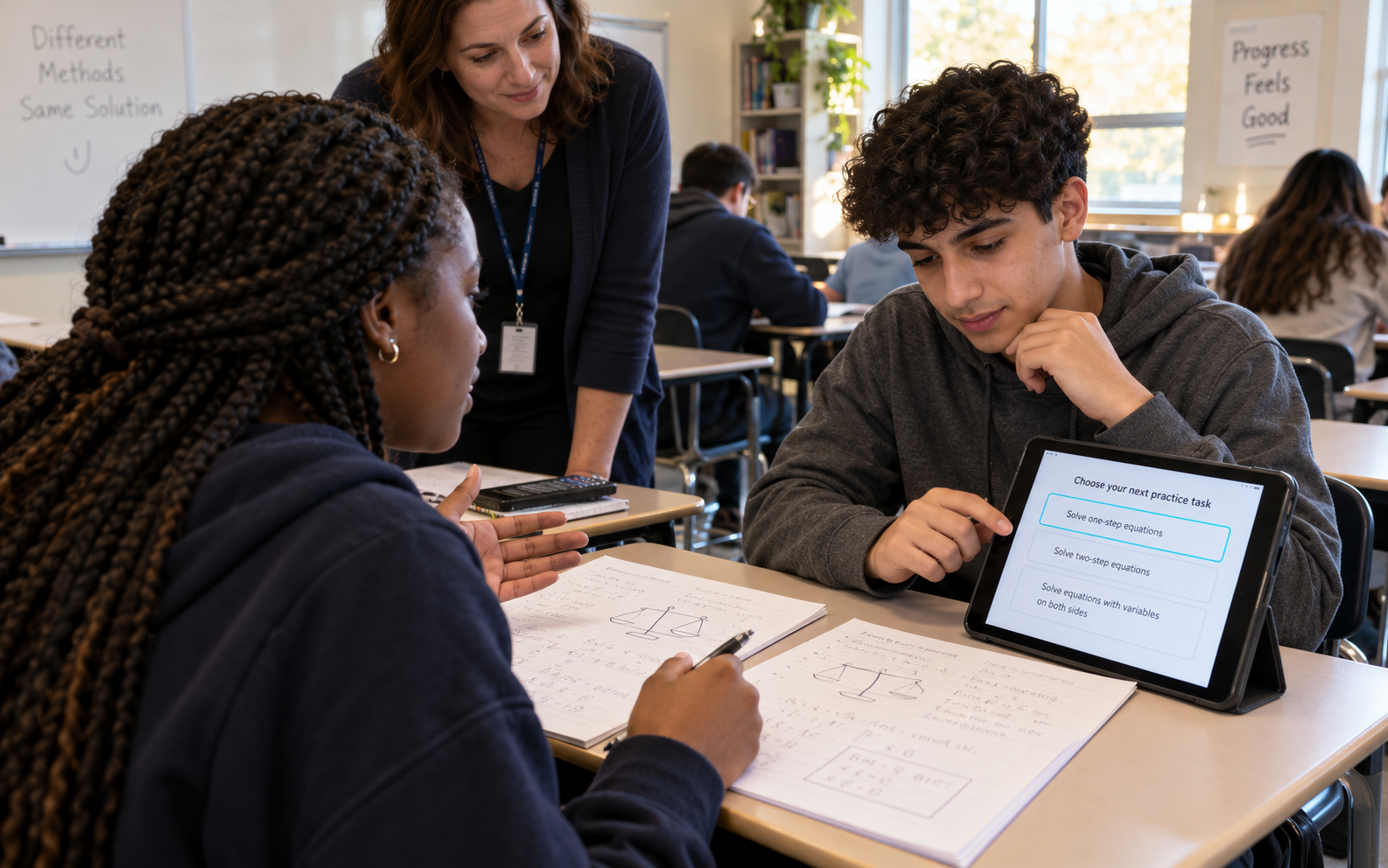
Two students discuss annotated algebra examples while choosing a next practice task on a tablet under a teacher's observation.
Artigo de revista2025
Artigo de revista 160

Motivational agents changed some algebra-learning choices without a significant overall test advantage

Man Su, Belle Dang, Andy Nguyen, Tomohiro Nagashima

npj Science of Learning

A randomized study analyzed 49 secondary pupils using an adaptive algebra system with or without motivational pedagogical agents. The agent condition showed descriptive gains, but its adjusted post-test advantage and error-rate difference were not significant. Interaction analyses highlighted different choices about optional learning activities and the importance of prior knowledge. The study illustrates why engagement paths deserve attention, while a small sample and 25-minute intervention cannot establish durable benefits from adding an agent.

adaptive learningpedagogical agentsalgebra
Ler resumo de 500 palavras →
Two design students compare an initial pull-along toy sketch with a revised axle drawing beside a small physical mock-up and laptop.
Artigo de revista2026
Artigo de revista 148

Thinking before consulting ChatGPT improved creativity on the next independent task

Sarah Shi Hui Wong, Sophia Xuefei Qiu

Educational Psychology Review

In a randomized experiment with 196 university students, unrestricted ChatGPT use improved an assisted product-design task but offered no advantage on the next unaided task. A guided group first generated its own ideas and then used ChatGPT to develop them; this group performed better independently afterward. The result supports investigating the sequence of human and AI work, while leaving delayed retention and the separate contribution of guidance unresolved.

human-AI collaborationcreativityindependent performance
Ler resumo de 500 palavras →
Editorial cover for a secondary-school randomized trial of motivational and cognitive generative-AI learning prompts
Artigo de revista2026
Artigo de revista 32

Enhancing School Students' Self-Regulated Learning through Generative AI Support: A Randomized Controlled Trial

Tim Fütterer, Lisa Bardach, Jochen Kuhn, Stefan Daniel Keller, Peter Gerjets

Educational Psychology Review

A preregistered three-arm trial with 371 German students in Grades 7–9 found limited advantages for theory-informed GPT-4o prompts over standard ChatGPT, highlighting that meaningful engagement and implementation quality matter more than adding prompts alone.

self-regulated learningsecondary educationrandomized controlled trial
Ler resumo de 500 palavras →
Diverse university students plan an AI-assisted assignment while a lecturer helps them compare self-reported AI literacy, self-efficacy and independent study strategies
Artigo de revista2026
Artigo de revista 80

Self-reported AI literacy and self-efficacy showed different relationships with student dependency in a 478-person survey

Hilit Maizel, Maya Kalman Halevi, Miri Sarid, Rony Tutian

Education Sciences

A survey of 478 Israeli higher-education students found that technical dimensions of AI literacy were positively associated with self-reported AI dependency, while AI self-efficacy, academic self-efficacy and effort regulation were associated with less dependency. Its cross-sectional design identifies relationships, not causal effects.

AI dependencyAI literacyacademic self-efficacy
Ler resumo de 500 palavras →