Product news: Claude for Teachers adds school-managed accounts and new mathematics checks
Anthropic
AI Product and Learning Report
Resumo de 500 palavras

Anthropic expanded Claude for Teachers to U.S. K-12 schools and districts on August 28, 2026. The new offering lets qualifying organisations manage educators and staff together, with institutional account controls, rather than relying only on individually verified teachers. It follows the product's July introduction. For schools, the news is therefore a change in how access and responsibility can be organised, alongside additional support for teaching practice.
The update includes lesson-preparation support and a skill for creating short checks of understanding, with mathematics available at launch. These resources were developed with Learning Commons. Anthropic also describes a planned evaluation with Detroit Public Schools Community District. An announced evaluation is a commitment to investigate, not a finding that teacher wellbeing or student achievement has improved. That distinction should remain visible when leaders discuss adoption with staff or families.
A short mathematics check can be valuable if it reveals how a pupil is thinking. It can be much less useful if it merely reproduces a familiar question with different numbers. Teachers reviewing generated items should ask which misconception each answer would reveal, whether more than one response is defensible, and what instructional decision would follow. The quality of the follow-up matters as much as the wording of the question.
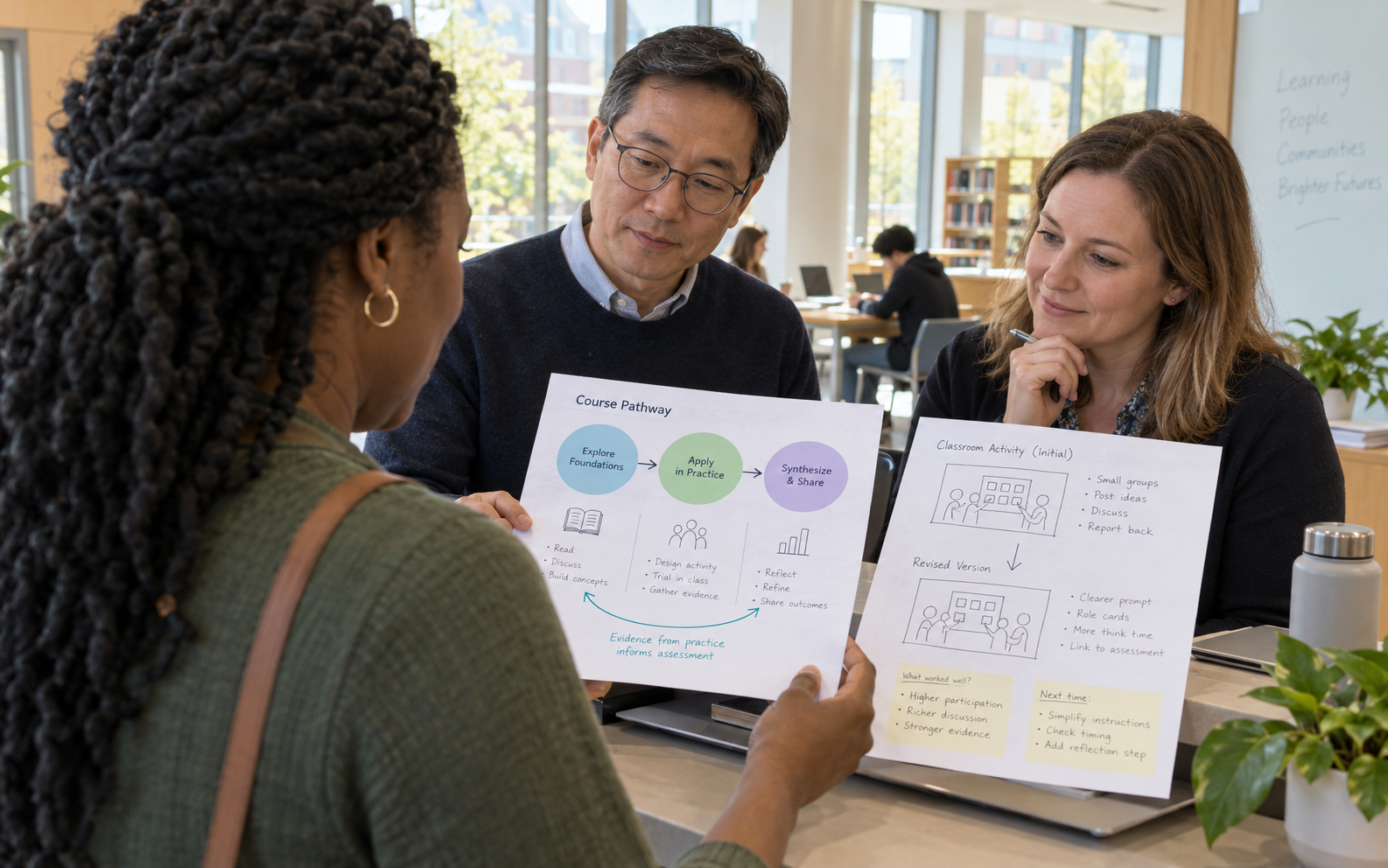
For example, a proposed departmental activity could give teachers the same fraction objective and ask them to review several generated questions. One item might measure calculation, another interpretation of a diagram, and another the ability to explain a comparison. Colleagues could identify what each item actually tests and revise ambiguous distractors. They would then use a small set in their normal teaching, examine the responses, and document what they changed in the next lesson.
OpenAI's August 26 announcement similarly expands ChatGPT for Teachers partnerships across U.S. school systems. Gemini's earlier Classroom update connects study prompts with course materials under administrator controls. These are distinct institutional approaches, with different account arrangements and educational functions. Their availability should not be flattened into a single claim that every pupil can use every service. The Anthropic offer discussed here is explicitly for eligible U.S. schools and districts; it does not establish eligibility for Hong Kong schools.
Central management can also change professional collaboration. A school could agree where reviewed teaching materials are stored, who maintains them, and how a correction reaches colleagues who copied an earlier version. New staff need a clear way to learn these practices, while departing staff should not leave essential resources tied only to a personal account. Such arrangements are ordinary educational infrastructure, and they deserve attention alongside the assistant's visible features.
For school leaders, a useful pilot would therefore combine access with a modest shared review process. Teachers can record the original objective, the generated draft, the changes they made, and the classroom evidence that informed those changes. Leaders can consider preparation time and staff experience without assuming that more generated material means better instruction. The expansion creates an opportunity to support teacher judgment collectively, provided the school evaluates the material and practice that result.