Generative Learning Strategies
Generative learning involves selecting important information, organizing it and connecting it with prior knowledge. Learner-created explanations, diagrams and examples need guidance and checking to make that thinking productive.
Fontes
Resumo completo
Generative learning describes the work learners do to make sense of information. They select what matters, organize it into a coherent structure and connect it with relevant knowledge they already have. The word generative refers to the learner's meaning-making. It does not require a generative AI system, an original artistic product or a lesson without teacher explanation.
Wittrock's account emphasized learners constructing relationships between incoming information and existing knowledge. Fiorella and Mayer later reviewed strategies including summarizing, mapping, drawing, imagining, self-testing, self-explaining, teaching and enacting. These activities can invite productive mental work, but their outward form is not proof that such work occurred. Copying a concept map or repeating an explanation can produce a polished artifact with little new understanding.
The teaching challenge is to choose a representation that makes important relationships inspectable. A drawing can help with a spatial process, while an explanation may reveal why a mathematical step follows. Learners often need examples, prompts and feedback to perform the strategy well. Asking novices to create an elaborate diagram while also learning unfamiliar content may overwhelm them. A small, supported task can expose more useful thinking than an ambitious product with unclear criteria.
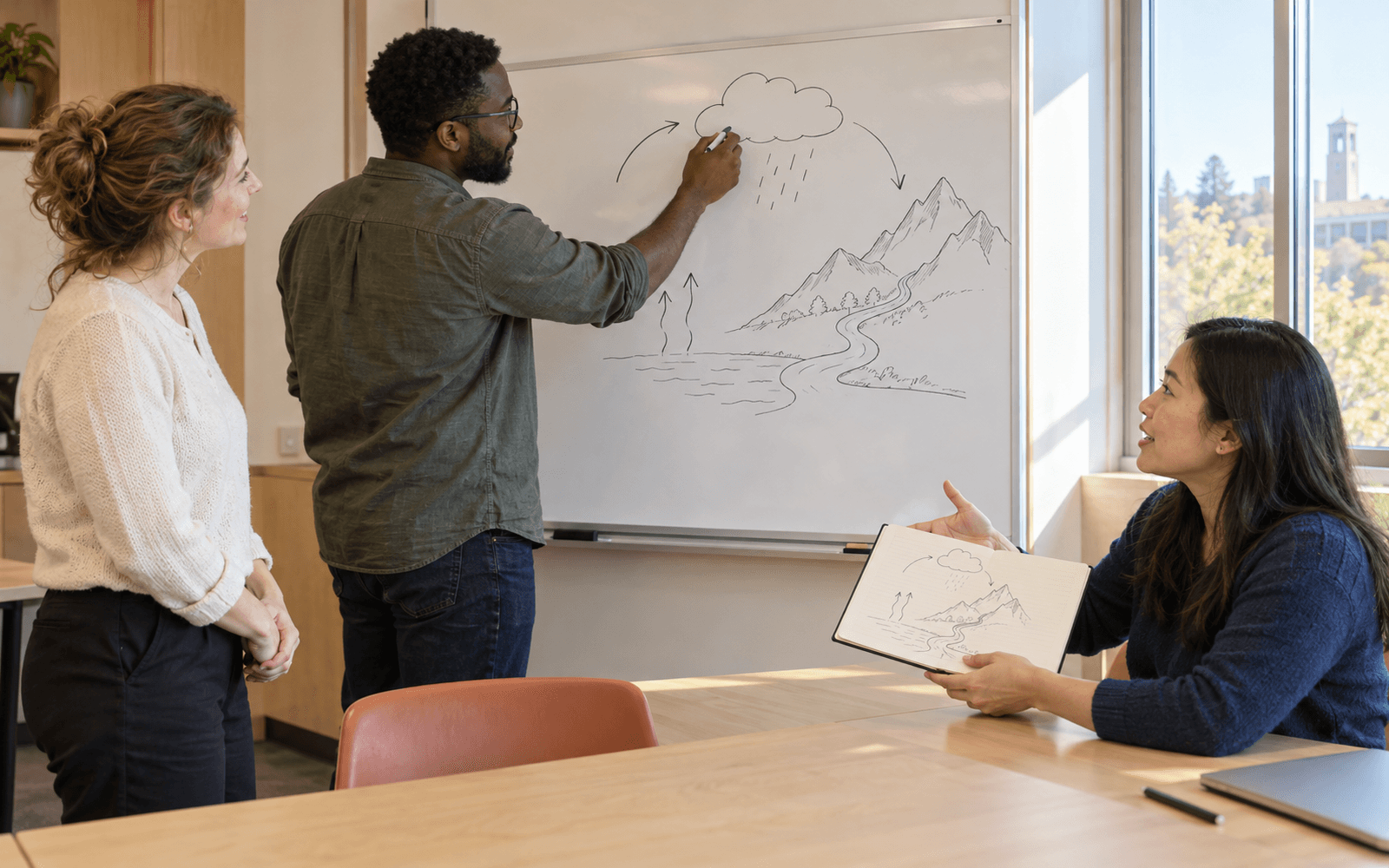
Consider an illustrative lesson on the water cycle. After a brief explanation, pairs draw how water moves between a puddle, the air, clouds and a hillside. Each arrow must stand for a process that the pair can explain. The teacher asks where the water is when it cannot be seen and what would change if the air became cooler. The drawing becomes a starting point for examining reasoning, rather than an exercise in matching a decorative picture.
Next, learners compare their diagrams with a reliable explanation and mark one revision. They explain what evidence justified the change. A learner who drew a direct arrow from cloud to underground water might add an intermediate process or clarify the conditions involved. The teacher can offer a partially completed diagram or an oral response option when drawing skill or language demands would otherwise hide understanding. The intellectual goal remains explaining the relationships.
An AI tool could supply an alternative explanation for critique after learners have made their own attempt. Students might identify an omitted process, an unsupported connection or a helpful example. If the tool produces the final diagram before students make any decisions, the teacher needs another way to see their reasoning. A useful prompt asks the learner to justify a change, not simply approve an attractive answer.
Assessment should examine the content of the explanation and its use in a new situation. Later, students could explain condensation on a cold window without their original diagram. That task asks whether the relationships have become available beyond the initial activity. It also helps separate a successful classroom performance from durable understanding.
Generative strategies are therefore tools for designing and observing learning, not a checklist to maximize activity. Choose a strategy because it serves a particular concept, support learners in using it and inspect what they produce. Revise the task when the representation obscures the idea or when students cannot explain the connections they have drawn.