AI-supported climate futures activities accompanied greater hope, without isolating the contribution of AI
Shu-Chiu Liu, Pierre-Alexandre Château
Journal of Science Education and Technology
500단어 요약
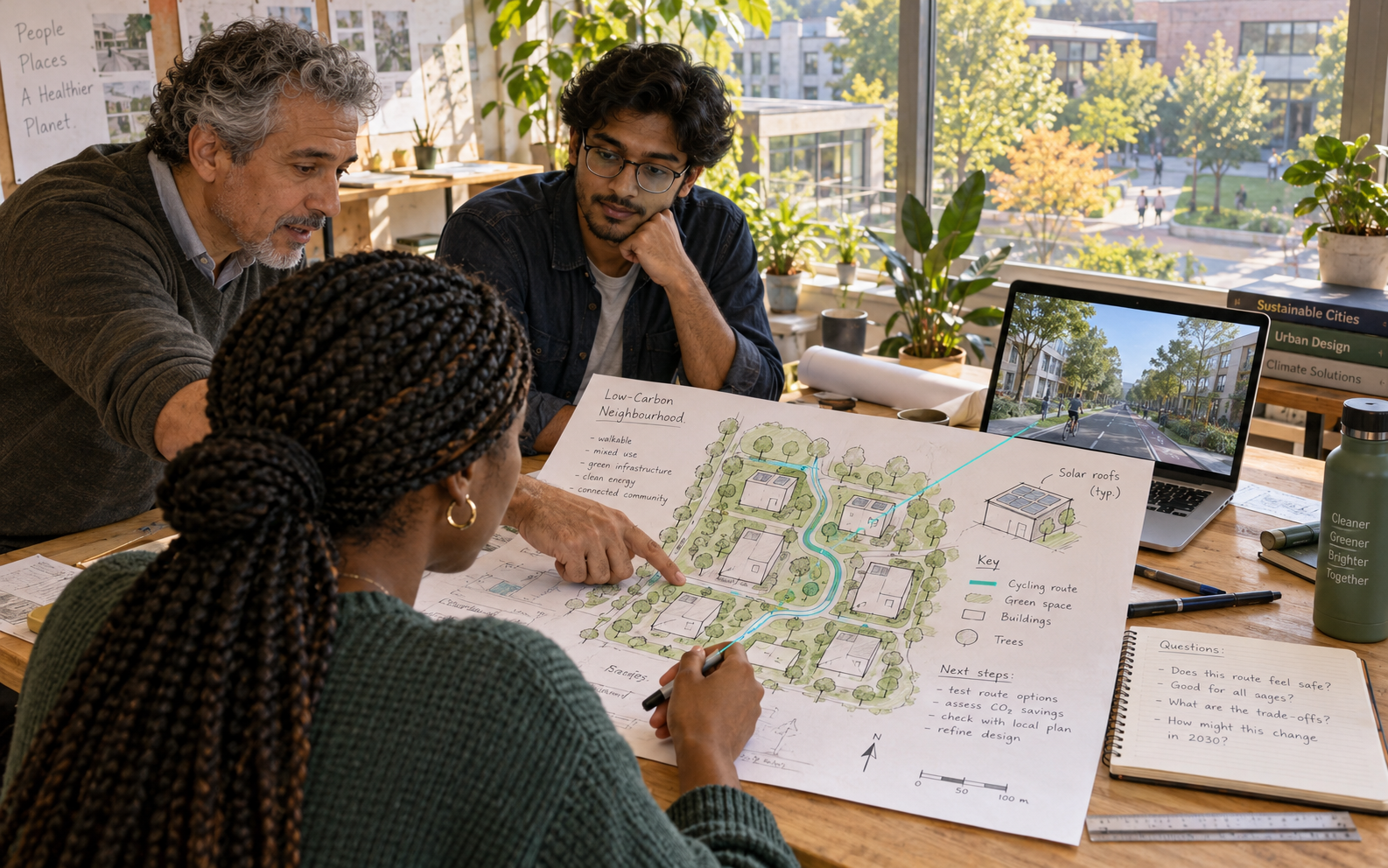
Climate education asks learners to understand serious risks while seeing meaningful possibilities for action. Shu-Chiu Liu and Pierre-Alexandre Château examined a teaching module that addressed this challenge through futures thinking, using generative AI to help students represent a desirable carbon-neutral future. Students reported more hopeful perspectives after the instruction. The evidence concerns a complete educational sequence, however, rather than an isolated test of whether image or text generation itself produces agency or changes environmental behavior.
The module formed the final part of an introductory university climate-change course. It followed instruction on scientific concepts and the ecological and social dimensions of climate change. Two consecutive semester cohorts experienced similar content and structure, with one using image generation and the other using text generation. Matched data were available for 58 students in the image group and 62 in the text group. The comparison was therefore between cohorts, not random allocation of students to tools within the same class.
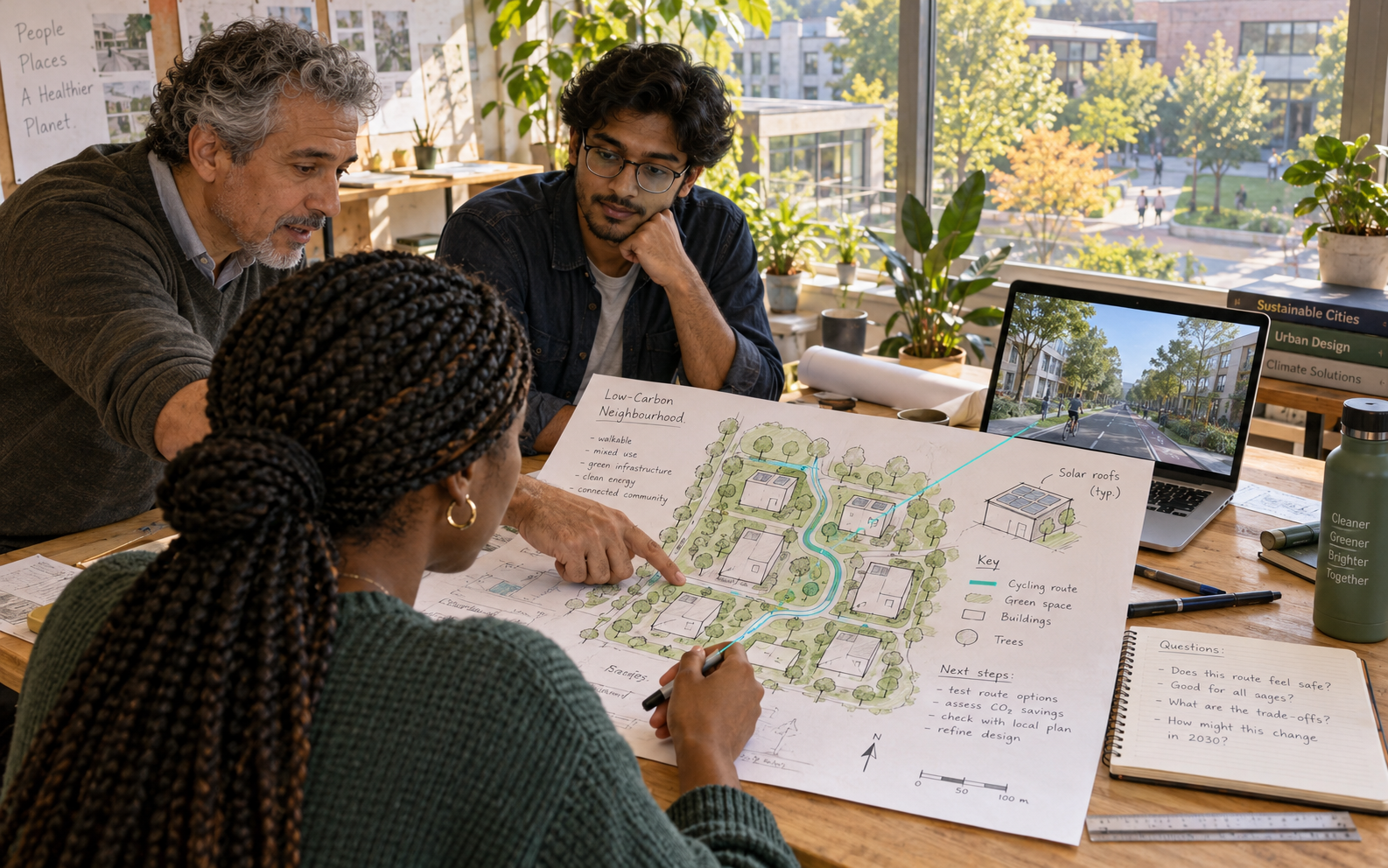
Across approximately eight hours, students explored climate projections, discussed drivers of different futures, and developed their own visions of a sustainable city. They were asked to imagine life in 2053 and translate prior discussions about energy, transport, consumption, and policy into concrete features of that future. AI entered after this preparatory work. Students refined prompts, compared outputs, and shared their scenarios with classmates, keeping scientific preparation and peer discussion within the activity rather than relying on generation alone.
The researchers combined word-association responses, climate-hope and self-perceived-action questionnaires, and written reflections. Both cohorts expressed more positive future perspectives and higher overall hope after instruction. The image group also improved on confidence in personal influence and willingness to act, while neither group significantly improved on perceived knowledge of action possibilities. These outcomes are not interchangeable: a shift in emotional outlook or declared willingness is different from demonstrating knowledge, undertaking an action, or sustaining that action later.
Student reflections described useful aspects of generation, including speed, imaginative support, and the ability to make an idea easier to discuss. They also identified limitations. Images sometimes lacked realism or failed to capture intended details, while generated narratives could feel shallow or dependent on the input supplied. Those comments provide evidence of participants noticing constraints. They do not by themselves establish a measured improvement in general AI literacy, nor show that the generated scenarios were scientifically reliable without teacher and learner scrutiny.
The study’s design limits comparisons between modalities and claims about causation. Cohorts came from different semesters, and there was no equivalent version of the module without AI. The observed changes could reflect the broader teaching, discussion, futures orientation, or differences between cohorts as well as AI-supported work. Outcomes relied substantially on self-report and immediate reflections, with no direct observation of later climate action. Larger change in one group also does not automatically demonstrate a statistically established advantage over the other group.
For AIEDHK, the useful design idea is to place generation after learners have gathered evidence and articulated their own values and proposals. A class could then examine which features of a generated future are plausible, what assumptions support them, and what actions would be needed to make them possible. Any local evaluation should track those reasoning steps and subsequent activity separately from hopeful feelings. This approach treats the study as a model for structured exploration, while leaving claims about durable learning and behavior open to testing.