AI feedback reached student groups, but fewer than one in three actionable comments appeared in their revisions
Guoqing Lu, Huimin Zhang, Shen Ba, Lan Yang
Journal of Educational Computing Research
500단어 요약

An open-access study by Guoqing Lu and colleagues follows the journey from AI feedback to group revision. Across an 18-week course, 114 geography pre-service teachers at one Chinese university worked in 16 groups and received three feedback rounds. Four conditions varied feedback detail and focus. Teaching assistants reviewed GPT-4 outputs before distribution, so the intervention combined human and AI work.
Researchers compared feedback with subsequent task sheets and projects. Of 965 actionable comments, 271 were implemented, 450 were not, and 244 had ambiguous status. The association between the four feedback conditions and implementation status was not statistically significant. Network analysis linked implemented comments with combinations of identified problems, suggestions, and solutions. Reflections included both appreciation and concerns about impractical or vague advice.
These findings describe uptake in a particular collaborative setting. They do not establish that a chatbot independently improved learning. The authors identify the single institution, inference from submitted artifacts, and teaching-assistant mediation as limitations. An observed revision also cannot settle whether students understood its rationale. The educational question raised by this evidence is what teachers should ask learners to do between receiving a comment and submitting another version.
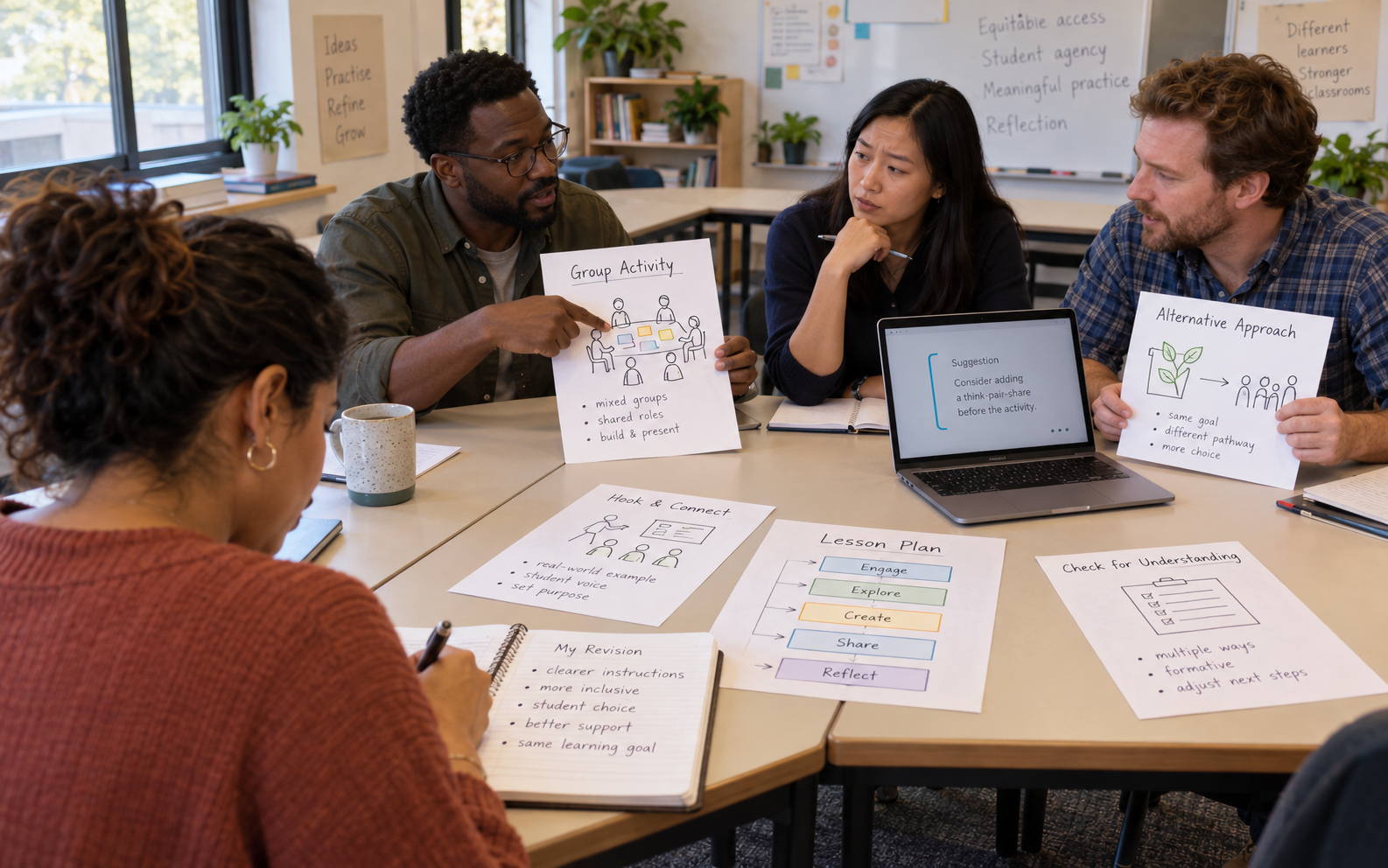
For AIEDHK, one possible classroom design is a short decision record attached to a group project. Each team would select two consequential comments, locate the passage or decision being challenged, and explain whether it accepted, modified, or rejected the advice. A rejected suggestion would require a reason grounded in the assignment and available evidence. This is an editorial proposal, not a procedure validated by the study. Its purpose would be to give teachers a manageable view of deliberation without requiring every conversation to be transcribed.
Consider a geography education team preparing a lesson about flood risk. A feedback system might suggest adding a map, but the group still has to decide which map, whose risk it represents, and whether its scale fits the teaching objective. Learners could compare two candidates and annotate the tradeoff before choosing one. The resulting record would show an instructional decision that a simple count of accepted comments misses. It would also leave room for a well-supported refusal when a suggested addition would distract from the lesson.
Assessment would need to follow the same logic. A teacher could compare the original and revised explanation, then ask an individual group member to justify one change without consulting the feedback. A local pilot could record time spent, unresolved disagreements, and the quality of those explanations. It should not set a target that every suggestion must be accepted, because that would turn selective judgment into compliance. Whether this activity improves later independent work would remain a separate question requiring appropriate comparison and follow-up.
For platform designers, the proposed workflow suggests a useful place for a small feature: connecting a comment to the learner’s stated decision and the relevant revision. The interface could allow acceptance, modification, or rejection, with the original wording retained for review. Teachers could inspect a few meaningful decisions instead of a large approval percentage. Such a design would make feedback use more inspectable while keeping its educational value open to evaluation.