From generative-AI feedback to sport skill learning: The roles of perceived competence and autonomous motivation in university physical education
Jiehao Dong, Zhen Zhang
Frontiers in Psychology
500단어 요약
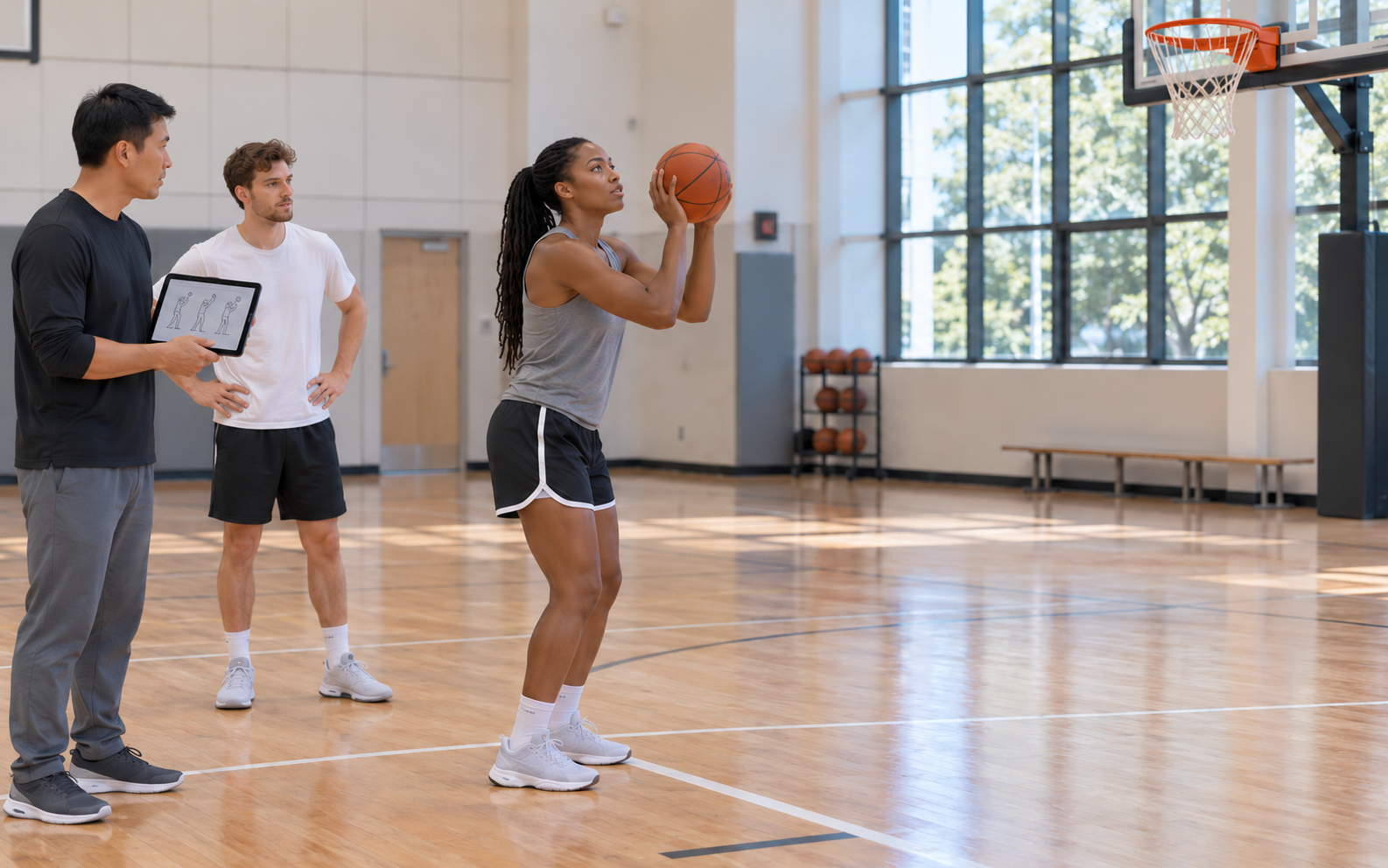
AI-supported learning research usually measures words, answers, or code. A university basketball trial instead examined a physical skill: free throws. Students assigned to a structured generative-AI feedback programme performed better than those receiving conventional instructor feedback, and the difference remained detectable two weeks after instruction. The important qualification is that the study compared complete feedback arrangements, not the source of an otherwise identical message.
Jiehao Dong and Zhen Zhang recruited 240 undergraduates and randomly assigned 120 to each condition during an eight-week physical-education unit. Both groups followed the same basketball curriculum, practice volume, technical rubric, and scheduled feedback frequency across sixteen sessions. The experimental package combined written AI-generated feedback, a standardized format, individualized explanation, an interface, and a brief action-intention step. The comparison package used the course's conventional oral instructor feedback.
The system worked from structured performance information, including recent shooting results and movement indicators, rather than inviting unrestricted chatbot conversation. Learners received guidance tied to a common technical rubric and a next action to attempt. This design connects the feedback to observable practice, but several features changed together. Written versus oral presentation, opportunities to reflect, personalization, novelty, and the action plan could all contribute to the difference alongside the generative model.
Skill was assessed at baseline, immediately after instruction, and fourteen days later without technical feedback. Shooting accuracy came from thirty free throws under standardized conditions. Two independent instructors, unaware of the assigned condition, rated anonymized videos using a five-domain technique rubric. Delayed accuracy and technique were the co-primary outcomes, with the analysis requiring both to favor the experimental package after adjustment for multiple testing.
Both groups improved. Immediately after the programme, accuracy had increased by 18.6 percentage points in the AI-package group and 11.6 points in the comparison group. The model-estimated difference in improvement was 6.7 percentage points. At the delayed test, the adjusted advantage was 6.1 percentage points for shooting accuracy and 1.63 points for technique quality. Both delayed outcomes met the study's statistical criterion. Of the original 240 students, 229 completed the delayed assessment; analyses retained original group assignment and examined missing-data sensitivity.
A higher score after two weeks is evidence of retained performance over that interval, but it is not evidence of slower forgetting. Both groups declined modestly after the immediate test, and the differences in their declines were not statistically detectable. The trial also found higher perceived competence and autonomous motivation in the experimental condition. Because the proposed psychological mediators were measured at the same mid-course occasion, their statistical associations cannot establish a causal sequence from competence to motivation to skill.
For physical-education teachers, the result makes a concrete feedback design worth examining: record a small set of relevant observations, explain a correction, and ask the learner to plan the next attempt. Whether AI is necessary for that design requires another comparison. The study concerns one basketball unit, a short retention interval, and a bundled intervention. It does not demonstrate transfer to other sports, durable long-term learning, or replacement of a teacher's observation and judgment.