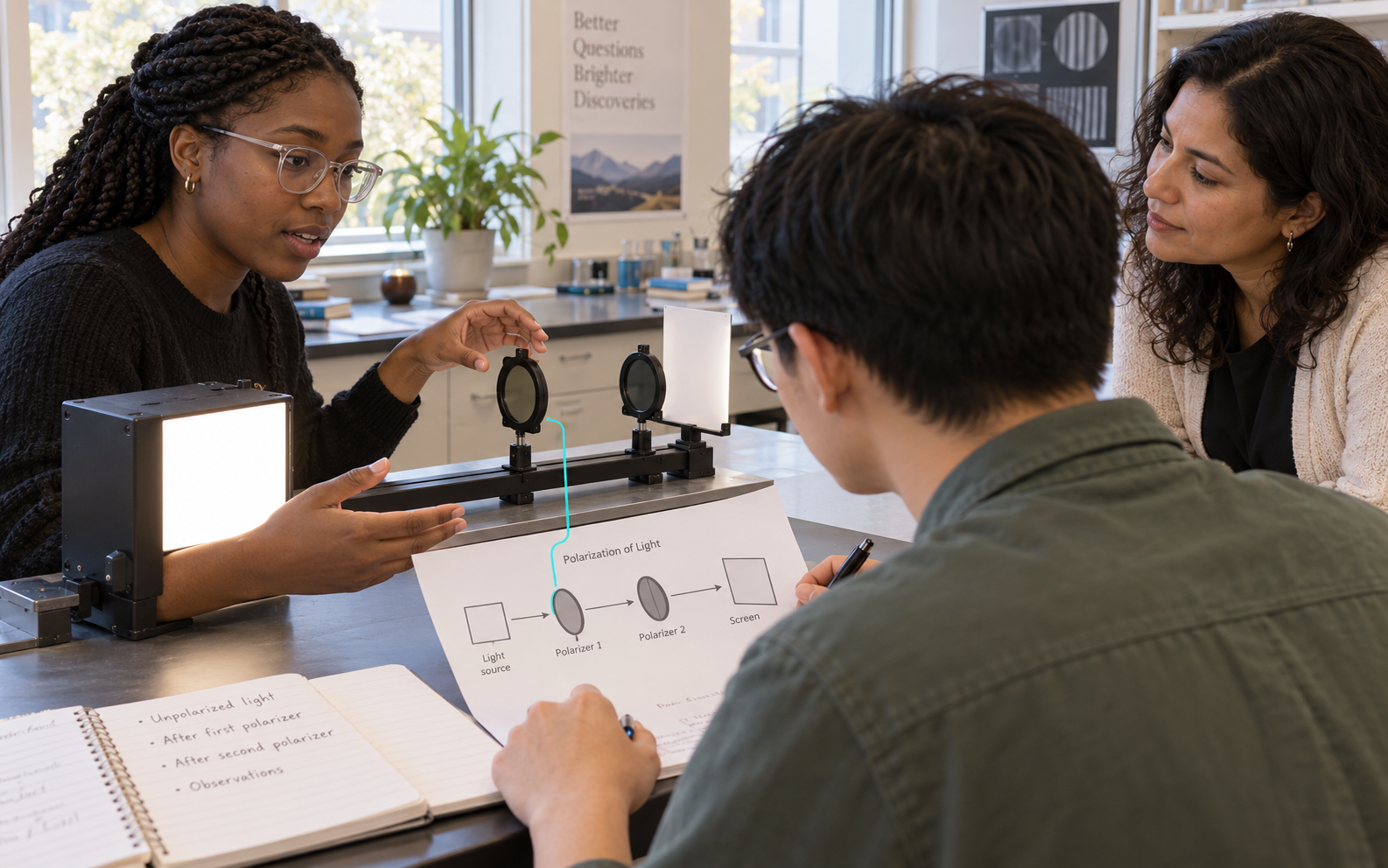
AI feedback improved answers during an augmented-reality physics lab, while independent transfer was not assessed
Atakan Coban, David Dzsotjan, Stefan Küchemann, Jürgen Durst, Jochen Kuhn, Christoph Hoyer
EPJ Quantum Technology
500단어 요약
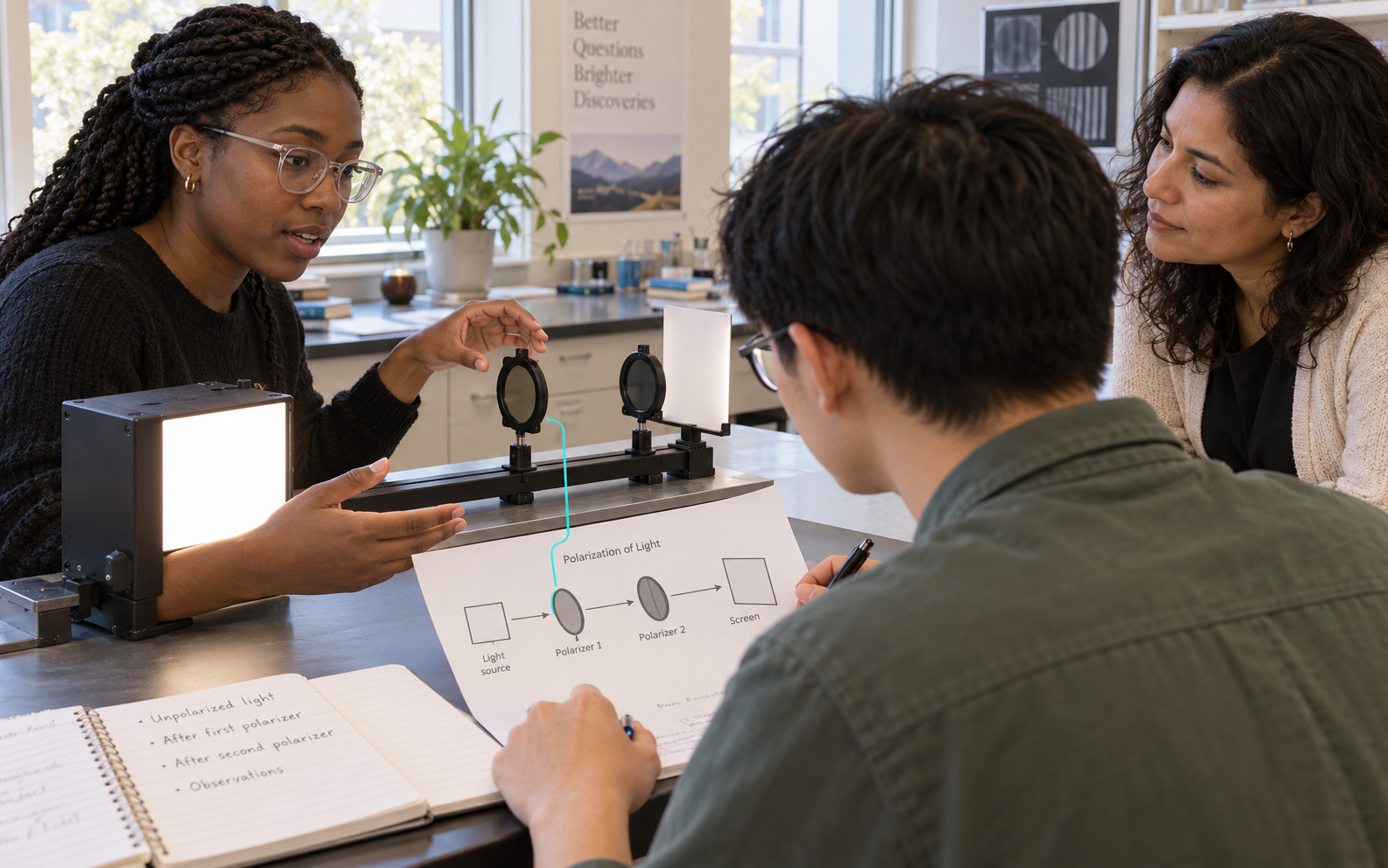
In a physics laboratory, a learner may need to connect an abstract model with the behavior of real equipment. Atakan Coban and colleagues studied whether spoken AI feedback could help make that connection during an augmented-reality activity about quantum cryptography. The system overlaid representations on a physical apparatus and asked groups to explain key steps. The research is distinctive because it examined both the answers students produced and where they looked while discussing the problem, rather than treating interaction with a visualization as evidence of understanding by itself.
Twenty-one student groups at a German university participated in an approximately three-hour laboratory experiment. The groups were assigned to two sequences: one received GPT-4 feedback on questions one and three, and the other on questions two and four. All completed the same experimental steps. The physical activity was an analogy demonstration of a quantum-key-distribution protocol, while augmented-reality glasses displayed relevant representations. Spoken responses were converted to text, and the AI's feedback was converted back to speech so that the group could hear and discuss it.
The feedback prompts included the question and a reference answer. The model was instructed to compare the group's explanation with that reference and guide correction without simply revealing the answer. In the no-feedback condition, it asked the question and then directed the group onward. Groups could receive multiple feedback rounds while developing their response. The comparison therefore tested the opportunity to revise an explanation with adaptive guidance within the activity, not whether AI feedback was better than expert human feedback or whether the resulting understanding persisted independently.
The analysis favored questions receiving feedback: groups improved their explanations during the interaction. Gaze records suggested that feedback on conceptual questions drew attention toward virtual representations, whereas feedback on experimental procedures drew attention toward physical materials. These observations offer hypotheses about how feedback and representations work together. Looking at a relevant object, however, does not demonstrate that the learner interpreted it correctly. The gaze analysis also used an exploratory significance threshold of .10 because of limited sample size, requiring particular caution when interpreting individual effects.
The study was small and participation voluntary. Its measured learning outcome consisted of responses produced during the supported laboratory process, with no delayed or unfamiliar task performed independently. The model's behavior reflected a specific period in 2024, and students were initially unfamiliar with the headset. Some reported discomfort from its weight or heat later in the activity. Because all groups used the augmented-reality environment, the study does not isolate the value of AR itself. Nor can the findings establish that adding both technologies will benefit other subjects or classroom settings.
For AIEDHK, the practical design question is whether feedback directs learners back to evidence they can inspect. A laboratory pilot could ask students to revise an explanation using an observation, diagram or measurement, then test the same principle through a new situation without guidance. Teachers should separately review the factual quality of feedback and the usability of the equipment. These are proposed extensions beyond the experiment. The useful contribution is a coordinated feedback-and-representation workflow, whose educational value still depends on what learners can explain after the support is removed.