Product news: OpenAI's learning report shows demand for help beyond the classroom, while outcomes remain an open question
OpenAI
AI Product and Learning Report
Ringkasan 500 kata
OpenAI published “Learning never stops” on August 26, 2026, describing how ChatGPT is used for learning beyond scheduled lessons. The company reports up to 70 million weekly conversations across age groups devoted to checking understanding and practising, alongside large seasonal volumes of schoolwork-related messages. These are measures of platform activity. A conversation about learning can contain useful practice, a copied answer, an unresolved misconception, or several of these at different moments.
That distinction changes the question a school should ask. Counting access establishes that students are seeking help, but it does not show whether the help is accurate, whether the student understands it, or whether it remains useful without the tool. Conversation counts and message counts are also different units; neither is a count of individual learners. A school should resist turning headline volumes into a local estimate of how many pupils are benefiting.
The timing of help is nevertheless educationally relevant. A question can emerge while a student is revising after school, drafting in a second language, or encountering an unfamiliar term in a textbook. If the student waits several days to ask, the original difficulty may be hard to reconstruct. A proposed learning routine is to save the question, the attempted solution, and the explanation received, then revisit the point in class. That record makes after-school assistance available for teacher discussion.
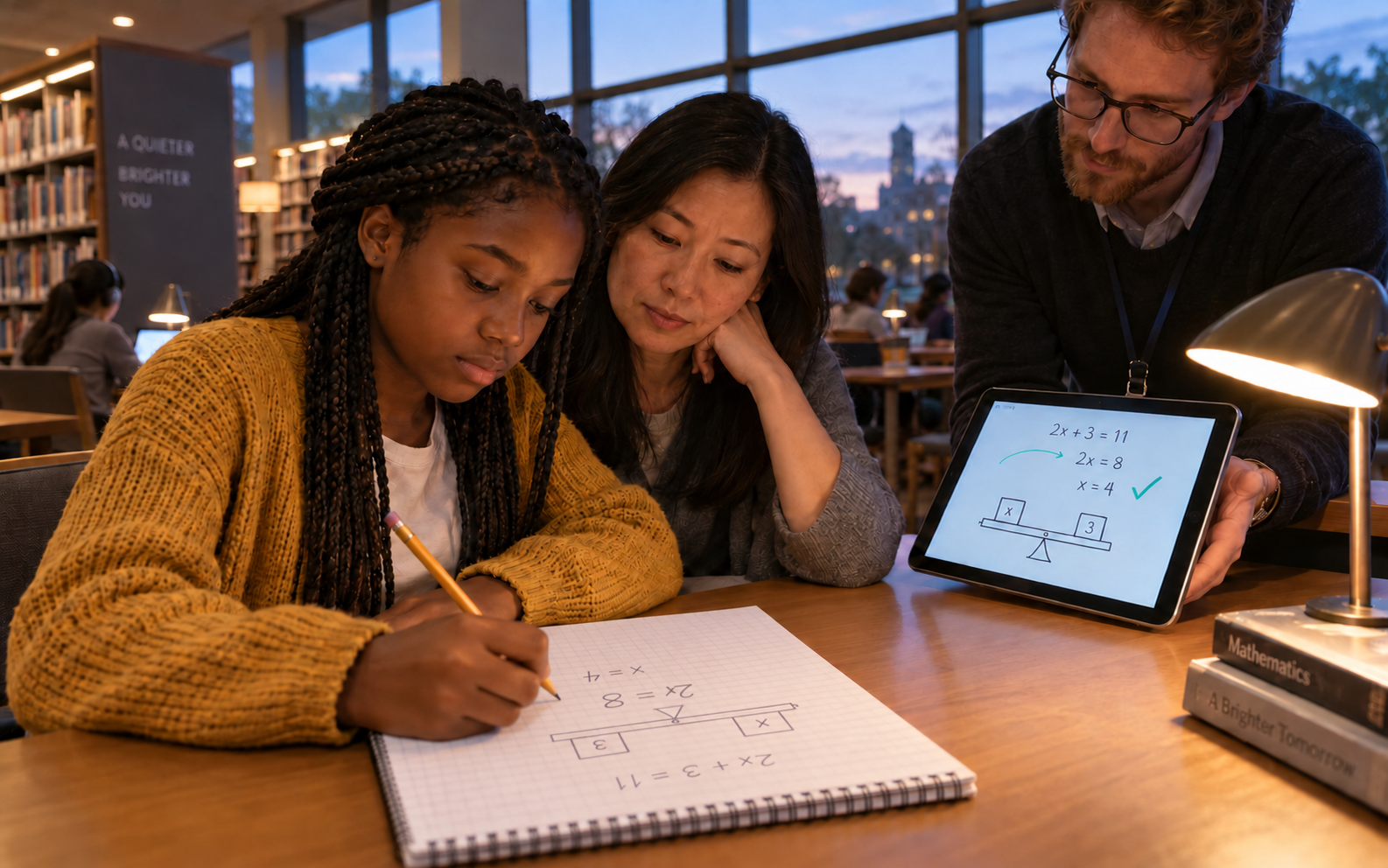
A practical assignment could ask students to identify one claim in an AI explanation that they can check directly. In mathematics, they might substitute a result back into the original problem. In history, they might inspect a cited primary document. In writing, they could compare suggested revisions with the meaning they intended. The purpose is to connect an answer with a method of checking it, rather than asking students to accept or reject the entire tool in the abstract.
Anthropic's August 20 description of Claude Academy places intentional use and continued skill practice at the centre of AI education. Gemini's established Guided Learning tools similarly offer questions and stepwise explanations. Together with OpenAI's report, these product accounts suggest that the design of assistance deserves attention. They do not provide a common outcome measure that would justify ranking the platforms by their educational effectiveness.
Teachers also need a fair picture of non-use. Some learners may lack reliable connectivity, prefer a human explanation, or find an assistant's language difficult. Others may rely on help without understanding its limitations. A class discussion can make these differences visible without requiring students to disclose private chat histories. Schools could collect a few voluntarily selected examples and provide an equivalent teacher-created exercise for anyone who does not use an AI service.
The report is most useful as a prompt for educational inquiry. Institutions can investigate which questions students bring to assistants, which misunderstandings persist, and whether later independent work improves. They can distinguish time saved on preparation from time spent correcting an explanation. OpenAI's figures establish the scale of reported activity; the next step for educators is to examine the quality, distribution, and consequences of that activity in their own setting.