
← Kembali ke Berita Riset
Editorial cover for metacognitive engagement in student-GenAI interaction
Makalah jurnalPeer-reviewed study20266 Jul 2026· 2 min

How motivation and roles influence metacognitive engagement in student-GenAI interaction

Yiran Cui, Wanxin Yan, Thomas K. F. Chiu, Taira Nakajima

International Journal of Educational Technology in Higher Education

Ringkasan 500 kata

Editorial cover for metacognitive engagement in student-GenAI interaction

Cui, Yan, Chiu, and Nakajima study an issue that sits at the center of generative AI in education: students do not learn from AI interaction simply because the tool can answer questions. They learn when the interaction pushes them to plan, monitor, evaluate, and revise their own thinking. The paper is useful for AIEDHK because it treats student-GenAI dialogue as a metacognitive activity shaped by motivation and roles. That is more precise than the common question of whether students use ChatGPT often. It asks what kind of learner stance the interaction encourages.

The study focuses on how motivation and role-taking influence metacognitive engagement during student interaction with generative AI. This matters because GenAI tools can place students in very different positions. A student may behave as a passive recipient of answers, a task manager asking for quick completion, a critic checking the model's claims, a collaborator refining ideas, or a learner using the dialogue to understand gaps in knowledge. The educational difference between those roles is large. The same AI response can support learning in one role and weaken learning in another if the student stops evaluating, explaining, or planning.

For AIEDHK, the strongest contribution is the shift from tool access to interaction quality. The paper points toward design and teaching routines that make metacognition visible. Students need prompts and tasks that ask them to state goals, compare alternatives, justify why they accept or reject AI suggestions, and reflect on what changed in their understanding. Teachers need ways to see not only the final product, but also the student's questioning, monitoring, and revision process. Product teams can translate this into interface patterns such as reflection checkpoints, role prompts, evidence requests, and revision histories.

The motivation dimension is equally important. If students are motivated mainly by speed or performance pressure, GenAI may become a shortcut for producing acceptable work. If they are motivated by mastery, curiosity, or self-improvement, the same tool can become a partner for testing understanding and improving strategy. The paper therefore supports a balanced adoption message: GenAI can be educationally valuable, but only when learning tasks and classroom norms reward thinking with the model rather than outsourcing thinking to the model.

The study also has practical implications for Hong Kong classrooms and universities. High assessment pressure, multilingual learning, and unequal AI confidence can all shape the roles students adopt when using GenAI. AIEDHK can use this paper to evaluate whether AI learning tools build metacognitive habits: planning, monitoring, critique, revision, and self-explanation. The takeaway is that responsible GenAI education should not only teach students how to prompt. It should teach them how to position themselves as reflective learners who can question the model, manage their motivation, and make their own reasoning stronger.
Makalah terkait

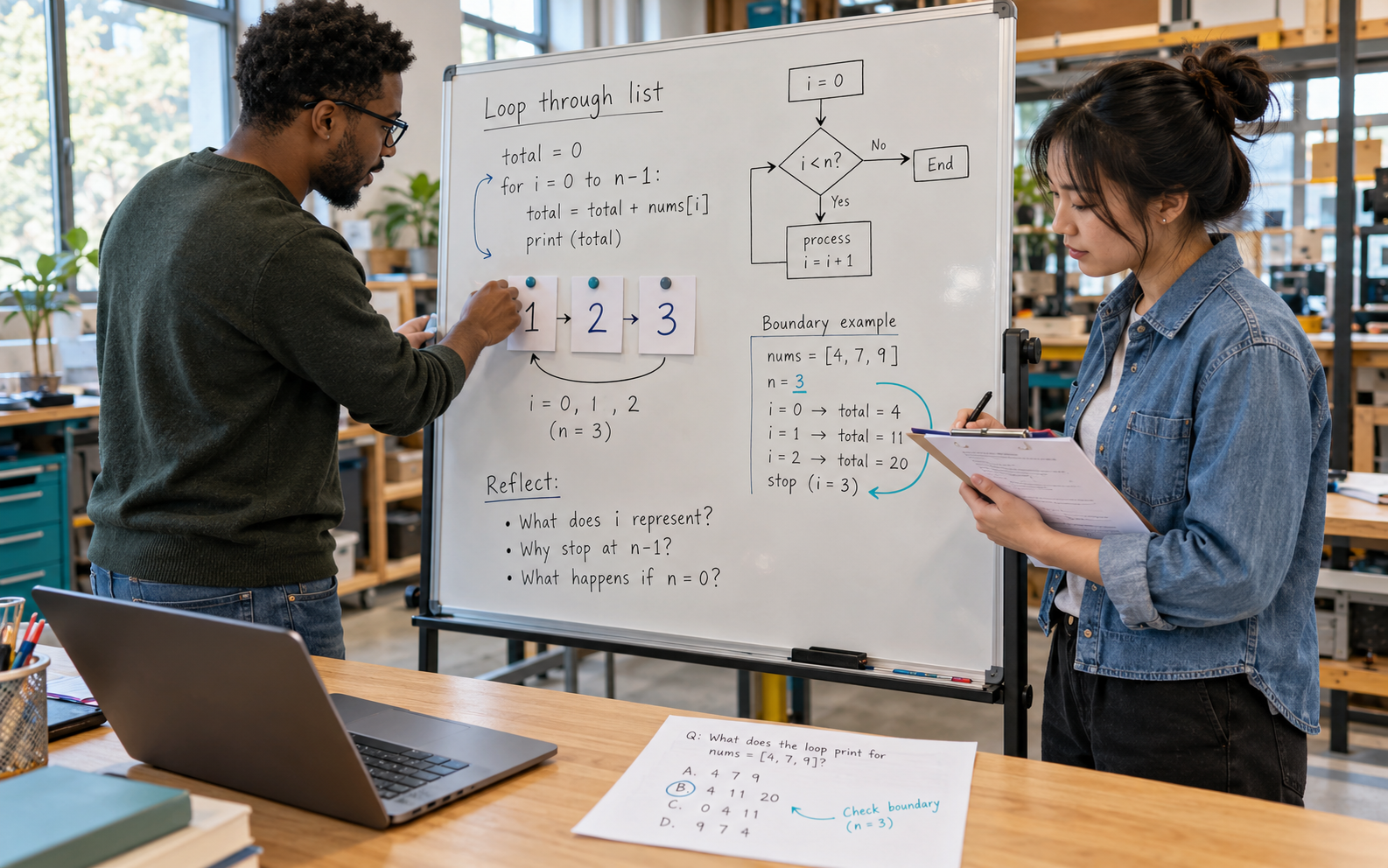
A Black male programming student and an East Asian female peer trace a loop on a small whiteboard while revising a printed multiple-choice question in a university maker room
Makalah jurnal2026
Makalah jurnal 218

Blending guidance with reflection prompted more revisions than reflective AI feedback alone

Omar Alsaiari, Nilufar Baghaei, Jason M. Lodge, Omid Noroozi, Dragan Gašević, Marie Boden, Hassan Khosravi

Computers and Education: Artificial Intelligence

A 12-week study followed 329 students receiving directive, reflective, or hybrid AI feedback while creating learning resources. Hybrid feedback had the highest observed content-revision rate, and both hybrid and directive feedback exceeded the reflective condition. Hybrid and directive conditions did not differ significantly from each other, and final resource quality showed no significant group difference. The study makes revision behavior visible while leaving deeper understanding and transfer unresolved.

feedback designstudent-generated resourcesmetacognition
Baca ringkasan 500 kata →
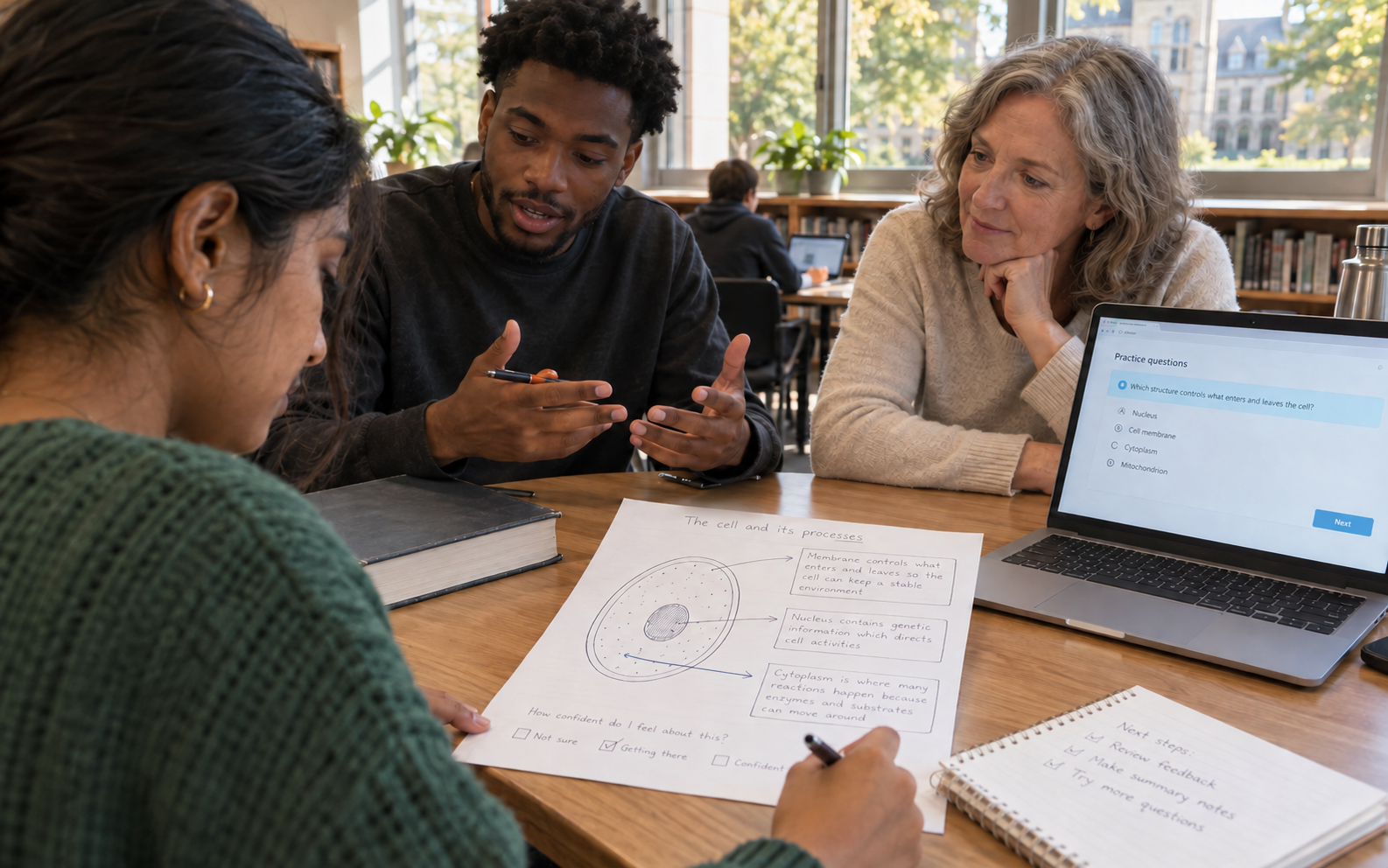
University learners and a tutor discuss a cell worksheet with written reasons and a confidence judgment beside a practice-question interface.
Makalah konferensi2025
Makalah konferensi 192

How Adding Metacognitive Requirements in Support of AI Feedback in Practice Exams Transforms Student Learning Behaviors

Mak Ahmad, Prerna Ravi, David Karger, Marc Facciotti

Proceedings of the Twelfth ACM Conference on Learning @ Scale

A large biology course tested several forms of practice-exam feedback, including GPT-4o explanations and textbook links. No significant overall difference emerged in subsequent exam performance between feedback conditions. Students nevertheless described useful changes in how they reasoned, judged confidence, and studied. Because every condition required an explanation and confidence judgment, the trial cannot isolate those requirements as the cause of learning gains. It offers a careful distinction between reported study changes and measured achievement.

Learning at ScaleBiology EducationMetacognition
Baca ringkasan 500 kata →
Graduate readers and a supervisor compare an annotated article's results table with a laptop critique while recording evidence checks.
Makalah jurnal2026
Makalah jurnal 188

Postgraduate readers used AI critiques in different ways, with original-source checking remaining essential

Haoming Lin, Wei Wei, Bin Zou, Ying Zheng

Discover Computing

An observational study followed 53 postgraduate readers as they revised critiques of academic articles using generated reviews, a chatbot and the original paper. Screen recordings and interviews revealed different patterns of reliance, re-reading and dialogue that varied with the perceived difficulty of the task. The study explains how AI-supported reading can unfold, but without a non-AI comparison or independent transfer assessment it does not establish that the tool improved critical-reading ability.

academic readingcritical AI literacymetacognition
Baca ringkasan 500 kata →