Analogical Reasoning
Analogical reasoning uses relationships in a familiar situation to understand a new one. Useful analogies make the mapping explicit and identify where the comparison stops working.
Sumber
Ringkasan pelajaran lengkap
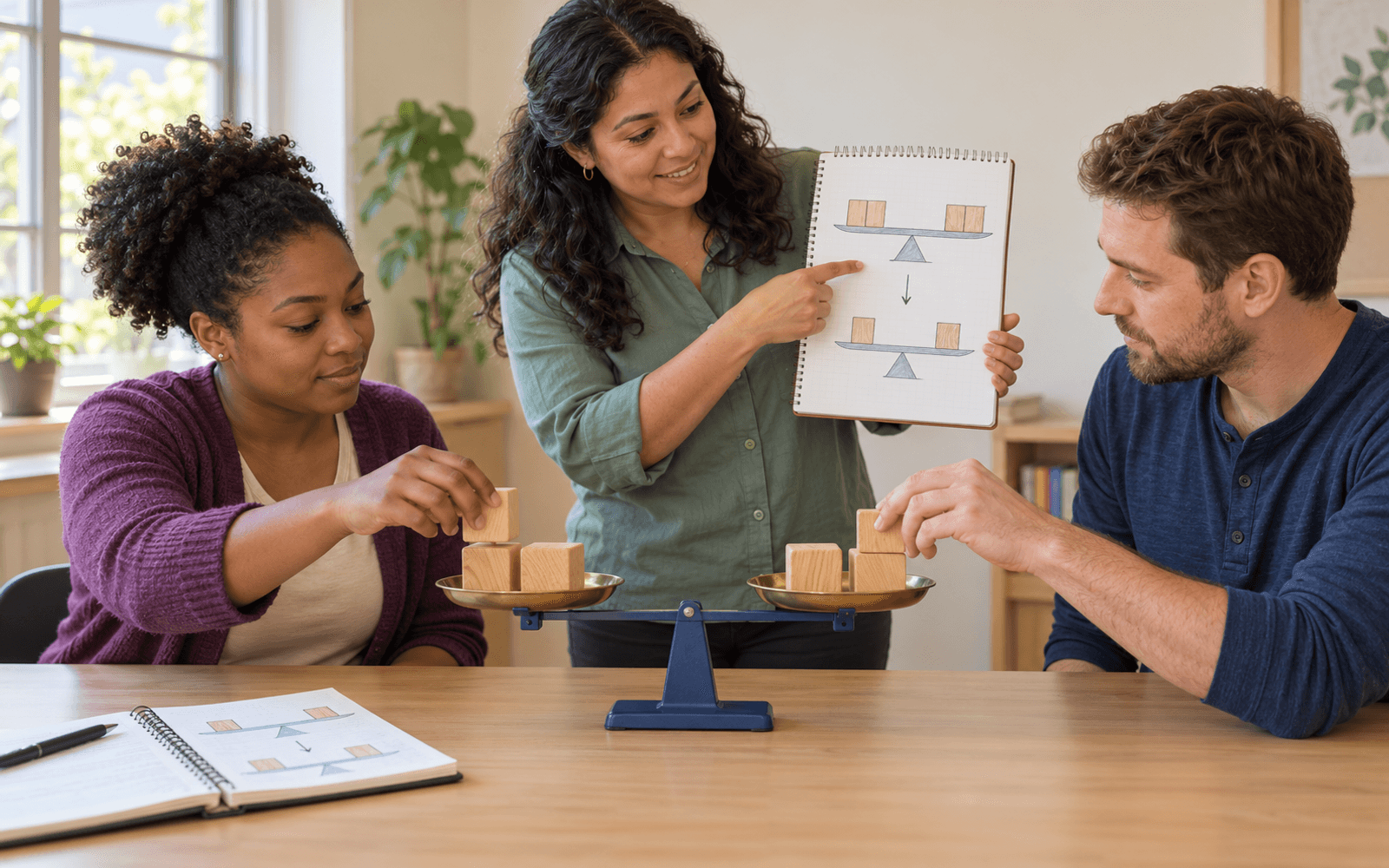
A teacher compares an equation to a balanced scale. The scale helps learners reason about maintaining equality when the same change is made to both sides. The usefulness lies in a relationship that can be carried from one situation to another. Analogical reasoning uses a source situation to understand or solve a target situation, often despite differences in their surface appearance.
Gentner's structure-mapping theory emphasizes relational structure. A strong analogy maps relationships among objects rather than simply matching visible features. The teacher is not suggesting that numbers are made of metal or that an equals sign has a physical hinge. The relevant connection is that coordinated changes preserve a relationship. Making that selection explicit helps learners use the analogy without importing irrelevant properties.
Analogical reasoning involves several demands. A learner must understand the source, notice its relevance, identify correspondences, and judge which inferences are legitimate. The teacher's familiarity with an analogy does not guarantee the learner's familiarity. A comparison involving an unfamiliar sport or technology can create a second problem instead of clarifying the first. Even a familiar source may invite an incorrect mapping if the relationships are left implicit.
In an adult mathematics class, the teacher presents a balance diagram representing an unknown quantity plus three units equal to seven units. Learners remove three units from each side and connect the action to subtracting three from both sides of the equation. They then explain which part of the diagram corresponds to each symbol. A second equation requires dividing both sides by the same nonzero number. Students discuss how grouping equal weights can illustrate that operation and where a physical balance becomes awkward, especially with negative quantities.
The limits belong in the lesson. A scale analogy can support equality while becoming less helpful for some algebraic operations or number systems. Teachers should identify those boundaries and move toward the mathematical structure rather than stretch the analogy indefinitely. Asking learners to compare two examples can help reveal a common relationship, but comparison needs prompts and feedback. Similar-looking cases can operate by different principles, and superficially different cases can share the same structure.
Assessment should examine whether students can use the relationship in a new case and explain why it applies. Ask for a mapping, a justified inference, and a feature that must not transfer. AI-generated analogies require this same scrutiny: vividness and familiarity do not establish mathematical or scientific validity. A practical planning routine is to name the target idea, check that learners understand the source, list the correspondences, and state at least one limitation. Analogical reasoning becomes a disciplined bridge when those relationships are inspected. Without that discipline, a memorable comparison can preserve a misconception as effectively as it can support understanding.