Knowledge Distillation
Knowledge distillation trains a student model to approximate a teacher model, trading some capacity for a smaller deployment while requiring independent checks of errors, bias, and educational usefulness.
स्रोत
पूरा पाठ सारांश
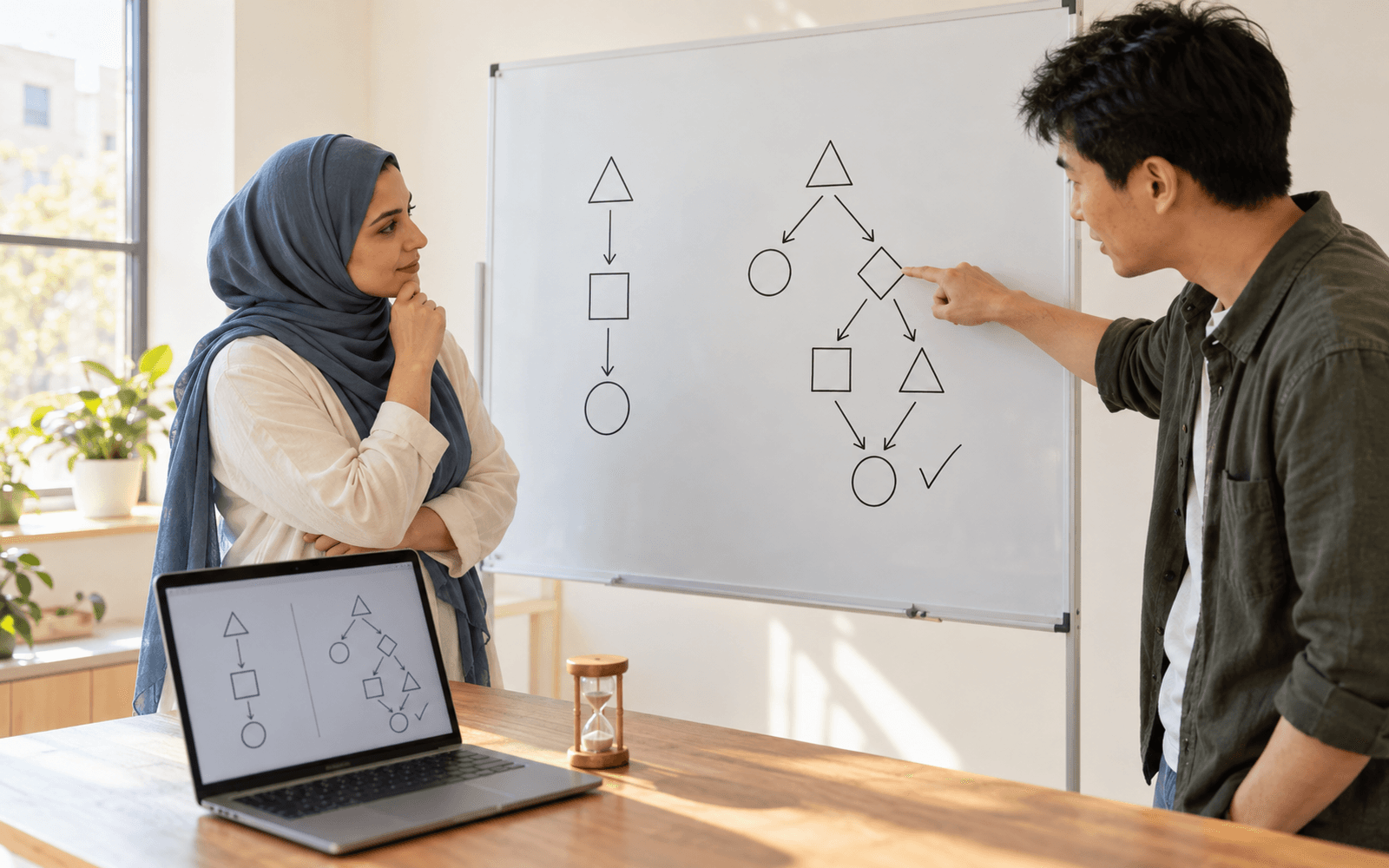
A school wants an AI classifier that can run on inexpensive laptops. Its strongest model is too large for those devices. Knowledge distillation offers one route: use a capable teacher model to help train a smaller student model. The words teacher and student describe computational roles. They do not imply that either model understands a subject as a human educator does, or that a smaller model receives an exact copy of everything the larger model knows.
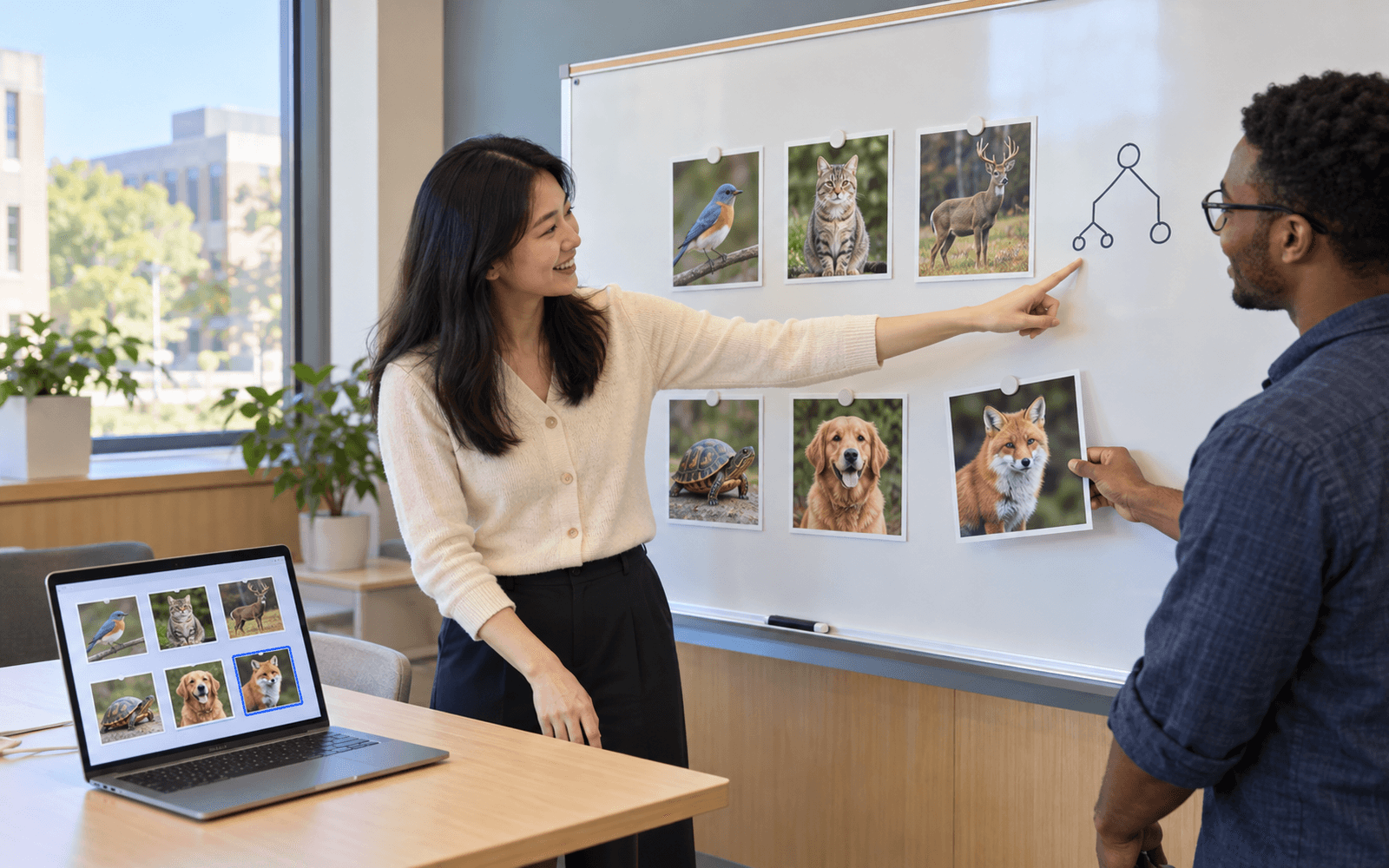
In a classification example, ordinary labels identify the expected category. A teacher can also supply a distribution across alternatives. Suppose a response is mainly about evaporation, but the teacher assigns some probability to boiling and very little to condensation. Those relative probabilities carry information about distinctions the teacher has learned. A temperature setting can soften the distribution during training so that less probable alternatives contribute more visibly to the learning signal. The student learns to approximate these outputs, often alongside learning from the original labels.
Distillation can target other information, including intermediate representations or generated responses. DistilBERT illustrates distillation during language-model pretraining, combining several training objectives. Different approaches preserve different behaviours, so a distillation claim needs to specify the teacher, student, training data, objectives, and evaluation tasks. A smaller file or faster response is an operational result; it does not establish that every useful capability has survived.
Consider an illustrative biology department building a local tool that sorts anonymous practice explanations into topics for teacher review. Staff first prepare a diverse set of examples and reserve a separate evaluation set. A teacher model produces candidate distributions for the training examples. Educators inspect ambiguous items and labels before a student model is trained. They then compare the two models on held-out responses, especially short answers, multilingual writing, unfamiliar wording, and closely related scientific ideas. The intended benefit is quicker sorting on classroom devices, while the teacher retains responsibility for interpreting student understanding.
The department should also measure memory use, latency, and battery demand on the actual equipment. A student that performs well on one benchmark may fail on a local curriculum. Distillation can reproduce a teacher's mistakes or biases and may discard rare but important distinctions. Training data and teacher outputs can contain protected or sensitive material. Using a smaller model does not resolve those issues, and generated labels should not silently become unquestioned educational judgments.
A useful classroom activity is to compare hard category labels with probability distributions for a few fictional examples. Learners explain what extra information the distributions contain and which uncertainty remains. They can then design an acceptance test for a hypothetical compressed assistant. Include a non-AI alternative, a manual review route, and examples where the system should decline classification. This makes distillation a concrete lesson about transferring behaviour under constraints, while keeping the educational purpose and the cost of lost distinctions visible.