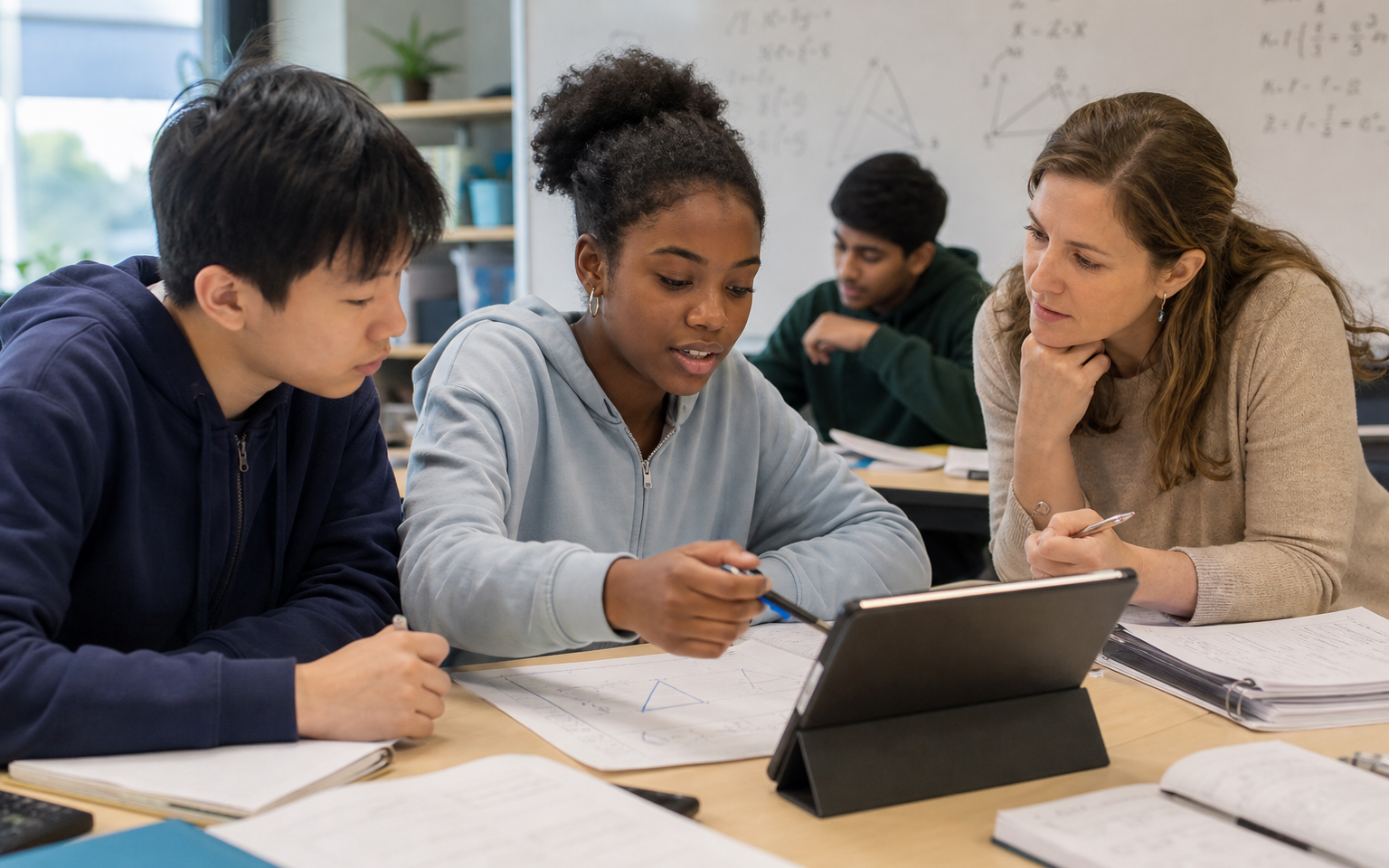
← Retour aux actualités recherche

#Mathematics Education

Mathematics Education

5 articles

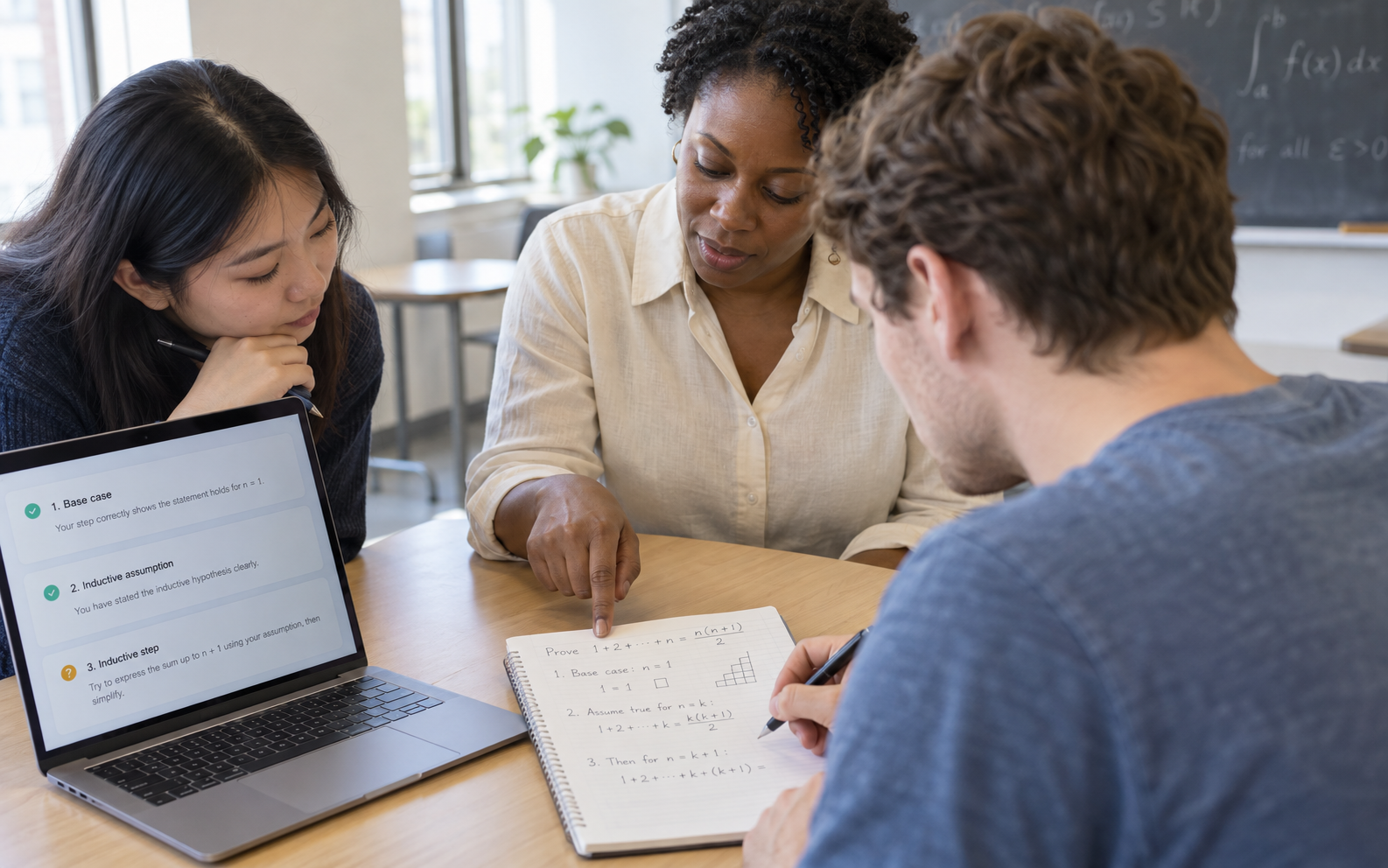
A mathematics lecturer and peer discuss a university student's induction proof beside a laptop showing feedback on the next step.
Article de conférence2026
Article de conférence 206

LeanTutor: Towards a Verified AI Mathematical Proof Tutor

Manooshree Patel, Rayna Bhattacharyya, Thomas Lu, Arnav Mehta, Niels Voss, Narges Norouzi, Gireeja Ranade

Proceedings of the AAAI Conference on Artificial Intelligence

LeanTutor connects a language model to the Lean theorem prover to support mathematical proof feedback. Its technical evaluation shows promising hints on a small selected benchmark, but also exposes a crucial boundary: a verifier can check the formal proof only after the learner's words have been translated correctly. The study did not test classroom learning, and feedback evaluation excluded failed translations. It is an early system design with explicit limitations, not a validated replacement for mathematics instruction.

Mathematics EducationIntelligent TutoringFormal Verification
Lire le résumé de 500 mots →
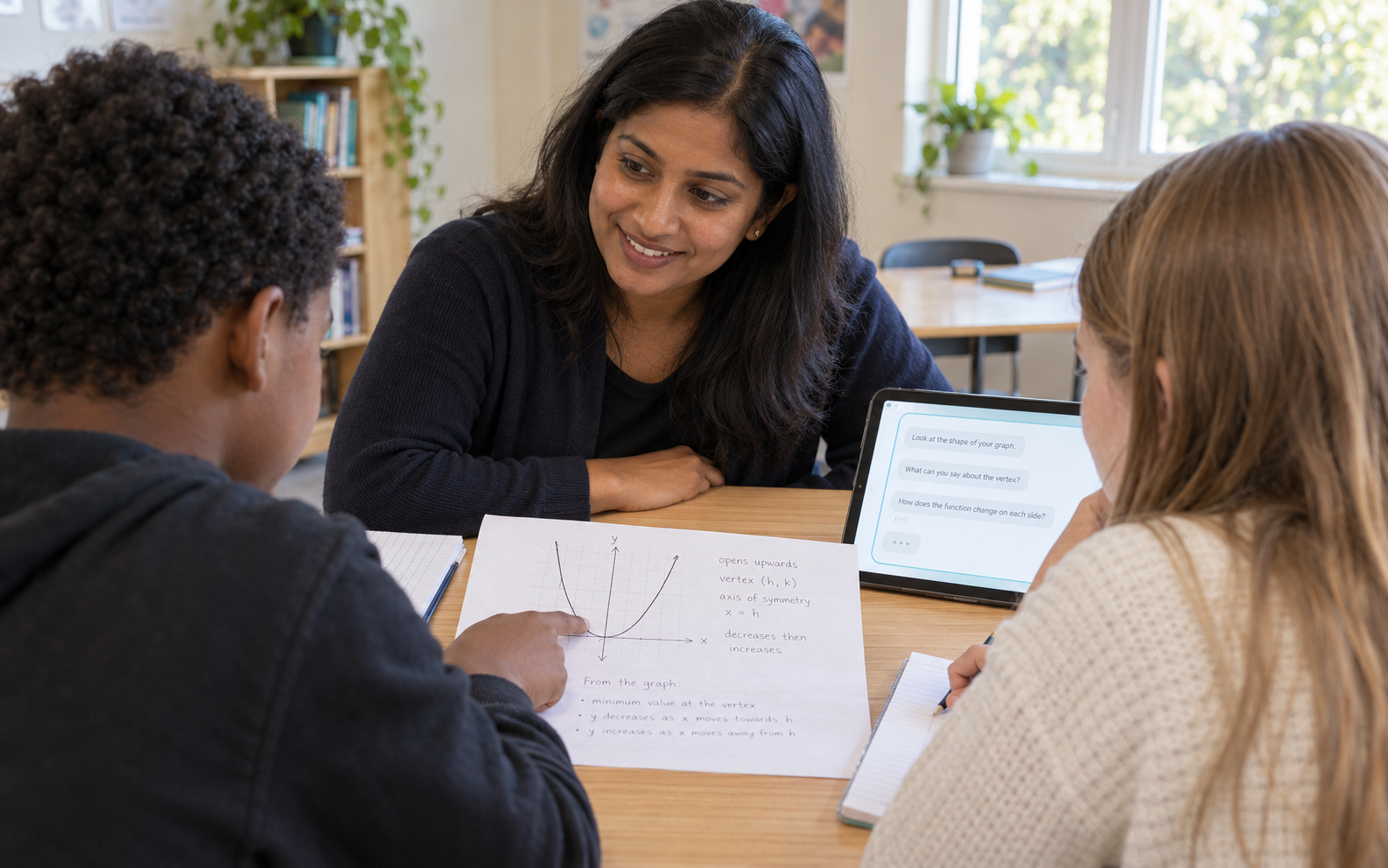
Two pupils discuss an upward quadratic graph with a teacher beside a tablet offering calm mathematical hints.
Article de revue2025
Article de revue 204

Designing Safe and Relevant Generative Chats for Math Learning in Intelligent Tutoring Systems

Zachary Levonian, Owen Henkel, Chenglu Li, Millie-Ellen Postle

Journal of Educational Data Mining

More than 8,000 learners used a structured growth-mindset conversation inside a mathematics tutor, giving researchers a practical view of moderation and response quality. Monitoring found no overtly objectionable model outputs, but identified subtler failures to respond appropriately to concerning student messages. A separate study found that educators preferred moderately guided textbook-supported answers. Neither safety monitoring nor response preference establishes improved learning, and both findings depend on the particular system and evaluation context.

Intelligent TutoringMathematics EducationAI Safety
Lire le résumé de 500 mots →
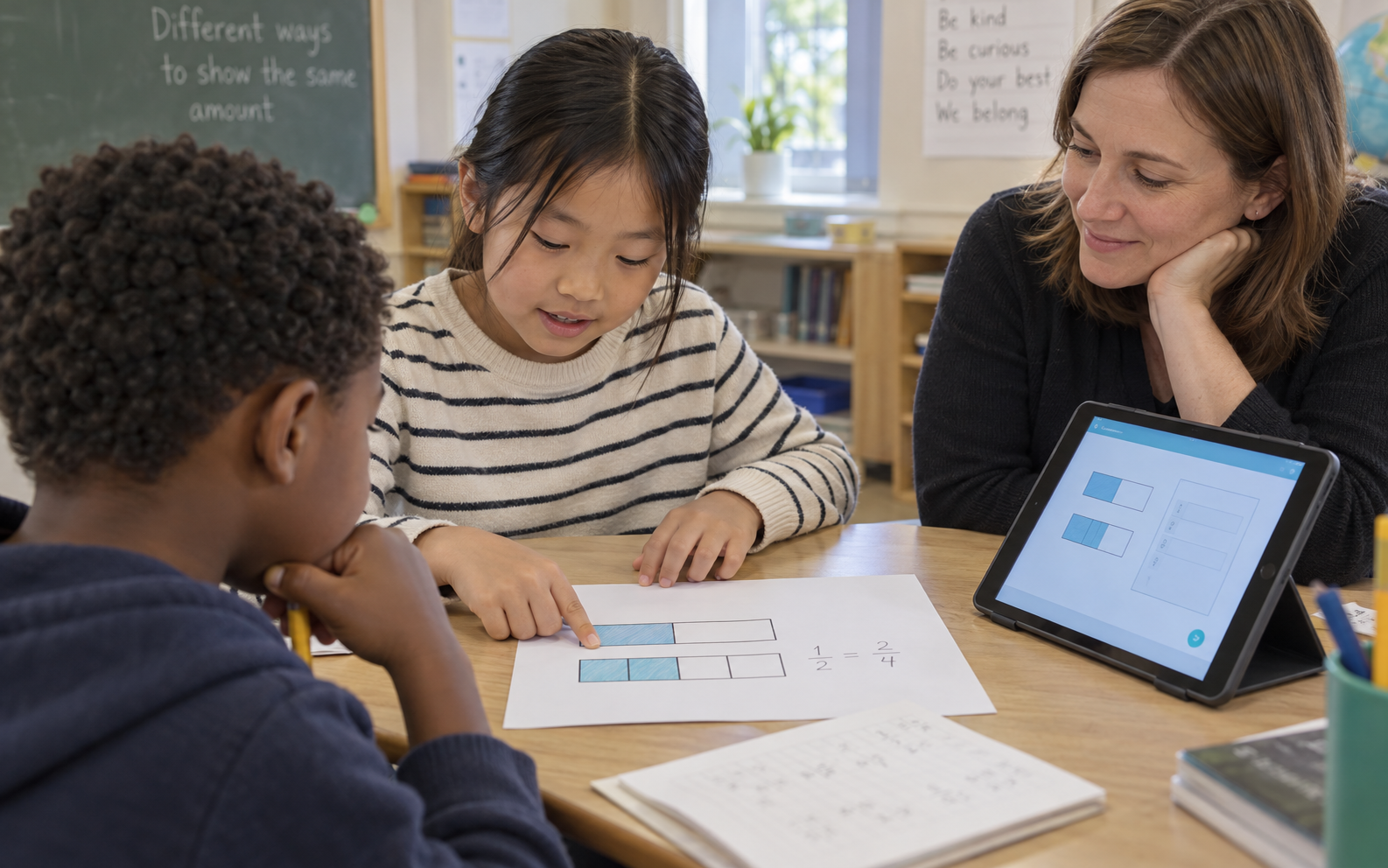
A teacher and two primary pupils compare equivalent fraction bars on a worksheet beside a tablet practice activity.
Article de revue2026
Article de revue 194

Computer-assisted learning in the real world: How Khan Academy influences student math learning

Taryn Eames, Emma Brunskill, Bogdan Yamkovenko, Kodi Weatherholtz, Philip Oreopoulos

Proceedings of the National Academy of Sciences

A large United States study links Khan Academy use with mathematics progress across roughly 214,000 students. Its observational design uses changes in classmates’ usage and extensive statistical controls, rather than random assignment. Average exposure was modest, and higher prior achievers appeared to benefit more. The findings highlight implementation and access to practice, while leaving uncertainty about causation. They concern established computer-assisted learning and should not be read as evidence for generative-AI chatbots.

Mathematics EducationAdaptive LearningLearning Analytics
Lire le résumé de 500 mots →
Two students explain square-root estimates using number-line and square-area sketches while a teacher listens beside a laptop hint panel.
Article de revue2025
Article de revue 166

A tailored mathematics chatbot increased situational interest without a significant overall learning-gain advantage

Cilia Ricarda Rücker, Sebastian Becker-Genschow

Computers and Education Open

A classroom study with 195 ninth-grade pupils compared the tailored ADA chatbot with conventional differentiated materials while learning a square-root method. Pupils using ADA reported stronger situational interest and favorable acceptance. Overall learning gains did not show a significant group-by-time advantage, and cognitive-load differences were also nonsignificant. The result supports studying motivational engagement separately from achievement, particularly when a new tool is introduced for a brief classroom sequence.

mathematics educationsecondary educationdomain-specific chatbots
Lire le résumé de 500 mots →
A diverse mathematics class works with an AI tutoring system while a teacher compares student reasoning and assessment evidence
Revue2026
Revue 74

Review of 12 studies finds promising mathematics-tutoring gains while generative-AI achievement evidence remains thin

Neo Molemane, Moeketsi Mosia, Felix O. Egara

Discover Education

A PRISMA systematic review screened 1,749 records and included 12 studies of AI tutoring and assessment in mathematics. Results were generally promising, especially for some lower-performing learners, but heterogeneous methods and limited direct achievement evidence for generative AI prevent a universal efficacy claim.

AI tutoringmathematics educationautomated assessment
Lire le résumé de 500 mots →