Compute, Efficiency, and Environmental Cost
How training and using AI consume computing, electricity, water, hardware, and money, and how educators can compare useful outcomes with full lifecycle costs rather than model size alone.
Fuentes
Resumen completo
Artificial intelligence requires physical infrastructure. Training adjusts model parameters through repeated computation, while inference uses a trained model to answer requests. Both run on processors in data centres supported by memory, storage, networking, cooling, and electricity. The environmental cost of one task depends on the model, hardware, software, data-centre efficiency, electricity source, location, time, workload, and how often the system is used. A single universal number for "AI energy" is therefore misleading.
Training a frontier model can be compute-intensive, but repeated inference can also become a large share of total demand when millions of users submit prompts. Longer contexts, repeated retries, high-resolution media, and unnecessary agent loops add work. Cooling may consume water directly or influence electricity use, and manufacturing processors has material and embodied-carbon costs. These impacts are distributed across places and supply chains, so a low visible price does not mean a cost has disappeared.
Efficiency can improve at several layers. Developers can choose smaller or specialized models, quantize parameters, reuse cached computation, batch requests, improve algorithms, and run hardware at higher utilization. Product designers can limit needless generations and route simple tasks to less intensive systems. Users can provide clear requirements, reuse verified results, and stop loops that no longer add value. Yet efficiency gains can be offset if cheaper use creates much more demand, an effect sometimes called rebound.
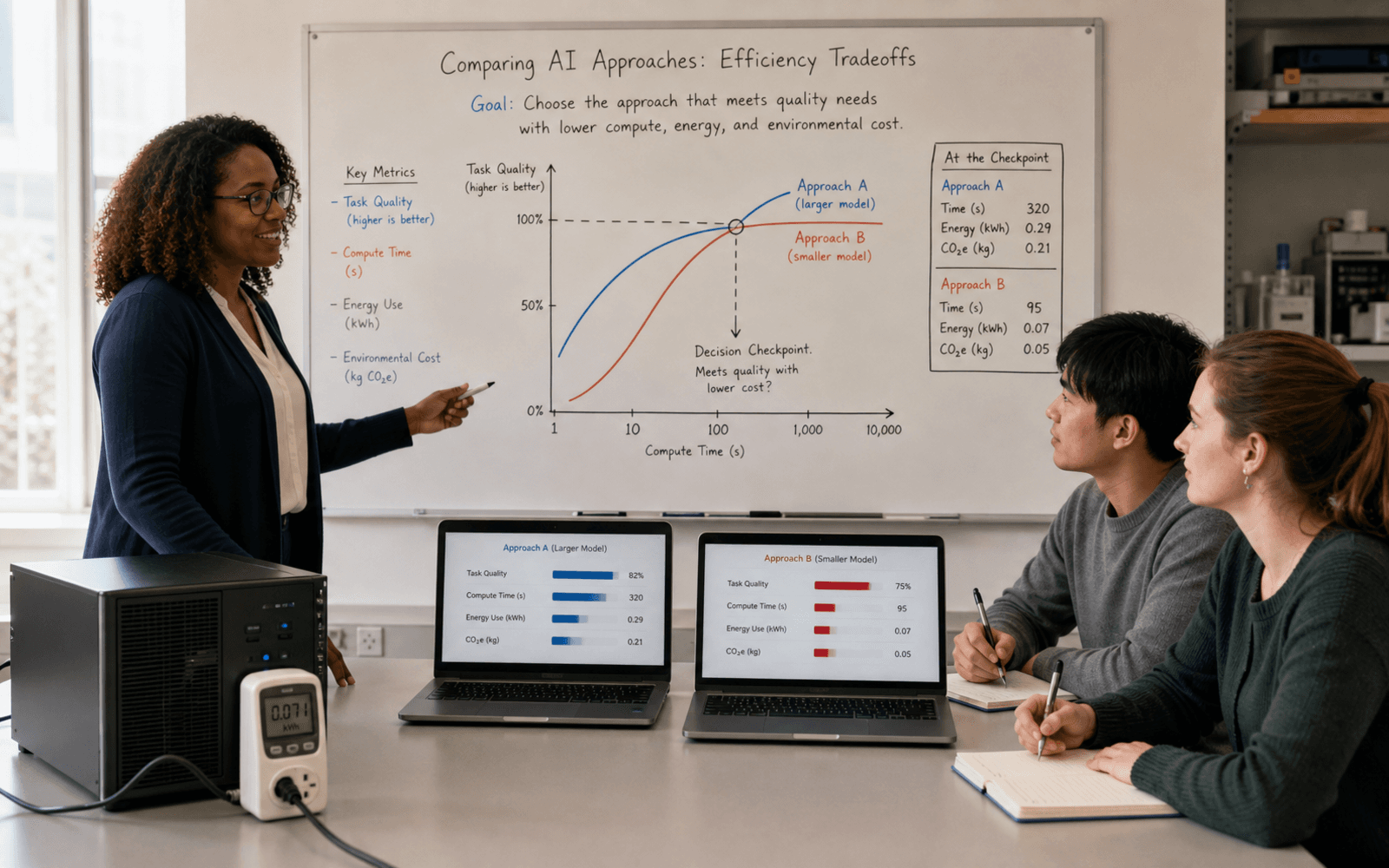
Comparisons need a defined unit and outcome. Energy per training run, per thousand tokens, per completed task, or per learner helped answer different questions. A smaller model that repeatedly fails may consume more resources per useful outcome than a larger model used once. Carbon estimates also require time- and location-specific electricity information. Transparent reporting should include hardware, run duration, utilization, energy method, model version, workload, and uncertainty rather than present a precise-looking total without assumptions.
In education, learners can compare three ways to produce feedback on a short assignment: a large general model, a smaller local model, and a teacher-designed rubric without generation. They define quality and safety criteria, measure response time and approximate energy where tools permit, count retries, and examine privacy and accessibility. They then recommend an approach for the actual learning purpose. The goal is not to reject computation, but to ask whether educational value justifies its full resource cost.
Responsible choices combine sufficiency and evidence. Institutions can inventory high-volume AI uses, request vendor reporting, set retention and routing policies, and evaluate whether the system improves learning or workload. Efficiency is not only a technical benchmark. It is a design question about accomplishing a worthwhile educational goal with appropriate models, limited waste, durable hardware, and honest accounting of environmental and social tradeoffs. Public reporting should distinguish measured consumption from estimates and state which lifecycle stages were omitted, allowing educators and learners to compare claims without false precision.