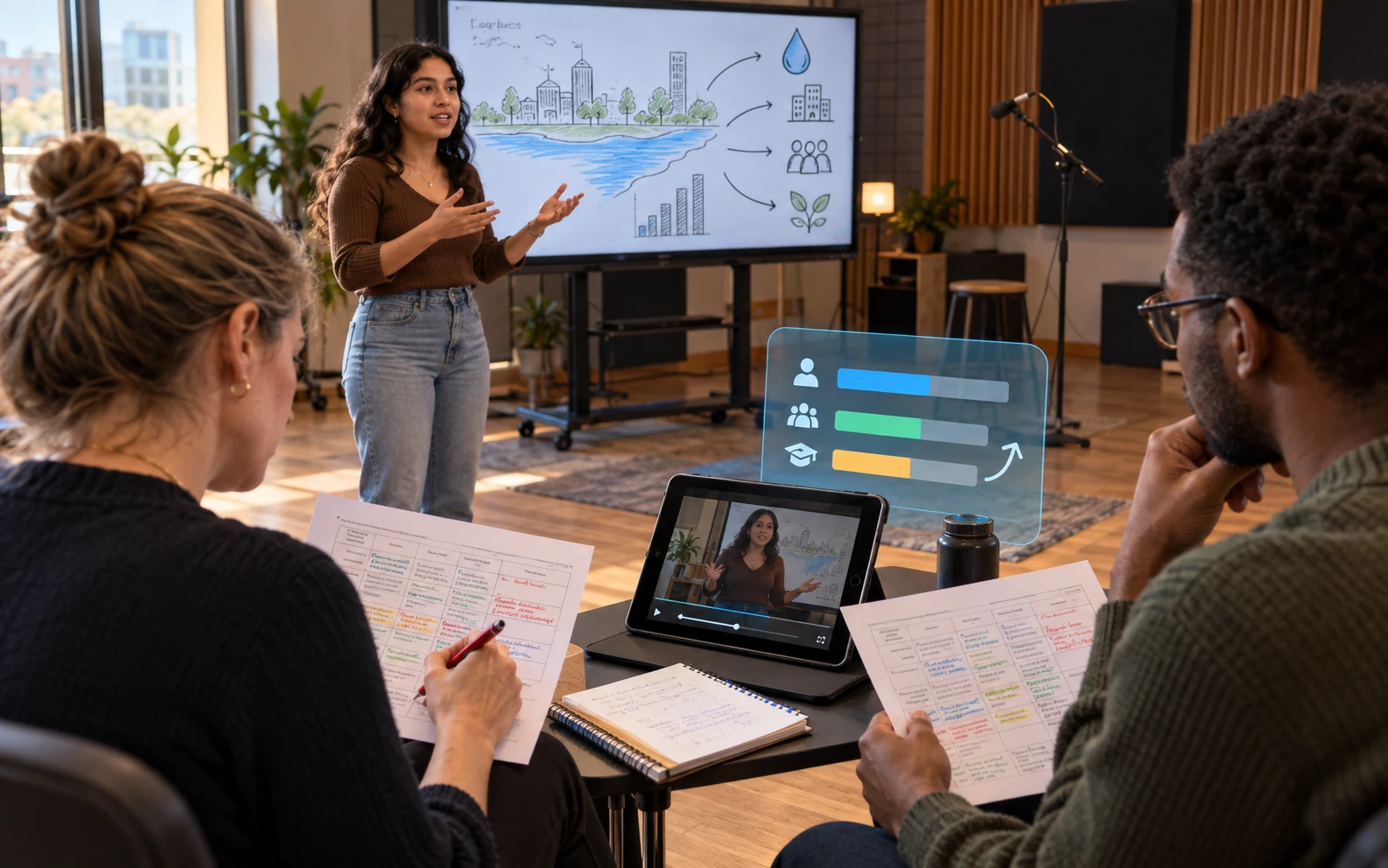
Conference demo: AICoFe connects peer and self-assessment with teacher-curated AI feedback
Alvaro Becerra, Alejandra Palma, Ruth Cobos, Julian Fierrez
European Conference on Technology Enhanced Learning (EC-TEL 2026), demonstration paper
500-word summary
Listen to the summary
Audio summary
AICoFe combines peer, self and teacher assessment with AI-supported feedback on oral presentations. The EC-TEL demonstration paper’s open author version describes a 2024–2025 deployment with 46 undergraduates and 19 master’s students at Universidad Autónoma de Madrid. Teachers can select, edit or combine generated comments before sending them. Satisfaction ratings were positive; 31 participants completed the usability questionnaire, producing a mean System Usability Scale score of 79.91. These observations concern students’ experience of the system, without establishing a causal improvement in presentation skills.
The workflow brings several perspectives into one review process. Learners can revisit a recording and compare their own rubric judgments with the feedback they receive. The authors also describe keeping drafts and sent versions distinguishable. The small deployment and questionnaire response counts limit the conclusions that can be drawn. A teacher’s involvement is part of the reported setting, so the findings should not be read as evidence for autonomous feedback without that mediation.
For AIEDHK, consider a proposed seminar activity centred on one short presentation. Before seeing feedback, the presenter would identify a moment that seemed clear and a moment they would change. A peer would independently select evidence using the same criterion. The teacher could then inspect the generated suggestion alongside those observations. The aim would be a discussion about which comment accurately describes the presentation and what action the learner can realistically take.
For example, a learner explaining urban water use might receive a vague suggestion to improve clarity. A more useful discussion would locate the transition where the audience lost the connection between the diagram and the claim. The presenter could rehearse a revised explanation and ask a new listener to describe the relationship. This is an editorial classroom proposal. The demonstration paper does not test that specific activity or establish the effectiveness of the example.
An institution trying a similar workflow could keep the pilot small and define the recording’s audience and retention period in advance. Reviewers should know which comments came from peers, which were generated, and which the teacher changed. Learners should also have a way to explain why a comment is inaccurate or unsuitable. These practical decisions make the feedback process easier to inspect and give disagreements an educational purpose rather than treating them as interface errors.
Participants could compare their first and revised explanations of one criterion, identifying what changed in their judgment after watching the recording. Keeping that account brief would help a teacher distinguish a considered response to feedback from a revision made only to satisfy a visible score.
A stronger evaluation could examine the next presentation, including an independent task and clearly specified criteria. It could record the teacher’s review time, the changes made to generated comments, and whether students can justify their chosen revision. Satisfaction and usability would remain useful alongside these measures. AICoFe offers a concrete system design for coordinating feedback perspectives; deciding whether that coordination improves learning requires additional evidence about what learners subsequently understand and can do.