Biology lessons provided a concrete route into AI concepts, but gains did not extend clearly to biology knowledge
Shenghua Zha, Marcy Maulucci Bragdon, Na Gong, Jinhui Wang, Silas Leavesley, Rachel Eaton, Erin Bosarge
International Journal of Artificial Intelligence in Education
500-word summary
Listen to the summary
Audio summary
AI literacy need not begin in a separate computer science course. Shenghua Zha and colleagues investigated what happens when students encounter machine learning through biology they are already studying. Their classroom case connects cell images, neurons and biological applications with the concepts behind AI systems. The educational question is whether familiar disciplinary knowledge helps students understand an unfamiliar technology, and whether the connection also deepens their science understanding. It is a study of learning about AI, not simply using a chatbot to complete biology assignments.
Thirty-seven students in a public high-school honors biology course in the southern United States participated in four integrated lessons. Twenty-nine completed both the pre-test and post-test. The experienced biology teacher had undertaken a six-week AI training program before teaching the course. Researchers combined knowledge assessments with worksheet analysis of how students explained relationships between the disciplines. Each lesson occupied roughly two or three class sessions, and teacher guidance remained central to introducing concepts and interpreting the activities.
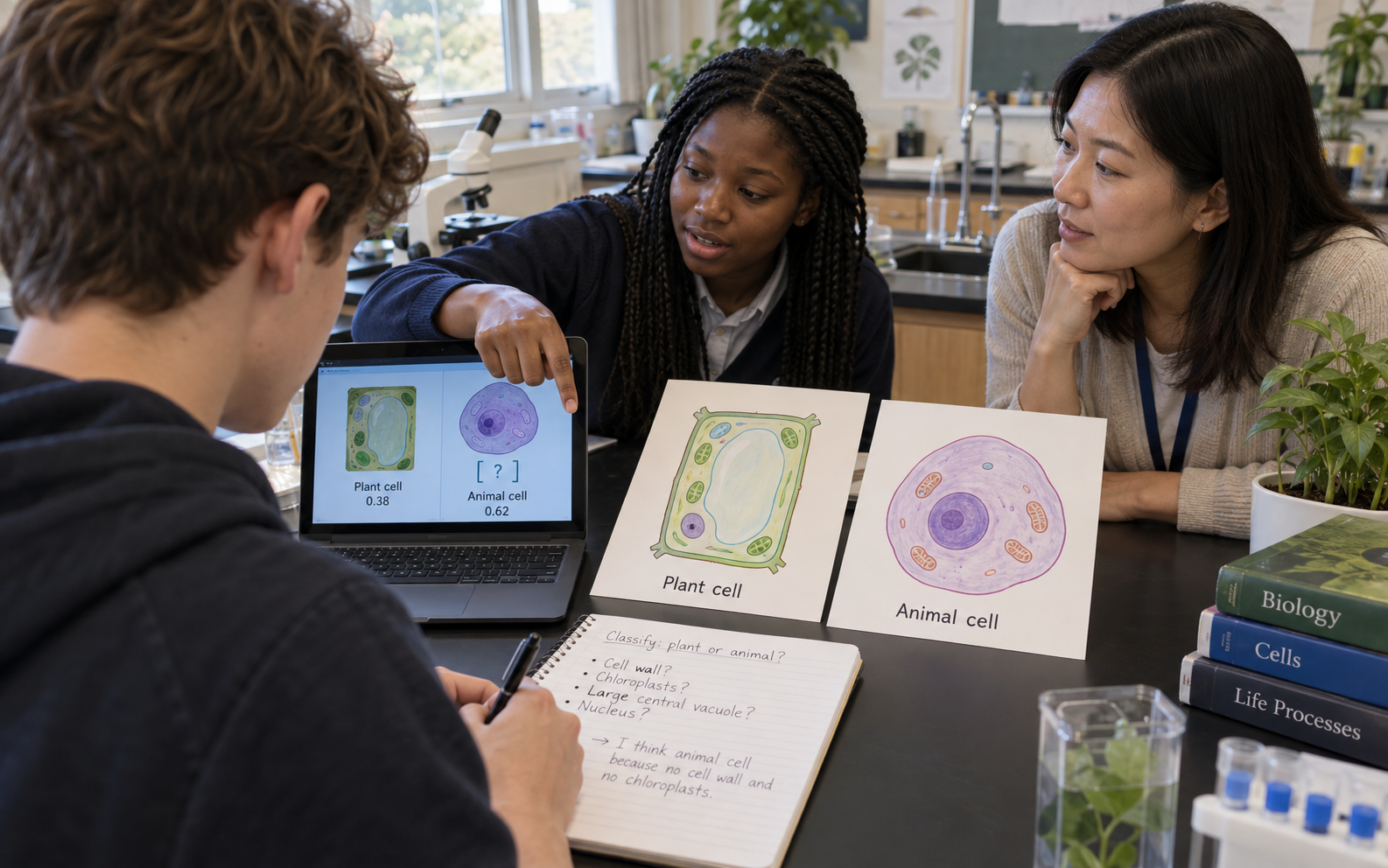
One activity used Teachable Machine to train and test classifiers on cell images. Students could connect their knowledge of biological categories with the need for suitable training examples. Another compared human neurons with artificial neural-network structures. Later lessons examined neural-network applications involving leaf pigments and cancer detection. These tasks offered different kinds of conceptual connection: using biology to understand AI, applying AI ideas to a biological problem and explaining where an analogy is informative or potentially misleading.
The paired assessments showed a significant improvement in overall AI knowledge. The increase in biology knowledge was smaller and not statistically significant. Quantitative relationships between the two subjects varied across lessons, while the qualitative analysis showed that some students used prior knowledge to explain the new domain effectively. Others produced vague or inaccurate accounts, even when they mentioned a relevant concept. Naming a model, recognizing an image or recalling a biological term therefore did not necessarily demonstrate a sound explanation of how the combined system worked.
The study's limits are substantial and useful for planning follow-up work. It examined one advanced class without a comparison group, so maturation, instruction and the particular teacher cannot be separated from the integrated design. Assessment coverage was limited, and eight students lacked paired tests. Time pressure also removed a planned reflection task in one lesson. The authors consequently call for stronger assessments and comparative designs. The findings cannot show that this curriculum outperforms separate AI instruction or that the absence of a significant biology gain means there was no benefit.
For Hong Kong schools, the case suggests a manageable curriculum experiment: start with a science classification problem that students already understand, let them train a simple model and ask them to explain a failure on a new example. Teachers could assess AI concepts and biology concepts separately, then require an explanation linking them. A second class or staggered introduction would strengthen evaluation, while delayed tasks would probe retention. These are proposed extensions beyond the reported case. The practical opportunity is broader access to AI understanding through ordinary subjects, with enough evidence to distinguish an engaging activity from a reliable conceptual connection.