Epistemic Games
Epistemic games organize learning around professional ways of knowing and judging. Their value comes from connecting knowledge, skills, values, identity and evidence through meaningful simulated practice.
Sources
Full lesson summary
Listen to Epistemic Games
Audio summary
Epistemic games, in David Williamson Shaffer's educational account, are designed experiences in which learners participate in ways of thinking and acting associated with a professional practice. Learners might work as urban planners, journalists, or engineers within a carefully structured simulation. The educational focus is how knowledge, skills, values, identity, and ways of justifying decisions become connected through activity.
These connections form what Shaffer calls an epistemic frame. A planner does more than calculate a cost: they decide which constraints matter, interpret evidence, consult stakeholders, and justify a proposal according to professional expectations. An epistemic game brings selected parts of that practice into a manageable learning environment. Roles, tools, mentoring, consequential choices, and reflection help make the reasoning behind decisions visible.
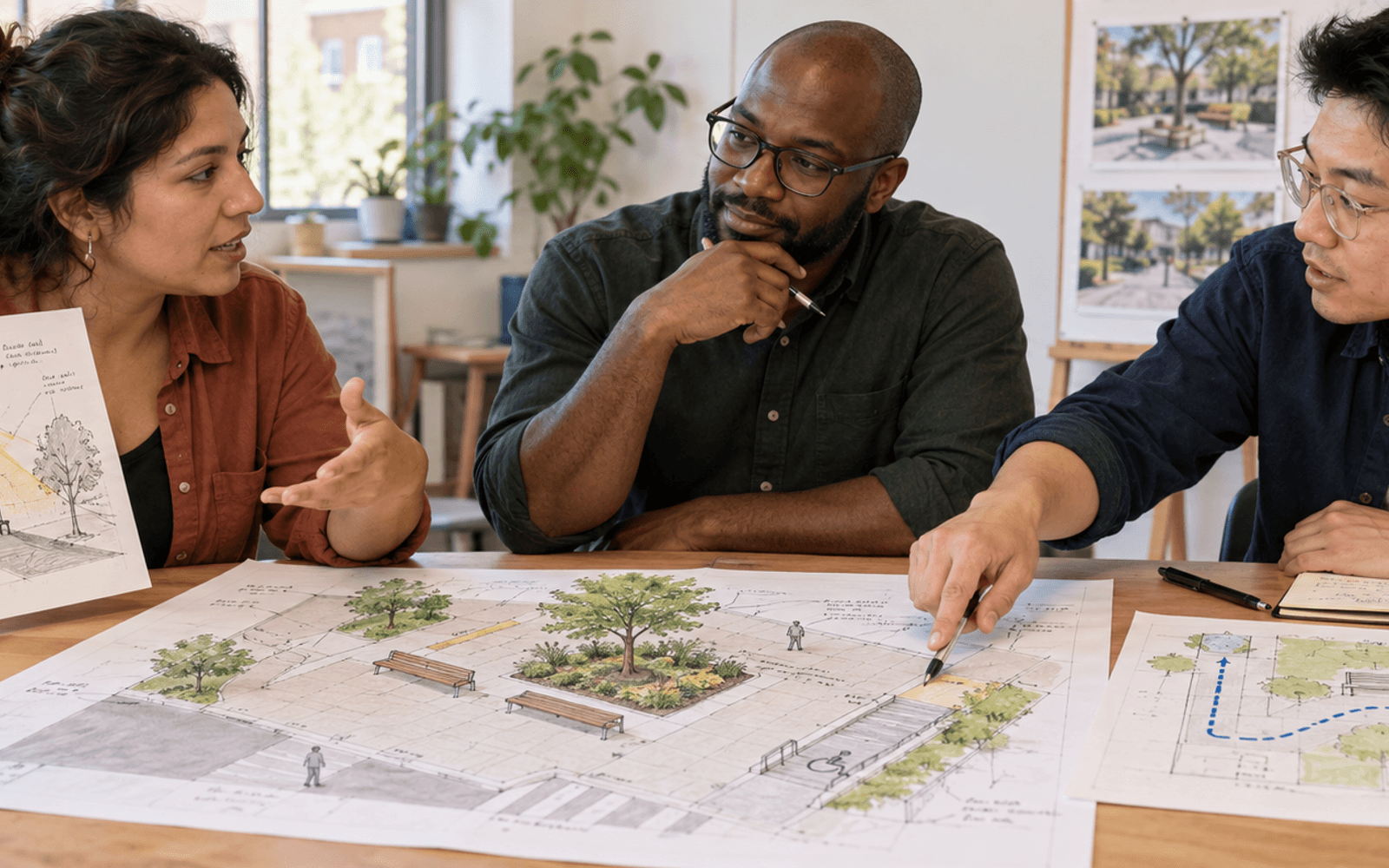
Consider a classroom simulation in which adult learners advise on converting an unused site into a public space. Teams examine a map, a limited budget, environmental information, and accounts from different community members. A choice that increases recreational space might reduce parking or affect drainage. Learners prepare a proposal and explain which evidence and values informed it. A mentor asks them to reconsider a recommendation when new information about accessibility becomes available.
The learning lies in the relationships among these moves. A student connects a technical measurement to a public concern, uses a professional criterion to compare alternatives, and revises a decision after critique. A decorative role title or a points system would not by itself create those connections. Designers need to identify the actual practice they want learners to engage in and build tasks that require its distinctive forms of judgment.
Scaffolding makes participation possible without pretending that novices are already professionals. Provide accessible data, worked examples of reasoning, bounded decisions, and opportunities to ask for advice. Keep the challenge intellectually meaningful while limiting irrelevant administrative complexity. A structured debrief can examine why certain evidence counted, whose needs were considered, and how a different situation might alter the decision. Transfer beyond the simulation should be investigated rather than presumed.
Assessment can examine proposals, explanations, revisions, and dialogue for evidence of increasingly connected reasoning. Epistemic network analysis is one research approach used to study connections among coded elements in discourse. Its output depends on the coding, units and analytic choices, so a network diagram is not direct proof that professional expertise has developed. Independent performance and explanation remain important when making claims about learning.
Epistemic games also carry choices about whose professional practices and values are represented. A simulation can omit contested histories, simplify power relations, or make one stakeholder's priorities seem inevitable. Teachers should invite critique of the modeled practice as well as competent participation within it. The approach is most useful when learners can experience a coherent form of professional reasoning, discuss its assumptions, and recognize both what the simulation teaches and what real-world participation would still require.