← Zurück zu Forschungsnachrichten

#AI scaffolding

AI scaffolding

3 Beiträge

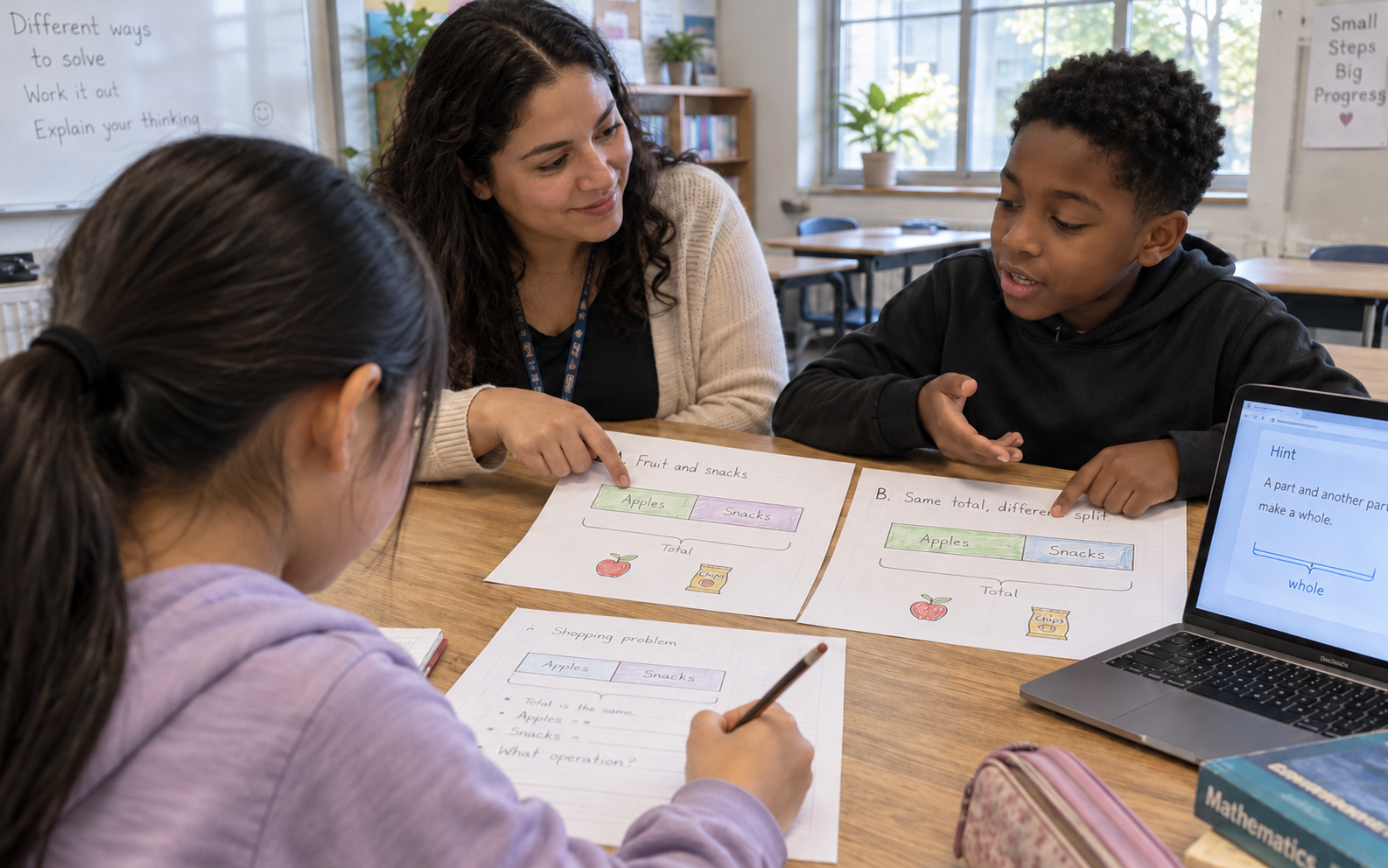
A teacher and two pupils discuss part-whole bar models for a shopping word problem while one pupil records the reasoning.
Zeitschriftenartikel2025
Zeitschriftenartikel 180

A primary mathematics AI pilot reported before-and-after gains, with comparative effectiveness still unclear

Jingxi Liu, Daner Sun, Jin Sun, Jingyun Wang, Philip Leung Ho Yu

Computers and Education: Artificial Intelligence

A ChatGPT-supported word-problem system was studied in two fifth-grade classes totaling 104 pupils. The detailed performance analysis reported gains among 49 AI-group pupils after three post-task outliers were removed. Although the abstract describes a comparative advantage, the main results present a within-group paired analysis rather than a clear between-group effect. The paper offers a learning-system design and preliminary task evidence, while leaving stronger claims about comparative and lasting effectiveness unresolved.

primary mathematicsword problemsAI scaffolding
500-Wörter-Zusammenfassung lesen →


Two university students and a teacher compare an annotated article with three question cards during a reading seminar.
Zeitschriftenartikel2026
Zeitschriftenartikel 178

Guided AI dialogue was followed by more developed reading questions, with task order limiting causal interpretation

Xiaoyu Zhao, Guili Kong, Hui Zhou, Liting Liao, Xiuhan Li

Smart Learning Environments

A within-student study of 112 undergraduates compared questions written after ordinary digital reading with questions written after a second reading supported by ERNIE Bot dialogue. The AI-supported phase produced more questions and higher rated question quality. Dialogue patterns also differed by performance. Because all students encountered the ordinary reading first and a different AI-supported text second, the evidence cannot separate assistance from order, practice and text effects or establish independent transfer.

digital readingquestion generationdialogue learning
500-Wörter-Zusammenfassung lesen →
A teacher prompts a diverse group of secondary students to reason with question cards while an unused answer-generating tablet rests at the edge of the table
Konferenzbeitrag2026
Konferenzbeitrag 104

Students' essays supported a scaffold-don't-substitute principle, but not a causal harm estimate

Lucile Favero, Juan Antonio Pérez-Ortiz, Tanja Käser, Nuria Oliver

ACM AI Leadership Summit

Favero and colleagues organize educational AI risks across cognition, agency, emotional wellbeing, and ethics, then examine 49 International Baccalaureate essays. Eighty percent described reduced thinking through AI reliance, while students preferred tools that prompt recall and reflection rather than supply immediate solutions. The sample is exploratory and self-reported, so it motivates a design principle, not a prevalence or causal claim.

AI scaffoldingcognitive offloadinglearner agency
500-Wörter-Zusammenfassung lesen →