← Zurück zu Forschungsnachrichten

#AI literacy

AI literacy

22 Beiträge

Three teachers discuss annotated history lesson and question cards on a sunlit staff-room pinboard, with a course outline on a tablet
Politik / Ethik15. Okt. 2026
Politik / Ethik 217

Product news: OpenAI adds Brazilian Portuguese to its educator course, keeping teacher judgment at the centre

OpenAI

AI Product and Learning Report

OpenAI announced a Brazilian Portuguese version of AI for Educators on October 15. The course offers a new language route into professional learning about classroom AI use. This report considers how a teaching team might turn that opportunity into a concrete lesson-design exercise: examine a generated question, explain the instructional choice, and test the activity against students' needs. Course availability is a product announcement, while changes in teaching quality and student learning remain outcomes to investigate.

product newsteacher professional developmentBrazilian Portuguese
500-Wörter-Zusammenfassung lesen →
A lecturer and two students compare initial and clarified task briefs while updating a decision record beside a simple data table.
Politik / Ethik2. Okt. 2026
Politik / Ethik 191

Product news: OpenAI's GPT-6 guide treats clear assignments and steering as part of working with agents

OpenAI

AI Product and Learning Report

OpenAI published a practical GPT-6 guide on October 2 covering assignments, model choice, longer tasks, and review. This is guidance for using an existing model family, not another model launch. Anthropic's recent Sonnet release and Gemini's learning tools provide useful context. For educators, the guide offers a way to discuss how a person defines success, updates a task when circumstances change, and checks what the assistant actually completed.

product newsGPT-6 guideAI delegation
500-Wörter-Zusammenfassung lesen →
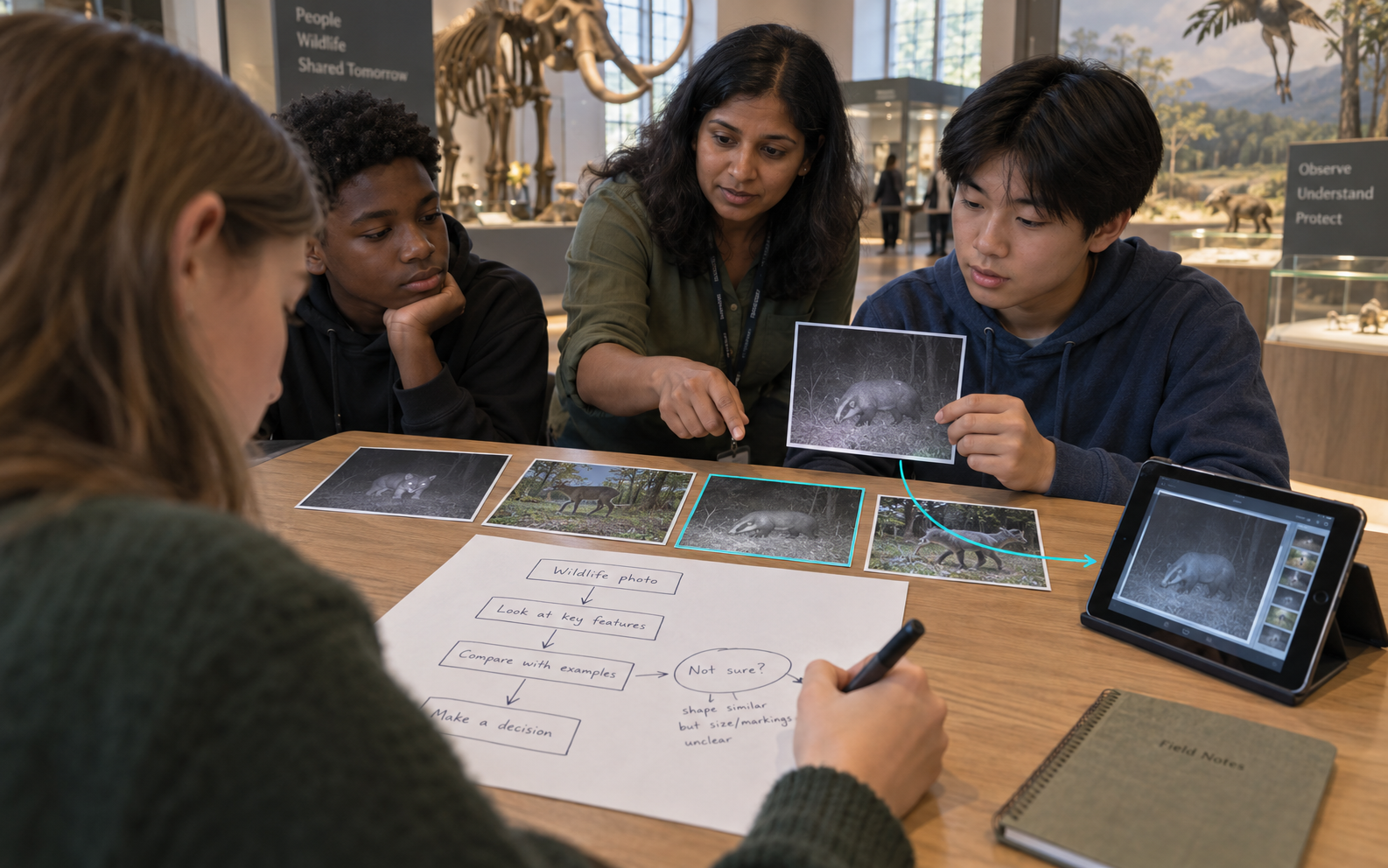
Teenagers and a science educator compare wildlife camera photographs and record uncertainty on a simple classification flowchart in a museum learning studio.
Zeitschriftenartikel2025
Zeitschriftenartikel 168

A museum science program improved measured machine-learning knowledge, while some concepts and access gaps remained unresolved

Gabrielle Rabinowitz, Katherine S. Moore, Safinah Ali, Mark Weckel, Irene Lee, Preeti Gupta, Rachel Chaffee

International Journal of STEM Education

A four-week museum program introduced 42 high-school learners to machine learning through scientific questions, datasets and hands-on activities. Knowledge-inventory scores and self-efficacy improved, while measures of bias understanding and applying ML in science showed a less consistent pattern. Exit tickets and interviews added evidence that tests alone missed. The uncontrolled evaluation informs curriculum design but does not establish comparative effectiveness, durable learning or the elimination of participation gaps.

AI literacyinformal science learningmachine learning
500-Wörter-Zusammenfassung lesen →
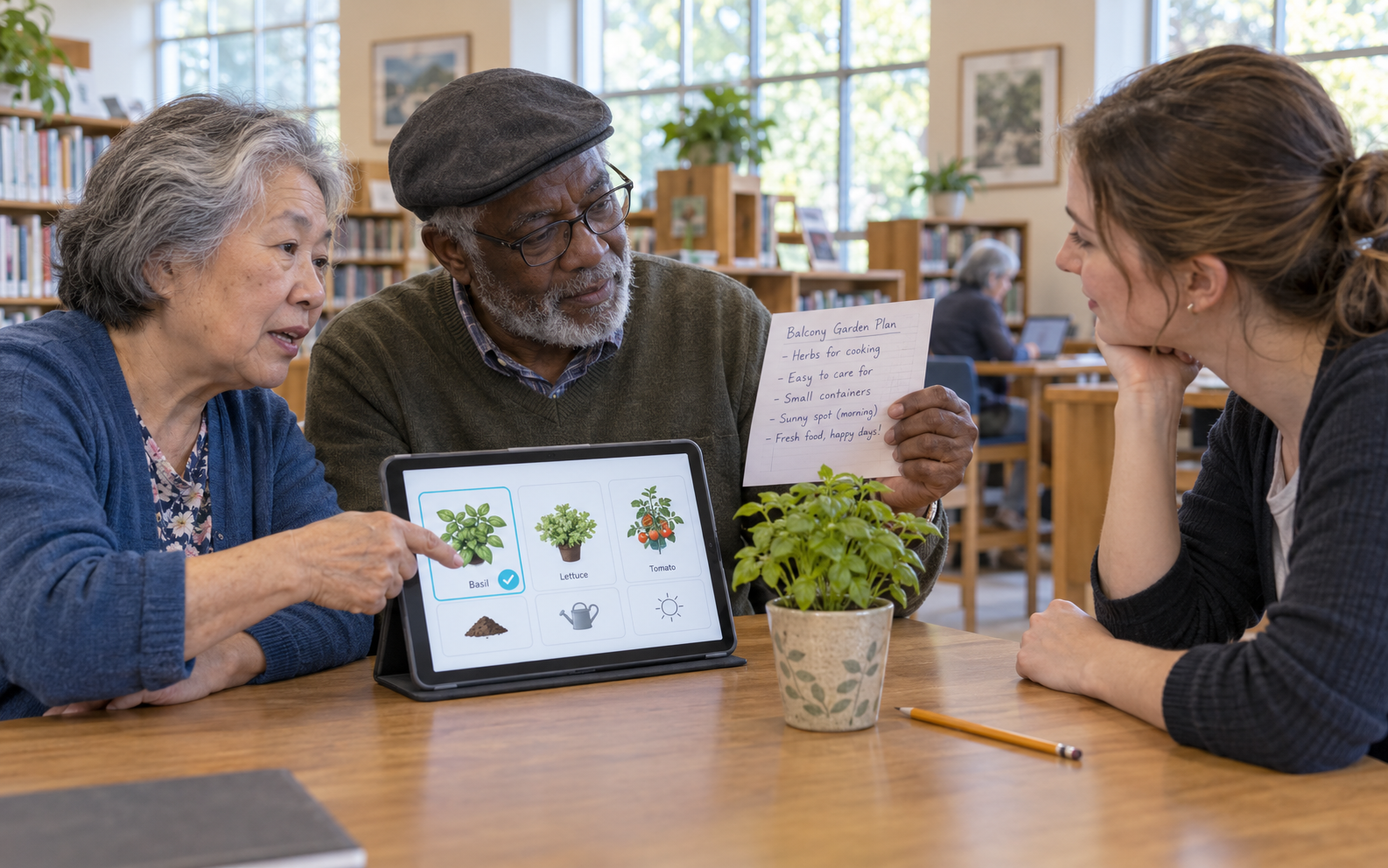
Two older learners explain a balcony-gardening plan and tablet choices to a facilitator during a community-library learning session.
Politik / Ethik20. Sept. 2026
Politik / Ethik 167

Industry news: OpenAI and OATS bring hands-on AI learning to older adults through community partners

OpenAI

AI Product and Learning Report

OpenAI's September 16 announcement describes free, in-person AI workshops with OATS from AARP across ten U.S. communities. This September 20 report examines the lifelong-learning design, rather than claiming completed outcomes. Anthropic's practical AI-learning guidance and Gemini's educator resources offer comparisons. Effective support should begin with a participant's own task, allow different paces and preferences, and help people decide when to question an answer or seek human assistance.

product newslifelong learningolder adults
500-Wörter-Zusammenfassung lesen →

An instructor and two adult learners compare a fictional catering inquiry, proposed menu workflow and weekly plan in a cafe-style training classroom.
Politik / Ethik19. Sept. 2026
Politik / Ethik 165

Product news: Claude's small-business expansion connects reusable workflows with entrepreneurship training

Anthropic

AI Product and Learning Report

Anthropic's September 15 update expands Claude for Small Business with workflows, integrations, and training activity. Reported here on September 19, it offers entrepreneurship educators a concrete set of tasks to examine, from proposals to recurring reports. OpenAI's agent tools and Gemini's educational training provide comparisons. The learning opportunity lies in defining a useful workflow, checking its inputs, and retaining the business decisions that a person must understand and own.

product newsClaude for Small Businessentrepreneurship education
500-Wörter-Zusammenfassung lesen →
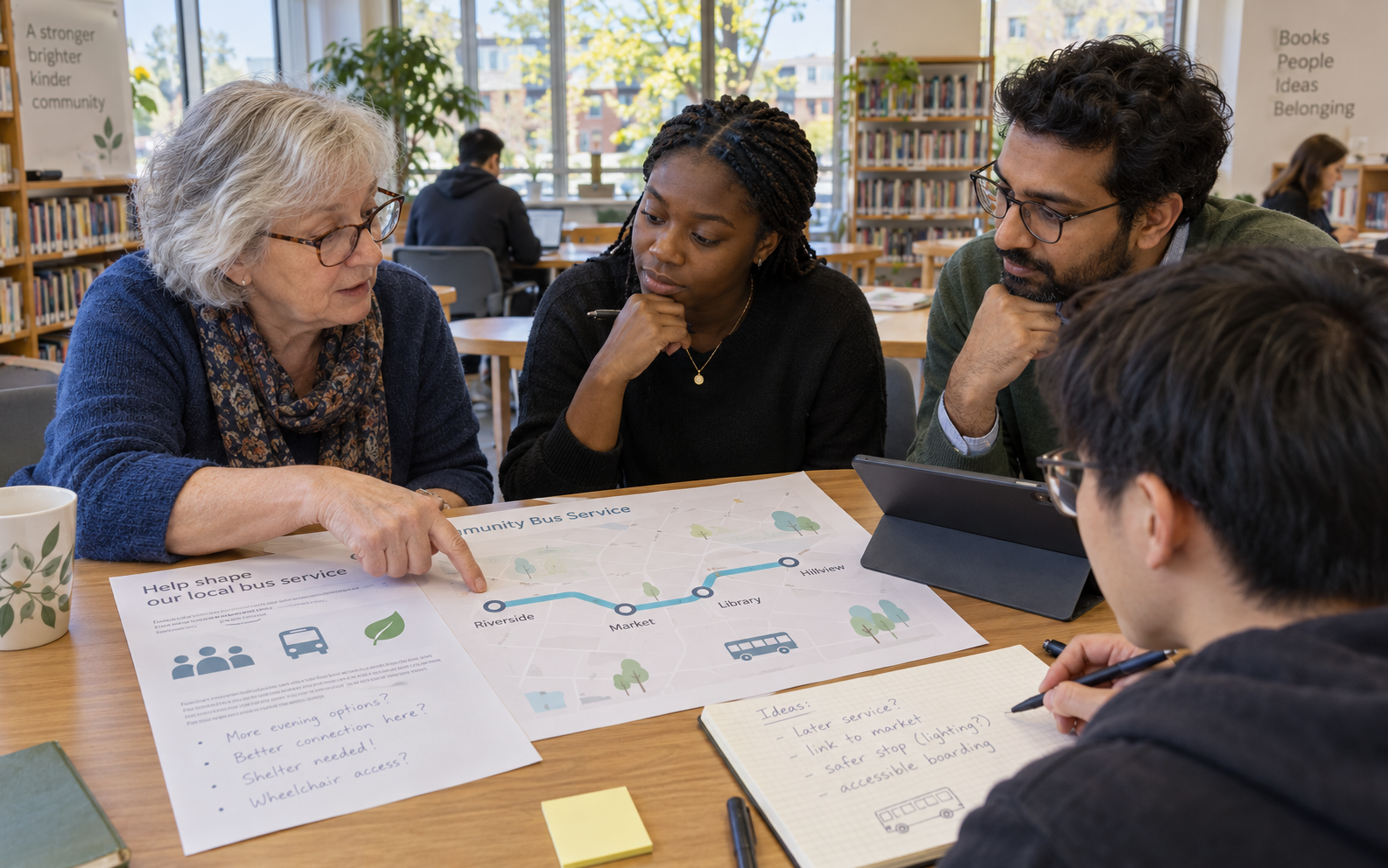
An older resident, students and a lecturer discuss a fictional community bus route while a student records suggestions about service and accessibility.
Politik / Ethik15. Sept. 2026
Politik / Ethik 157

Industry news: Google.org selects public-service AI projects, offering cases for responsible project-based learning

Google.org

AI Product and Learning Report

Google.org announced 15 recipients of its AI for Government Innovation challenge on September 15, combining funding with expert support for public-service projects. The selection is a starting point, not proof that the proposed systems have delivered their intended benefits. OpenAI's agent infrastructure, Anthropic's delegation guidance, and Gemini's inquiry training give educators practical comparison points for teaching how to define a public problem, involve users, and evaluate a proposed solution.

product newspublic-service AIproject-based learning
500-Wörter-Zusammenfassung lesen →

Teacher trainees and a facilitator review an annotated English dialogue activity, source checks, lesson-sequence notes and a laptop comparison.
Zeitschriftenartikel2025
Zeitschriftenartikel 144

A twelve-week teacher-education course raised self-reported GenAI literacy across five dimensions

Ting Huang, Chenze Wu, Meixin Wu

Discover Artificial Intelligence

A twelve-week English teacher-education intervention compared four existing university classes, with 45 analyzed participants in each condition. Students receiving explicit GenAI instruction reported higher post-course literacy across technical, critical, communication, creative and ethical dimensions. The course combined practice with reflection and disclosure of AI use. Because the main outcomes came from self-report and classes were not individually randomized, the findings do not demonstrate independent teaching competence or lasting classroom impact.

teacher educationAI literacylanguage education
500-Wörter-Zusammenfassung lesen →

An adult learner discusses an inventory spreadsheet with an instructor and volunteer, beside a diagram linking study, practice, project work and workplace application.
Politik / Ethik8. Sept. 2026
Politik / Ethik 143

Industry news: Missouri and Google connect classroom AI access with workforce training

Google

AI Product and Learning Report

Google's September 8 Missouri partnership links education tools, teacher training, and career credentials across schools, higher education, and community job centres. The announced reach is an intended provision, not a count of completed learning. OpenAI's district partnerships and Anthropic's school-managed teacher offering provide comparisons. For education leaders, the useful questions concern who participates, which support makes access usable, and whether participants can apply their learning beyond a credential.

product newsGemini for EducationMissouri
500-Wörter-Zusammenfassung lesen →
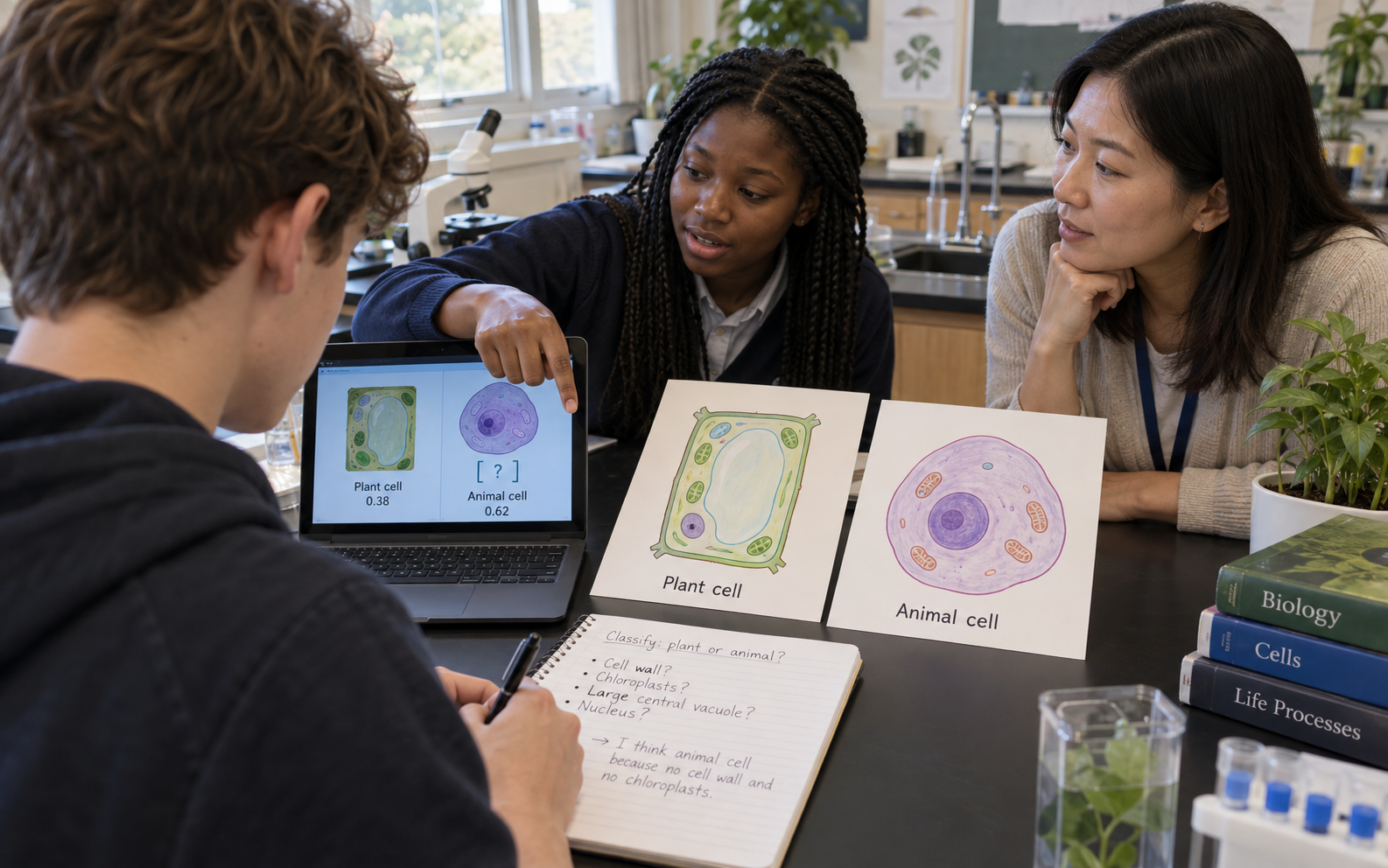
A teacher and two students compare plant and animal cell diagrams with a laptop classification display while one student records reasons in a notebook.
Zeitschriftenartikel2025
Zeitschriftenartikel 140

Biology lessons provided a concrete route into AI concepts, but gains did not extend clearly to biology knowledge

Shenghua Zha, Marcy Maulucci Bragdon, Na Gong, Jinhui Wang, Silas Leavesley, Rachel Eaton, Erin Bosarge

International Journal of Artificial Intelligence in Education

Researchers integrated four AI lessons into an honors biology course attended by 37 secondary students. Activities linked cell classification, neural networks and biological applications with familiar science content. Among students with paired assessments, AI knowledge improved significantly while biology knowledge did not. Worksheet explanations revealed both useful cross-disciplinary connections and persistent misconceptions. This classroom case supports further curriculum development, but its small sample and lack of a control group preclude a causal effectiveness claim.

AI literacybiology educationsecondary education
500-Wörter-Zusammenfassung lesen →
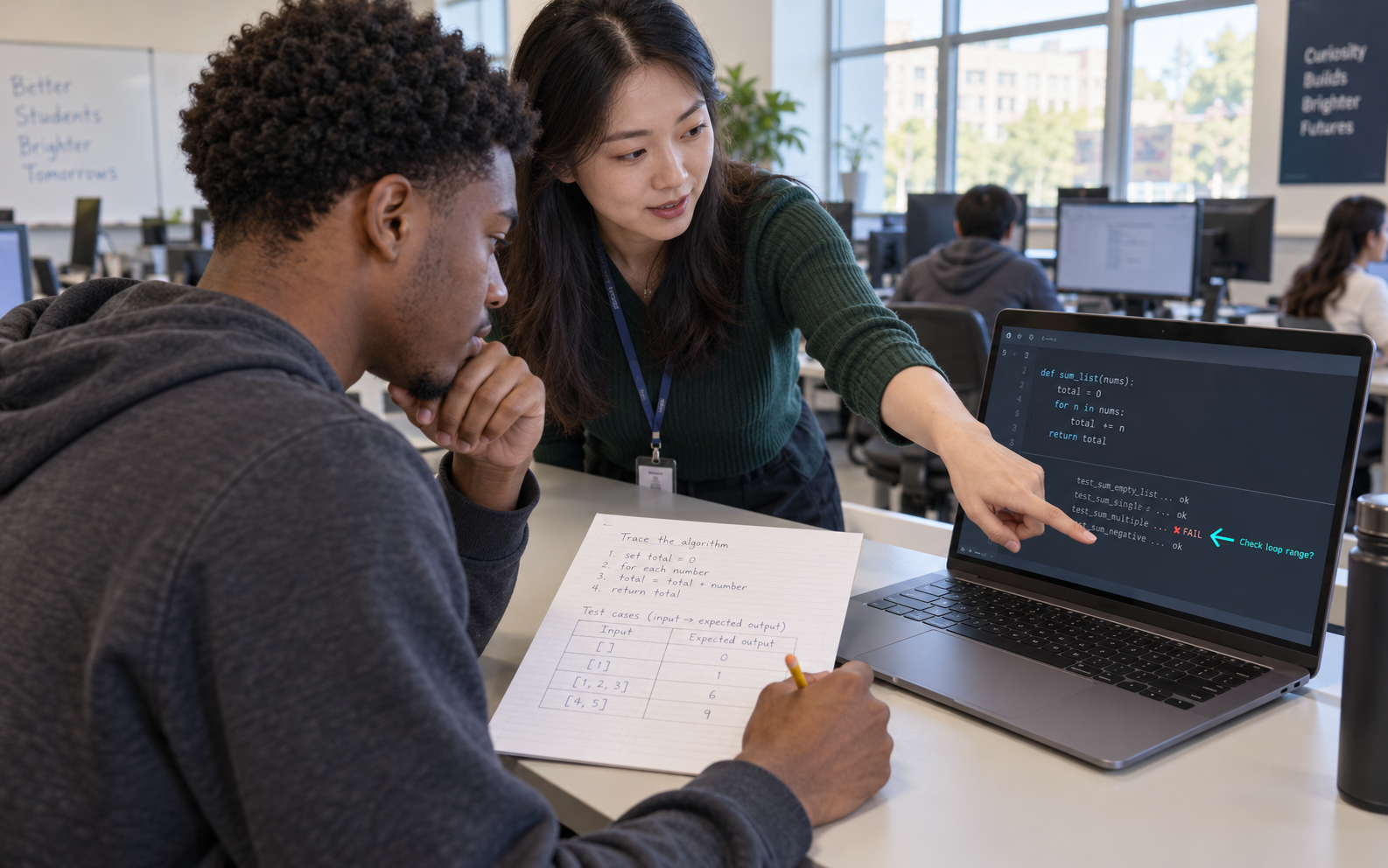
A programming student traces an algorithm and test cases on paper while a tutor points to a test report beside code on a laptop.
Zeitschriftenartikel2025
Zeitschriftenartikel 134

Students valued AI coding help while exam evidence exposed difficulties in correcting generated code

Dan Kohen-Vacs, Maya Usher, Marc Jansen

International Journal of Artificial Intelligence in Education

Two studies examined student attitudes to generative AI and performance on code-correction tasks. A survey found favorable perceptions, while exam analyses found lower performance on AI-generated debugging tasks in several cohorts. The studies involved different students and compared debugging with code construction, so they do not establish that positive attitudes caused weak verification or that AI origin alone made the tasks harder. They identify a specific skill worth teaching and assessing.

programming educationdebuggingassessment
500-Wörter-Zusammenfassung lesen →

Two graduate learners discuss a marked-up paragraph beside a desktop writing editor and a notebook containing planning and claim-evidence notes.
Zeitschriftenartikel2025
Zeitschriftenartikel 124

Higher self-reported AI literacy accompanied stronger assisted essays and different interaction patterns

Jinhee Kim, Sang-Soog Lee, Rita Detrick, Jialin Wang, Na Li

Journal of Computing in Higher Education

Researchers observed 36 graduate students writing with a GPT-4 system, combining think-aloud recordings, interaction traces, expert essay ratings, and epistemic network analysis. Students with higher self-reported AI literacy produced stronger assisted essays and showed different patterns of collaboration with the system. The association does not demonstrate that AI literacy training caused better writing, because underlying academic skills and other learner differences were not experimentally separated.

academic writingAI literacyepistemic network analysis
500-Wörter-Zusammenfassung lesen →

A teenage learner writes algebra in a notebook oriented toward her, while an adult and a librarian review a worked example on a tablet.
Politik / Ethik26. Aug. 2026
Politik / Ethik 119

Product news: OpenAI's learning report shows demand for help beyond the classroom, while outcomes remain an open question

OpenAI

AI Product and Learning Report

OpenAI's August 26 education report describes substantial use of ChatGPT for homework, practice, and checks of understanding outside classroom hours. Its figures concern activity on the platform, not measured learning gains. Read alongside Anthropic's approach to AI education and Gemini's learning tools, the report gives educators a concrete reason to discuss how students ask for help, verify explanations, and return to independent practice.

product newsChatGPTeducation usage
500-Wörter-Zusammenfassung lesen →
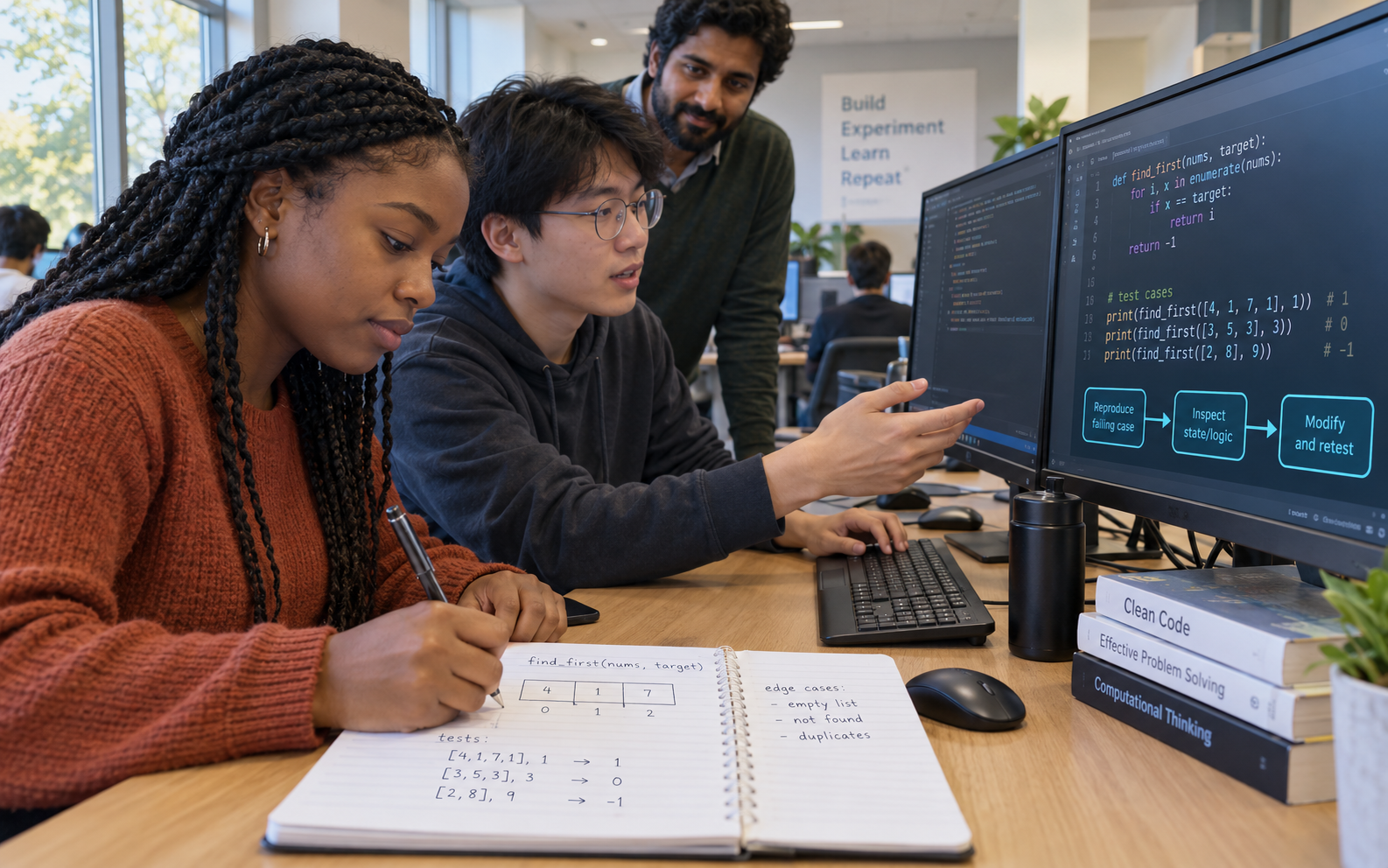
Two programming students trace and test their own code with an instructor in a university computer lab
Zeitschriftenartikel2025
Zeitschriftenartikel 114

Programming students shifted their AI habits with guidance, but better interaction was not a randomized learning effect

Hacer Güner, Erkan Er

Education and Information Technologies

A classroom study followed programming students through unguided ChatGPT use, a prompting demonstration, and embedded example prompts. Their interaction profiles changed substantially, while students who refined their own code often achieved stronger unaided quiz scores than students who requested complete solutions. The study offers practical evidence about classroom guidance, but its sequential tasks and existing knowledge differences do not establish that a particular prompting intervention caused better learning.

programming educationAI literacylearner agency
500-Wörter-Zusammenfassung lesen →

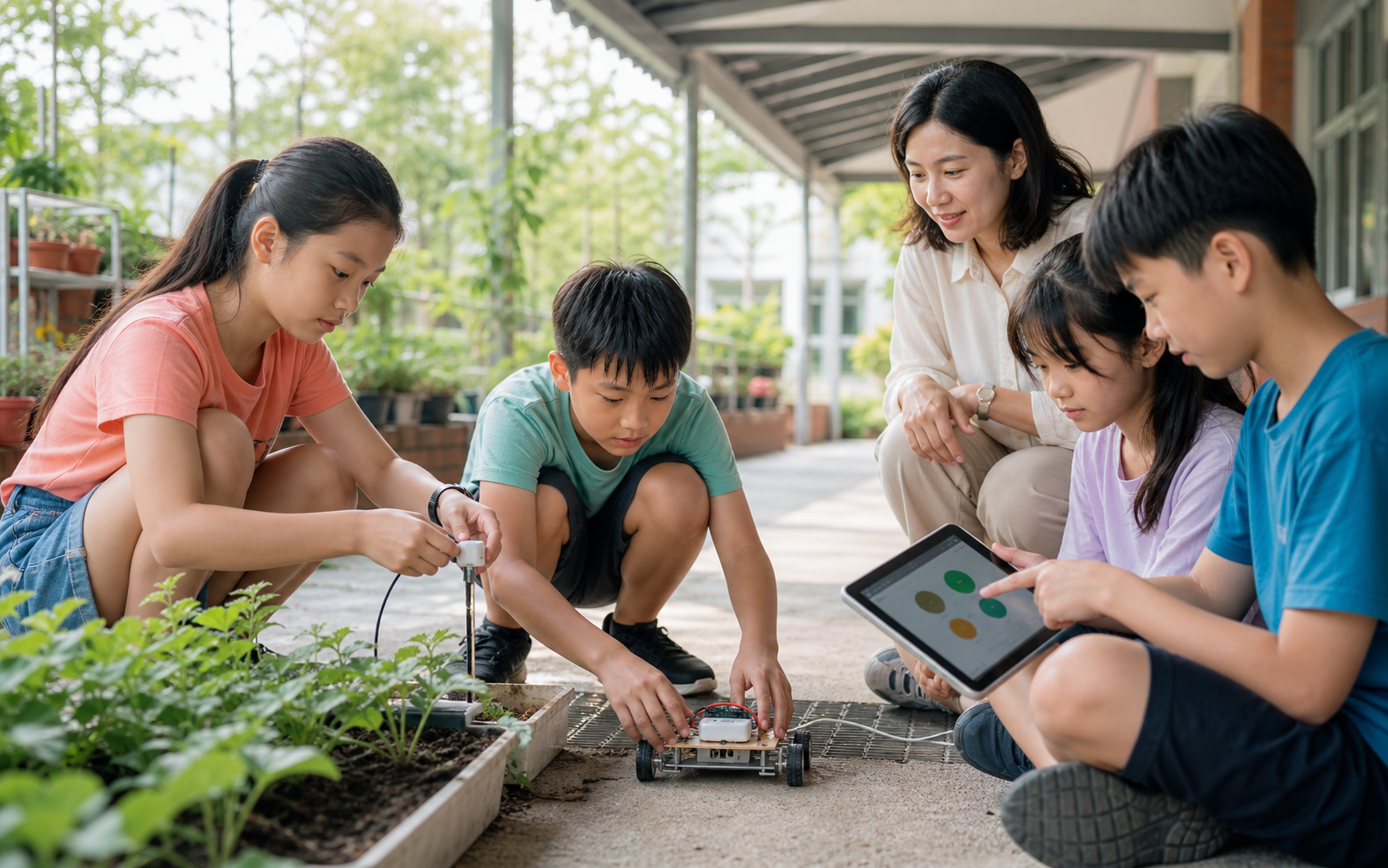
A gender-balanced group of Taiwanese fifth-grade learners builds and discusses a simple community-focused AIoT project with their teacher
Zeitschriftenartikel2025
Zeitschriftenartikel 62

A STEAM-PBL-AIoT course was associated with broader elementary AI-literacy gains and narrower measured gender gaps

Chih-Chan Cheng, Jeen-Shing Wang, Xiaoming Zhai, Ya-Ting Carolyn Yang

International Journal of STEM Education

A two-part study validated a fifth-grade AI-literacy questionnaire with 504 learners and compared a 19-week STEAM-PBL-AIoT course with an AIoT course in 109 students. The integrated course showed larger self-reported gains in several dimensions, while the ethics advantage was not significant.

AI literacyelementary educationgender equity
500-Wörter-Zusammenfassung lesen →
Korean and international educators complete an AI-literacy learning pathway and compare credential evidence in a professional development centre
Politik / Ethik31. Juli 2026
Politik / Ethik 57

Product news: Microsoft Elevate reaches its Educator Expert deadline with free AI-literacy credential pathways

Microsoft

AI Product and Learning Report

Product news: July 31 was the application deadline for Microsoft Elevate for Educators' 2026–27 Expert Track. The programme connects Explorer, Expert and school-recognition routes with free Microsoft–ISTE+ASCD credential learning pathways, while regional eligibility and the value of recognition still require careful review.

product newsMicrosoft Elevateteacher credentials
500-Wörter-Zusammenfassung lesen →

A Black teacher and East Asian and White secondary students compare image and video frames across a monitor and tablet with restrained cyan provenance markers
Politik / Ethik28. Juli 2026
Politik / Ethik 45

Gemini product news: SynthID verification gives schools a media-provenance check, not a truth detector

Google for Education, Google DeepMind

AI Product and Learning Report

Product news: Google Workspace for Education directs learners and educators to upload media to Gemini and ask whether SynthID identifies Google AI generation or editing; the signal can support provenance lessons but cannot establish accuracy, intent or human authorship when absent.

product newsGemini media verificationAI literacy
500-Wörter-Zusammenfassung lesen →

University students discuss transparent and responsible generative-AI use during a collaborative assignment while a teacher facilitates peer reflection
Zeitschriftenartikel2026
Zeitschriftenartikel 84

Perceived classmate GenAI use was associated with lower trust, while perceived AI literacy attenuated the direct link

Zhen Zhang, Jiaying Geng, Chunhui Qi

Behavioral Sciences

A cross-sectional survey of 406 students at two institutions found that perceiving a classmate as using more GenAI was associated with lower perceived warmth, competence and interpersonal trust. Perceived target AI literacy weakened only the direct association, while the design cannot establish that AI use caused distrust.

generative AIinterpersonal trustAI literacy
500-Wörter-Zusammenfassung lesen →

Diverse university students plan an AI-assisted assignment while a lecturer helps them compare self-reported AI literacy, self-efficacy and independent study strategies
Zeitschriftenartikel2026
Zeitschriftenartikel 80

Self-reported AI literacy and self-efficacy showed different relationships with student dependency in a 478-person survey

Hilit Maizel, Maya Kalman Halevi, Miri Sarid, Rony Tutian

Education Sciences

A survey of 478 Israeli higher-education students found that technical dimensions of AI literacy were positively associated with self-reported AI dependency, while AI self-efficacy, academic self-efficacy and effort regulation were associated with less dependency. Its cross-sectional design identifies relationships, not causal effects.

AI dependencyAI literacyacademic self-efficacy
500-Wörter-Zusammenfassung lesen →

A racially diverse university language class evaluates AI-supported writing, speaking, translation and feedback activities with an instructor
Review2026
Review 78

A review of 101 higher-education English-language studies maps five roles for AI and recurring evidence gaps

Yanping Wang, Zuwati Hasim, Ling Wu, Yujia Fang

Cogent Education

A systematic review retained 101 empirical studies of AI in higher-education ESL and EFL from 1,536 records. It identified five broad roles for AI and generally positive reports, while finding regional and skill imbalances, uneven methods, overreliance risks and limited evidence about culture, equity and durable outcomes.

AI in educationEnglish language teachingsystematic review
500-Wörter-Zusammenfassung lesen →

Editorial cover for ChatGPT-supported EFL writing and AI literacy
Zeitschriftenartikel2026
Zeitschriftenartikel 15

AI literacy and mediated learner autonomy in ChatGPT-supported EFL writing: a qualitative study at a Palestinian university

Bilal Hamamra, Asma Abdullah, Sanadil Alawi

International Journal of Educational Technology in Higher Education

A 2026 qualitative study follows Palestinian undergraduates using ChatGPT in EFL writing, showing how AI literacy, teacher mediation, and learner autonomy develop together.

AI literacyChatGPTEFL writing
500-Wörter-Zusammenfassung lesen →