Product news: Gemini 3.8 Flash puts richer educational prototypes within reach, with review work still essential
Google DeepMind
AI Product and Learning Report
500-Wörter-Zusammenfassung

Google introduced Gemini 3.8 Flash and Gemini 3.8 Flash Cyber on September 2, 2026. This September 4 report focuses on the general Flash model, which Google positions for stronger reasoning, coding, and agent workflows. Flash Cyber is a separate restricted offering for trusted defenders, not a general classroom tool. The announcement's benchmarks and demonstrations are evidence of what Google tested and showcased, rather than evidence that a generated resource will teach a topic well.
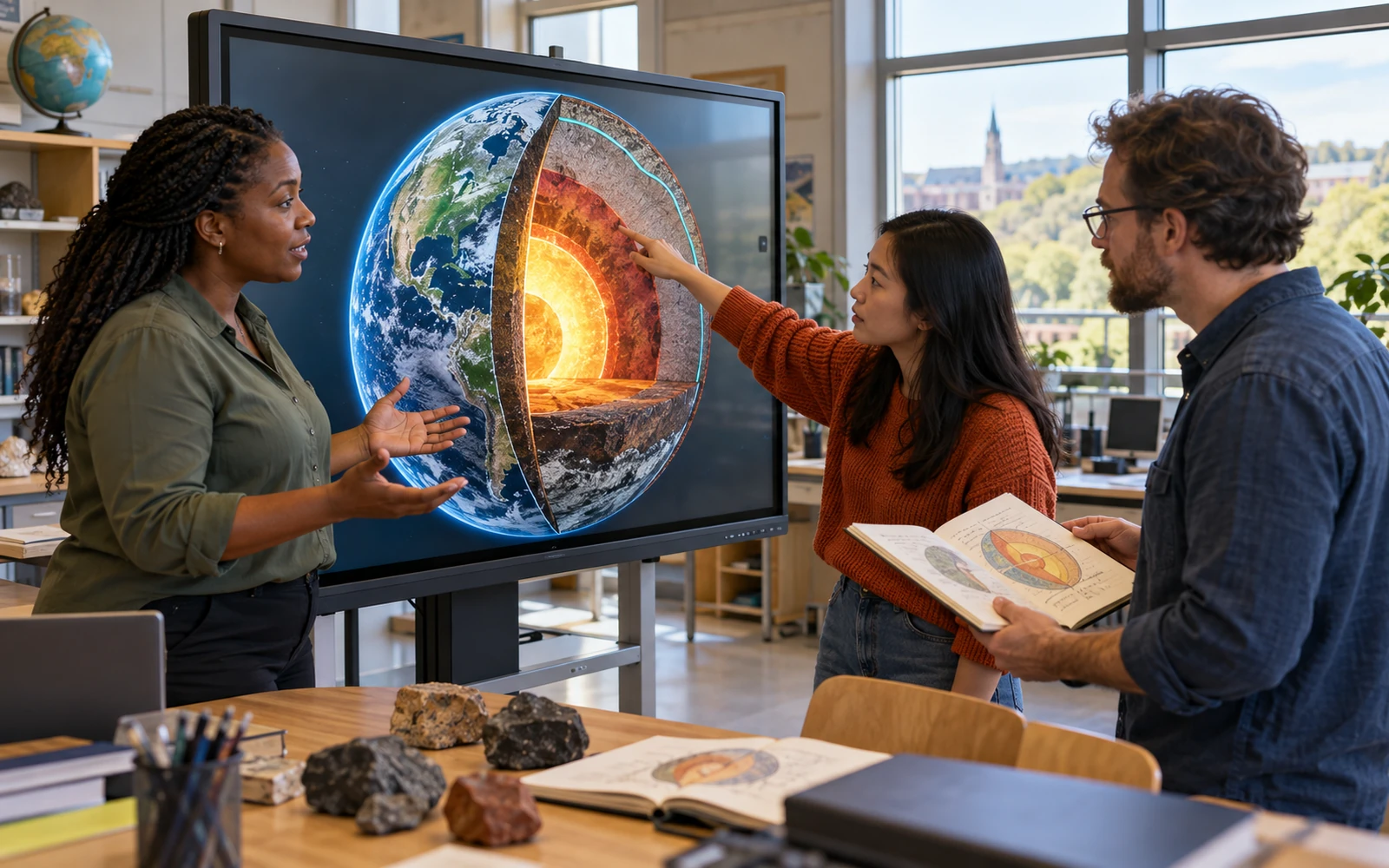
One demonstration uses geographical data to create an interactive topographic map with cross-sections and explanations. That is a useful starting point for educational design because it connects code generation with a visible scientific representation. A teacher considering such a prototype should ask which relationship students are meant to understand. Rotating a colourful landscape may be engaging, but an activity becomes clearer when learners must predict a cross-section or explain how elevation changes along a route.
The underlying data and transformations deserve attention before the interface is used. A map may mix units, exaggerate vertical scale, or interpolate between observations in a way students cannot see. A correct-looking display can therefore support an incorrect inference. Reviewers should compare selected points with the source data, inspect how the representation is calculated, and make any deliberate simplification explicit in the teaching materials.
A proposed geography exercise could begin with a printed contour map. Students sketch the expected profile along a marked line, then use the interactive prototype to test their prediction. They explain disagreements and try another route. The assistant may help build or revise the tool, but the learning activity should require the student to connect two representations. That task remains worthwhile even if the class uses a simpler, manually prepared visualization.
OpenAI's August 24 Kiro integration similarly connects model assistance with software requirements and tests. Anthropic's Claude Academy guidance asks learners to make intentional choices about delegation. These contemporary developments support a useful comparison with Gemini: which parts of creating a teaching tool should be automated, and which decisions should the educator retain? Model choice can follow that answer rather than precede it.
Evaluation should include the ordinary ways a classroom resource can fail. Labels may be too small, controls may be inaccessible from a keyboard, or the activity may depend on a connection that is unreliable in the teaching room. Students may also discover inputs the developer did not anticipate. A bounded pilot with colleagues can reveal these issues before a whole class relies on the resource. A successful model demonstration does not remove that work.
Cost should be considered at the level of the finished activity, including generation, revision, checking, and maintenance. Google notes that the newer model may use more tokens on demanding tasks, so stronger benchmark performance does not guarantee a cheaper project. For educators, the practical promise is greater freedom to prototype a specific learning idea. The useful outcome is a resource whose scientific meaning, interaction, and teaching purpose remain understandable after the impressive first demonstration.